Pixel Scroll 11/22/26 How To Succeed In Pixels Without Even Filing

(1) SEE ME. FEEL ME. Joel Miller’s author profile includes the argument that “Bob Shaw’s Best Sci-Fi Book Isn’t the One He’s Famous For” at Transmissions from Tomorrow.

When science fiction writer Bob Shaw was a child, his ten-year-old friend fell onto a protruding steel rebar. What horrified Shaw the most was that the boy had brought the eye home to his mother in the frantic hope someone could fix it. A few decades later, Shaw would work that horror into his novel Ground Zero Man.

But Shaw had his own trauma when it came to eyes. In the same 1976 interview where he shared that story with David Langford, he told another:

“I had quite a serious eye disease which once threatened my sight, and since then I can’t bear to sleep in a totally dark room. When I waken up I have to see immediately. I open my eyes.”

Even his glasses had to be rimless, unable to stand when the frames blocked any part of his vision.

Sight and the properties of light are major recurring themes in Bob Shaw’s work. In fact, once you start looking for it, it’s hard to miss. His first novel, Night Walk, follows a blinded man who escapes a prison with the help of a device that lets him see through the eyes of others. Perhaps his most famous concept, “slow glass”, first appeared in the short story “Light of Other Days”, then was further developed in the novel Other Days, Other Eyes. In it, light takes years to pass through the material, turning an ordinary window into a vision of the past. And even A Wreath of Stars has glasses that reveal an otherwise invisible world….

(2) PROJECT GUTENBERG UPDATE. The gutenberg.org website is undergoing a deep rebuilding due to vandalism. For the past week, they have been periodically adding status information to this r/projectgutenberg Reddit post. Here is today’s update:

Sunday 11am PT: Still working on the back-end tooling. Our book collection is complete and safe and we have over 80,000 books coming back online as soon as the website is back up. No exact time/day for us to come back online yet, but great progress is being made.

(3) LICENSE TO CHILL*. Neither shaken nor stirred:“UK operation wards off risk of cyber-attack on supermarket fridges and freezers” reports the Guardian.

A secret government cybersecurity operation recently warded off the risk of a cyber-attack on fridges and freezers in UK supermarkets, warehouses, restaurants, petrol stations and stadiums, it has emerged.

An attack would have been similar to those that have caused many millions of euros of damage in continental Europe in recent months. But, while many retailers have now been protected, researchers warned that many more could still be vulnerable.

News of the operation led by Whitehall and the National Cyber Security Centre, first reported by the BBC, follows a cyberattack this month of supermarket chains in at least seven European countries.

Another wave of attacks also affected hundreds of retailers across France in October in an act of “unprecedented scale and unprecedented aggression” for which Paris has publicly blamed Iran. The Pentagon is also investigating a suspected hack after a series of fridge malfunctions hit at least six US military bases in August….

(4) TEN TBR. Collider’s Jeremy Urquhart says these are “10 Classic Books You Must Read Before You Die”. Four of them are sff.

…They’re good bucket list selections, though. Most are famous, and then there are a couple of slightly less well-known ones, so you could always be on your way toward getting through the lot of them (if so, congrats). Also, some of these books are long, and perhaps a bit intimidating to start, but some of the best books of all time go on for many pages and prove especially rewarding, so finding the time to chip away at these ones is very much worth it….

At number one is the sff work that’s less known than the other three —

1. ‘Different Seasons’ (1982)

There is quality throughout the entirety of Different Seasons, and that’s not something you can say about all the short story/novella collections of Stephen King’s. With Different Seasons, it’s all novellas, and this collection is being singled out here, rather than there being a mention of one of his bigger novels, mostly because this feels like one of the more approachable classic Stephen King books.

Like, a few people don’t like horror. And sure, you do get a bit of horror here, namely in “The Breathing Method,” but then “Apt Pupil” is more of a thriller, and “Rita Hayworth and Shawshank Redemption” and “The Body” are more dramas, not to mention tremendously moving ones at that (and they became the films The Shawshank Redemption and Stand by Me, respectively). Just really good writing here, and the stories are all easy to get through, immensely readable, and compelling in their own different/interesting ways.

(5) YOU TAKE THE HIGH ROAD. “Mothballed Scottish spaceport helps inspire new BBC sci-fi thriller”. (BBC subscription required by readers outside the UK.)

A project to establish a spaceport in the Scottish Highlands has played a part in inspiring a new BBC sci-fi thriller.

Plans to launch small satellites from a facility near Tongue, in Sutherland, were unveiled in 2018, but the site remains largely undeveloped after the operator Orbex put construction on hold before it later collapsed.

The new series, called Sutherland, stars Gugu Mbatha-Raw and Stuart Martin and is set in the near future in the area of the north Highlands it is named after – as well as deep space.

The BBC has released “first look” images of the show made by World Productions Scotland, which makes the BBC’s military conspiracies drama Vigil.

The series was written and created by James Smythe, whose previous work includes the mystery thriller miniseries All Her Fault.

Mbatha-Raw, who has played roles in US shows Loki and The Morning Show, is Mirren Wood, a flight director on the UK’s first crewed space mission.

The series involves the strange return of a missing biologist caught trying to break into a spaceport, and a “decades old mystery”.

(6) HIS DAY IN COURT.  Dogpatch Press reports, “Nazi-furry sex offender Jacob Kovar loses in court, but is still shielded by Colorado furry groups”.  

A meritless case to remove a felony conviction.

Youtube’s Law Talk With Mike has a lawyer who covers silly antics in court, often by self-represented (Pro Se) Sovereign Citizens who make fools of themselves.

In August 2026, the channel featured a furry named Jacob Kovar.

Kovar had a long record as a repeat felon who kept making furry news. He helped to run the Furry Raiders nazi-furry group while bouncing in and out of jail. In 2019, Dogpatch Press was credited in an arrest warrant for Kovar, for reporting him for witness intimidation that targeted Dogpatch Press as well.

The 2026 court date was right after Kovar finished jail time that Dogpatch Press helped him to get. Kovar was representing himself to get that crime taken off his record. Fresh out of jail, he was trying to deny responsibility and undo justice for the victims.

The two-hour video explains why he lost and how the law works. “Furry Pro Se – YouTube”.

Kovar’s chronic lying.

You have to know the agenda behind Kovar’s denial of responsibility. Predators and con artists love to manipulate and deny what they do.

When Kovar helped to run the Furry Raiders, he delighted in trolling with fake identities. In 2019, he supported gay fascist Milo Yiannopoulos in a scheme to get the Proud Boys to attack Midwest Furfest. These fascists had intentions for terrorist violence.

They crave power to manipulate without consequences….

(7) HUNGER FOR POPCORN, MAYBE? “’Hunger Games: Sunrise on the Reaping’ box office: Prequel opens to $120 million, the franchise’s biggest debut since 2014” – Yahoo! watched the money roll in.

“The Hunger Games: Sunrise on the Reaping” opened to an estimated $120 million in U.S. and Canadian theaters this weekend, according to studio estimates published Sunday by Box Office Mojo. That is the biggest debut for the franchise in 12 years.

The Lionsgate prequel, which follows a young Haymitch Abernathy, played in 4,018 theaters and averaged $29,865 per location. It took in $56 million on Friday, including $21 million from preview screenings, then $36.3 million on Saturday and a projected $27.7 million on Sunday, The Numbers reported.

Overseas, the movie added an estimated $105 million, for a worldwide opening of $225 million. Its reported production budget is $150 million, according to The Numbers.

How it ranks in the franchise

“Sunrise on the Reaping” had the fourth-biggest domestic opening of the six “Hunger Games” movies, according to Box Office Mojo data:

(8) MEMORY LANE.

[Written by Cat Eldridge.]

November 22, 1996 — Star Trek: First Contact

Thirty years ago on this date, Star Trek: First Contact premiered. It was the eighth film of the Trek films, and the second of the Next Gen films following Star Trek Generations. The story was written by Rick Berman, Brannon Braga and Ronald D. Moore.   It was directed by Jonathan Frakes from the screenplay by Brannon Braga and Ronald D. Moore. Not quite a film by committee, but damn close. 

It had the Next Generation cast plus Alfre Woodard, James Cromwell and Alice Krige, the latter as the Borg Queen. She reprised the role in Voyager and Picard, and recently voiced the role in Lower Decks. 

A lot of titles were tossed around — Star Trek: Borg, Star Trek: Destinies, Star Trek: Future Generations and Star Trek: Generations II were all considered before Star Trek: Resurrection was chosen and then abandoned when 20th Century Fox announced the title of the fourth Alien film as Alien Resurrection, so the film was finally Star Trek: First Contact.

It did very well at the box office making one hundred fifty million against a budget of fifty million. 

With very few exceptions, critics really loved it. Only The Voyage Home seems as to be highly regarded as this film by them. 

First Contact received generally positive reviews upon release. The Independent said “For the first time, a Star Trek movie actually looks like something more ambitious than an extended TV show.”  And the Los Angeles Times exclaimed, “First Contact does everything you’d want a Star Trek film to do, and it does it with cheerfulness and style.” 

Audience reviewers at Rotten Tomatoes currently give it a most excellent rating of eighty-nine percent. 

It was nominated for a Hugo at LoneStarCon 2, the year that Babylon 5’s “Severed Dreams” won. That was a scary episode, a very scary episode.

Do I like it? Very much so. Other than The Voyage Home, it’s my favorite of all the films. And yes, the Suck Fairy loves it too. For some reason, she finds the Borg Queen fascinating. Well, she finds the Borg in general fascinating. 

It is streaming on Paramount+ like almost everything Trek except inexplicably a certain animated series with Janeway. 

(9) COMICS SECTION.

Note: Gocomics.com links return error messages for some but not all browsers. This is a known but as yet unexplained problem.

(10) INSIDE SCIENCE THIS WEEK HAD A SUBSTANTIVE SECTION ON SCIENCE FICTION. [Item by SF Concatenation’s Jonathan Cowie.] Inside Science is BBC Radio 4’s weekly science programme and a large part of its latter half was on AI (artificial intelligence) and how SF is the only genre to ask questions about where we may be going with technology.  It also noted that Musk is naming some of his spacecraft after Iain Banks’ Culture ships.  In the process, Ken MacLeod was interviewed as a fellow author and friend of Iain’s.  Ken noted (I believe rightly) that Iain would not subscribe to Musk’s libertarian politics.

You can access it here but if outside Brit-Cit may need a subscription.

(11) THE NOSE KNOWS. [Item by Steven French.] Every once in a while, SF inspires something other than the ‘Torment Nexus’: “Inspired by ‘Flowers for Algernon,’ experimental nose drops improve memory in mice” – Medical Xpress has the story.

Researchers at the University of Sydney have developed experimental nose drops that enhance learning and memory in aged mice while also preventing memory loss in a mouse model of Alzheimer’s disease. The treatment uses mRNA technology similar to that developed for use in COVID-19 vaccines.

The research, from the laboratory of Professor Greg Neely at the Charles Perkins Center, will lead to a new way to treat diseases of the brain, allowing for the development of medicines that target major neurological diseases, including neurodegeneration, stroke, traumatic brain injury and rare genetic and developmental diseases.

“If we can proceed quickly to clinical trials in humans, this approach could represent a world-first noninvasive delivery system to treat Alzheimer’s that bypasses the blood-brain barrier,” Neely said.

The study was inspired by the science fiction short story “Flowers for Algernon” written by Daniel Keyes, where scientists increase intelligence in lab mice and humans to better understand the limitations of human intelligence.

The findings show that delivering messenger RNA (mRNA) packaged in lipid nanoparticles (LNPs) can turn the nose into a drug factory, producing medically active proteins that can enter the brain and increase cognitive ability….

(12) GRAVITY WAVES BACK. [Item by Steven French.] Ok, this is ‘far from practical’ as things stand, but it raises some intriguing possibilities (on the other hand, would we want to make contact with an alien species that could modulate gravity waves?!) “Physicists send an unblockable message using gravity” at Phys.org

University of Queensland researchers have used gravity to transmit a message through a brick wall using an elevator and a sensitive gravimeter. The unusual experiment took place in UQ’s Parnell Building, where the team of physicists sent the elevator back and forth between two levels, moving its 1.8 metric ton (4,000 pound) counterweight between positions representing binary 0 and 1.

A gravimeter in an adjacent bathroom detected the changes in the gravitational field and translated the message into a single word, “Gravity.”

A signal ordinary barriers cannot block

Dr. Charles Woffinden from the School of Mathematics and Physics said gravitational communication had an intriguing advantage. The research has been published in Science Advances.

“Unlike the electromagnetic signals used in modern wireless communication, a gravitational signal cannot simply be screened out by placing ordinary material in its path,” Woffinden said.

“Anyone who has lost phone reception in a tunnel or struggled with Wi-Fi through a solid wall will understand the appeal.

“While the present system is far from practical, it demonstrates the possibility of communicating using a method that ordinary physical barriers cannot block.”…

(13) THANKSGIVING’S TOP 10 STREAMING MOVIES. What are people streaming for Thanksgiving? Between cooking, travel and family gatherings, the holiday has its own movie canon. New JustWatch Streaming Charts data shows which films US viewers are seeking out most this year.

  • The classics hold the top three: Planes, Trains and Automobiles (#1), A Charlie Brown Thanksgiving (#2), Home for the Holidays (#3)
  • A Villeneuve surprise at No. 4: Prisoners (2013) is Denis Villeneuve’s dark thriller about a kidnapping on Thanksgiving Day. It sits just behind the traditional Thanksgiving comedies, and with Dune: Part Three arriving in December, viewers may be revisiting his earlier work
  • The critically reviled 1993 turkey Son-in-Law with Pauly Shore and Carla Gugino (Cliff Booth) shows up as #7 on the list.
  • For a darker holiday: Eli Roth’s holiday slasher Thanksgiving (2023), the cult horror-comedy ThanksKilling (2008) and two A24 family dramas streaming for free on JustWatch TV – Krisha(2016) and Stephen Karam’s The Humans (2021), #12 on the list.

Rankings use JustWatch Streaming Charts data from US users between Nov 1 and 16, 2026.

[Thanks to Mark Roth-Whitworth, Mike Kennedy, Andrew Porter, John King Tarpinian, Steven French, SF Concatenation’s Jonathan Cowie, and Kathy Sullivan for some of these stories. *Item heading copied from Roy Kettle. Title credit belongs to File 770 contributing editor of the day Daniel Dern.]

Xingyun Awards 2026 Winners

The 17th annual Xingyun Awards for Chinese science fiction were announced by the World Chinese Science Fiction Association at a ceremony held in Chengdu on November 15.

Best Novel

  • Gold Award: Ocean Break, Chen Qiufan (Flower City)
  • Silver Award: The Gun that Ends Beginnings, Liang Qingsan (People’s Literature)
  • Silver Award: The Tale of a Loong’s Metamorphosis, Hai Ya, Fengxing Chengzi (New Star)
  • Silver Award:  Wayless to You, Lu Ban & Ren Qing (Sichuan University Press)

Best Novella

  • Gold Award: “Future Stories”, Baoshu (Jiangnan 7/25)
  • Silver Award: “Documentary: ‘The Sweetness of Speed’”, Liangling (Anywhere Station)
  • Silver Award: “Proust on the Cliff”, Cheng Jingbo (Science Fiction World 9/25)
  • Silver Award: “An Evolutionary Article of Five Senses on ‘Facial Tattoo’”, Shuang Chimu (Mercury Retrograde)

Best Short Story

  • Gold Award: “To the Other Shore”, Gu Shi (Beijing Literature 8/25)
  • Silver Award: “Cloud Seeding Ritual”, Chen Qiufan (Galaxy’s Edge 023)
  • Silver Award: “Ceres”, Shuang Chimu (Guangzhou Literature & Art 11/25)
  • Silver Award: “The Mycelial Computing Museum”, Regina Kanyu Wang (Fiction World #2 2025)

Best Translated Work

  • Gold Award: Arthur C. Clarke: The Authorized Biography, Neil McAleer, tr. Zhang Xu & Wang Zihan (New Star)
  • Silver Award: Return from the Stars [Powrót z gwiazd], Stanisław Lem, tr. A Gu (Yilin)
  • Silver Award: Spectrum [Спектр], Sergey Lukyanenko, tr. Song Hong (New Star)
  • Silver Award: “A Sweet, Gentle Sorrow [김초엽, 달고 미지근한 슬픔]”, Kim Cho-Yeop, tr. Chun Xi (Body, Again)

Best Non-Fiction

  • Gold Award: RoboHumanities: Imaginations, Narratives, and Ethics regarding Robots, Cheng Lin (The Commercial)
  • Silver Award: A Century of Chinese Science Fiction Literature, Xu Yanli (Hebei Education)
  • Silver Award: “An Overview of African Science Fiction in North Africa’s Arabic-Speaking World and Sub-Saharan Africa’s English-Speaking World: Rethinking the Shift of ‘Afrofuturism’ from the Anglophone Sphere to Local Contexts”, RiverFlow (Science Fiction Research Newsletter Vol. 5 No. 1)
  • Silver Award: A Compendium of Theoretical Materials on Early Modern Chinese Science Fiction (1891–1949), Jia Liyuan (The Commercial)

Best Review

  • Gold Award: “Han Song, Pressing on After the Collapse of Meaning: A Review of ‘The Fear of Seeing’”, Yao Lifen (Non-Exist SF 10/22/25)
  • Silver Award: “Grotesque Carnival: The ‘Faces’ of Sci-Fi Screen Imagery”, Shuang Chimu (Beijing Literary and Arts Observer 9/17/25)
  • Silver Award: “The Literary Modulations of Technology: On the Evolution of Science Fiction”, Regina Kanyu Wang (Beijing Literary and Art Criticism 1/25)
  • Silver Award: “How Reproduction is imagined in Contemporary Chinese Science Fiction”, Li Guangyi (Modern Chinese Literature Studies 12/25)

Best New Writer

  • Gold Award: Ju Chu
  • Silver Award: Tan Que
  • Silver Award: Huang Zizhen
  • Silver Award: Dan Shi

Star Bridge Award

  • Gold Award: Science Fiction World Magazine Co., Ltd.
  • Silver Award: Chinese Science Fiction Database
  • Silver Award: RiverFlow
  • Silver Award: Science and Fantasy Growth Foundation

2026 CHILDREN’S SCIENCE FICTION XINGYUN AWARDS WINNERS

Best Novel and Novella

  • Gold Award: Ancient Chinese Civilization: Science Fiction for Young Readers — The Molecular Archaeology Team, Dong Renwei
  • Silver Award: Red Window Paper-Cuts, Liu Fangfang
  • Silver Award: Fishing Songs of Leichi, Ma Chuansi
  • Silver Award: Zuo Wenping’s Science Fiction for Young Readers: Pioneers on Mars, Zuo Wenping

Best Short Story

  • Gold Award:  Somersault Cloud: A Robot Dog Competes on Mount Tai, Ling Chen
  • Silver Award: The Robot Who Kept His Promise, Hu Xiaoxia
  • Silver Award: Deeper into the Abyss, Peng Liurong
  • Silver Award: Operation: Drones, Zi Long Qing Chuan

Best Review

  • Gold Award: The Art of Transforming Stories, Li Xiaohu
  • Silver Award: Science-Fiction Variations on Traditional Myths: A Multifaceted Reading of Ma Chuansi’s Fishing Songs of Leichi,Fu Changyi
  • Silver Award:Bringing Hard Science into Children’s Science Fiction: A Review of Wang Jinkang’s New Book, The Green Flying Monkey from Planet Beauty, Chao Xia
  • Silver Award: Changing Worlds and Shifting Stars: Exploring Civilization and Human Nature amid an Interstellar Mystery, Liu Fangfang

Most Influential Writer

  • Gold Award: Pan Liang
  • Silver Award: Xu Yanli
  • Silver Award: Zhao Hua
  • Silver Award: Zuo Wenping

Best New Writer

  • Gold Award: No Award
  • Silver Award: Su Zhan
  • Silver Award: Wang Yunxuan
  • Silver Award: Xu Huili
  • Silver Award: Zhang Tianhang

Best Editor

  • Gold Award: Gu Xi — Changjiang Children’s Publishing (Group) Co., Ltd.
  • Silver Award: Li Na — Writers Publishing House / China Campus Literature Magazine
  • Silver Award: Shi Yuan — Shaanxi Youth Periodicals Media Co., Ltd. (Junior Monthly)
  • Silver Award: Zhang Bohong — Zhejiang Children’s Publishing House

Best Series

  • Gold Award: Time Capsule: Young Readers’ Science Fiction Series (First Series, 6 volumes), Changjiang Children’s Publishing House
  • Silver Award: Children’s Science Fiction by Award-Winning Authors (4 volumes), China Children’s Press & Publication Group Co., Ltd.
  • Silver Award: I Want to Be a Nation-Building Engineer: A Science Fiction Series for Young Readers (6 volumes), University of Electronic Science and Technology of China Press
  • Silver Award: Science Fiction by Renowned Chinese Authors, Jinan Publishing House

[Thanks to Feng Zhang for the story.]

Pixel Scroll 11/21/26 “The Scroll Well” Is A Bit Of A Misnomer, Since There Is No Scroll There, And It Isn’t A Well

(1) DIAGRAM PRIZE. The 2026 Bookseller/Diagram Prize for Oddest Book Title of the Year went to Six Dead German Composers and How They Got That Way by Robert Bakos – “Dead Germans narrowly beat Japanese excrement in the closest-ever Diagram Prize race” in The Bookseller (behind a paywall.)

Vote margin: Won with 30.8% of the public vote, beating runner-up The Excremental Imagination: Disgust, Compassion, and Laughter in Medieval Japan by 0.5 percentage points (seven votes).

(2) PROJECT GUTENBERG LATEST. Project Gutenberg’s Saturday update to their “Site down for a while” journal at Reddit says:

Saturday 9am PT: We can see a light at the end of the tunnel. We appreciate all the support that has come in. Most of the work has been focused on the internal tooling that is used to support the site and catalog.

(3) GRAND THEFT AUTO 6 SHAKES ALL THE CHANGE OUT OF THE INTERNET. “GTA 6 sales hit $3.8bn in single day – the biggest launch in history” reports BBC. (Subscription required by readers outside the UK.)

Grand Theft Auto 6 (GTA 6) saw record retail sales in its first full-day of release, hitting $3.8bn (£2.9bn), making it the biggest entertainment launch in history.

Take-Two, the parent company of Rockstar Games, said on Friday the figures were based on estimates through end of day on Thursday and marked a record for “entertainment across any medium”. It pre-sold 32.5m copies of the game.

To compare, Spider-Man: Brand New Day, this year’s highest-grossing film so far, made $2.5bn (£1.8bn) over its entire run in cinemas.

Internet infrastructure firm Cloudflare said earlier that PS5 downloads in the UK peaked at 8.6 times normal levels around its launch.

New Zealand, where GTA 6 was first available, saw a 14.8-fold spike four hours before, suggesting some players switched regions for early access.

In its initial findings since the game’s launch, Cloudflare also recorded a huge surge in traffic to Rockstar’s online services, peaking at 11.2 times normal levels in Australia and 9.3 times on the US East Coast.

(4) ARTISTIC INFLUENCE. David Mattingly tells why there’s “A Little N.C. Wyeth on a Baen Cover”.

The cover I painted for Once There Was a Giant by Keith Laumer, published by Baen Books, is one of those paintings that has always been a little special to me.

Part of that is because I was able to put in some second-read imagery. The other reason is that I was consciously borrowing from one of my biggest influences, N.C. Wyeth. My painting is a direct reference to Wyeth’s The Giant. I wasn’t trying to copy his painting, but I liked the idea of taking the basic concept and using it on my cover.

The second read is in the foreground. If you look at the mound of snow directly at the astronaut’s feet, the shape is of the giant….

(5) CHRISTMAS IS COMING AND SO A YOUNG FAN’S FANCY TURNS TO… [Item by SF Concatenation’s Jonathan Cowie.] With Christmas coming there’s that question as to what on Earth does one get that fan friend, fan partner, or event as a treat to get one’s self.  Well, if the answer is an SF/F book, you don’t want to get them something that they will have already, so best to get something new.  Yet seeking out publisher websites and numerous catalogues is time consuming… All that running around Mr Bond, it’s so exhausting…  So, how to find out what is out there!

Here, over here in Brit-Cit, a score of imprints regularly send their book catalogues to SF² Concatenation who list their titles and promo blurbs on its seasonal news page book listing. Yes, the titles are all from Brit Cit publishers but nearly all will be available elsewhere in the world, be it the other side of the Black Atlantic, in Mega-City One and even Texas Cit, or even further afield in Mex-Cit, Hondo-Cit, the Pan-Andes Conurb, Hong Tong, or Sino-Cit One, the Mongolian Free State and even way down under in Oz.  Just pick a title and then search the website of your favourite local, bricks-and-mortar SF/F bookshop.

The current season’s lists are:

There should be something for everyone.

Of course, for the discerning SF fan into science, or even the scientist into SF, I have my own completely balanced, unbiased, impartial, unprejudiced, neutral, even-handed, objective, fair and just recommendation, but then what do I know? (30% discount here.)

Let’s tread boldly!

…And have a merry Christmas.
Making space
A safer place
For the human race…

(6) UNPRODUCED SCRIPT FOR HEINLEIN NOVEL. Gary Farber told Facebook readers where to find it online: “The Moon Is A Harsh Mistress.pdf” – Google Drive.

I just found what appears to be Tim Minnear’s script for the never-produced film adaptation of Robert Heinlein’s THE MOON IS A HARSH MISTRESS.

I am about 96% sure this authentic; I found out about it, it’s entirely well known to have been written, articles said it might be difficult to find… but, no, it isn’t at all.

I have not yet read it, but I will, with great interest, because Minnear is a superb TV writer, and RAH’s work very obviously influenced FIREFLY in a list of ways, from the Conestoga wagon settlers with long explanations of why farmers with cows would be sent, from TUNNEL IN THE SKY, to the shortened Loonie speak with language mixes, and considerable picked up from Hong Kong lingo, from TMIAHM, and onwards.

But you’ve got the Traders from “Citizen Of The Galaxy,” very very loosely, of course, the improvisational nature of interplanetary trading from “The Rolling Stones” (“Space Family Stone” in the UK), the idea of courtesans of high society scattered all over the late and largely unfortunately Lazarus Long stories, as well as variant family/sexual arrangements from “Stranger In A Strange Land,” and the line marriages, etc., of TMIAHM, the entire “cowboys in space” rationalization and explication at length straight from “Tunnel In The Sky,” and more; there’s quite a bit to elaborate upon.

(7) TODAY’S DAY.

Days of the Year reminds everyone it’s “Alascattalo Day”.

Alascattalo Day celebrates a creature that never existed—a moose with tusks and a walrus’s body. This oddball mix, born from Alaskan humor, stands as a symbol of the state’s love for playful stories and quirky traditions.

Locals embrace the day with laughter, donning disguises and sharing tall tales that blur the line between fact and fiction. It’s a time when the unusual becomes the norm, and everyone joins in the fun.

(8) MEMORY LANE.

[Written by Cat Eldridge.]

November 21, 2012 — The Rise of the Guardians

On this day fourteen years ago, The Rise of the Guardians enjoyed its premiere in limited release with its full one that coming weekend. It is quite possibly my favorite holiday film, though Scrooged, the original and absolutely perfect A Lion in Winter, and The Polar Express are also on the list as well. Oh, and the forty-year-old version of A Christmas Carol starring George C. Scott

It was directed by Peter Ramsey and produced by Christina Steinberg and Nancy Bernstein from a screenplay by David Lindsay-Abaire. It was based on William Joyce’s The Guardians of Childhood series, a most delightful read indeed. 

The Guardians of Childhood series was a mystical epic of mythological characters fighting darkness to protect childhood dreams. It made very good source material for that aforementioned screenplay by Lindsay-Abaire in which Jack Frost awakens from a very long nap under the ice with his memory gone to discover everyone has forgotten him.

Meanwhile at the North Pole (splendidly realized here), the Man in the Moon warns Nicholas St. North that Pitch Black (who look a lot Mr. Dark in Bill Willingham’s Fables series) is threatening the children of the world with his nightmares. 

He calls E. Aster Bunnymund, the Sandman, and the Tooth Fairy to arms along with aforementioned Jack Frost. Each of these is a wonderfully realized character as is the Man in the Moon and Nicholas St. North. 

A series of truly epic battles to defeat Pitch Black follows lest all the children of the world are permanently beset with nightmares. He is defeated when his own Nightmares sensing he has grown weak drag him down into the Underworld.

We have the voice talents of Hugh Jackman, Jude Law and Isla Fisher among others. I think it is a stellar voice cast and the animation was splendid. I’ve rewatched it several times alongside the Suck Fairy as she sits on the couch sighing, drinking hot chocolate, stroking a Pixel, and saying that it’s too sweet for her to mess with. The holiday season does bring out the soft side of her. Ask her about Miracle on 34th Street sometime, or the Twilight Zone’s “Night of the Meek” story. Not to overlook How the Grinch Stole Christmas. And yes she likes Scrooged as well. 

It did exceedingly well at the box office taking in over three hundred million on a budget of one hundred and thirty million according to Box Office Mojo, and about half of the critics really liked it such as Derek Adam’s of Time Out who proclaimed “Rise of the Guardians is an effervescent dose of fantasia that’s pretty hard to dislike. Unless, of course, you’re a cynical grump.” The latter ones I’ll not quote, but let just say that a certain Nickolas gave them a lump of coal when it came out, possibly even a sackful. 

The audience rating at Rotten Tomatoes is very healthy eighty percent.

It can be streamed on Peacock Premium.

(9) COMICS SECTION.

Note: Gocomics.com links return error messages for some but not all browsers. This is a known but as yet unexplained problem.

(10) UNWANTED AI FILTERING OF VISTAPRINT ORDERS? That’s what this Bluesky user shared.

So… about this ongoing bullshit with VistaPrint blindly running everything through an AI "clean up" filter before printing it, here's the artist over on thread where they talked about it:www.threads.com/@authorrlcau…And here's the relevant snippets, with alt-text of the text of each post.

— Wolf, Wings Not Included ????v20.26 Upgrade Installed (@wolfwings.us) 2026-11-21T06:20:54.865Z

(11) ILLUMINATING CHOICES. [Item by Steven French.] The Guardian’s list “Light in the dark: 20 long books for short winter days” includes several genre choices, such as:

Dhalgren by Samuel R Delany (1975)

The story of a young man – “Kid” – becoming a poet and having a breakdown in a semi-ruined American city called Bellona, the million-selling Dhalgren is one of the stranger and more opaque science-fiction novels – and definitely the most modernist – to have found a mass audience. A circular text, it moves between plot and plotlessness, variant versions of itself, and repetitious bursts of seemingly pointless sex and violence. One to surrender to rather than conquer, the book’s draw is its extraordinary all-enveloping weirdness.

(12) VIDEO OF THE DAY. “James Earl Jones’ Top Ten Things That Sound Cool When Spoken by James Earl Jones” from an old Letterman show.

[Thanks to Kathy Sullivan, Mark Roth-Whitworth, Mike Kennedy, Gary Farber, Andrew Porter, John King Tarpinian, Steven French, and SF Concatenation’s Jonathan Cowie for some of these stories. Title credit belongs to File 770 contributing editor of the day Tom Becker.]

2026 Frank R. Paul Awards

The 2026 Frank R. Paul Awards were presented at Philcon on November 20.  The winner in each category receives both a trophy (featuring a 3D print of the “Tiger-bot” smashing a car, from Frank R. Paul’s cover for the September 1935 Wonder Stories), and an honorarium of $500.

The winners are:

BEST BOOK COVER ART

  • Maurizio Manzieri, for The Year’s Top Robot and AI Stories, edited by Allan Kaster

BEST MAGAZINE COVER ART

  • Gal Barkan for Starline magazine 

The judges and administrators this year were Frank Wu, Brianna Wu, Linda Pierce and Eliza Engle (Frank R. Paul’s granddaughter).

[Thanks to Frank Wu for the story.]

Pixel Scroll 11/20/26 The White Knight Is Filking Backwards, And The Red Pixel’s Off Her Head

(1) PROJECT GUTENBERG STILL DOWN. The Project Gutenberg Literary Foundation today announced that “The gutenberg.org website is undergoing a deep rebuilding due to vandalism. Our volunteers are working to bring it back shortly.” See a more detailed update in File 770’s post “Project Gutenberg Blames Vandalism for Downtime”.

(2) AI UNCOVERED AT TOR. Tor Books told Facebook readers today they have taken down the recently revealed cover of Ilona Andrews’ This Crown Will Not Rule Me because it was created using AI.  

It appears this is the cover at issue:

(3) DOWNTOWN DUNE. “L.A.’s immersive ‘Dune’ experience takes superfans onto the desert planet of Arrakis” – the LA Times took a tour. (Behind a paywall.)

Early in “Dune: The Experience,” an immersive pop-up museum inside a production studio, guests will come face to face with a member of the Bene Gesserit, a group of priestesses who possess, among other things, the ability to bend the will of others. Place your hand in a box and try to survive the “test of humanity.”

Spoiler: Everyone will make it out OK. Shown in the first film in the trilogy as an agonizing ritual given to Timothée Chalamet’s Paul Atreides, at “Dune: The Experience” this inquiry of will and fear is a slightly odd sensation at best….

…The challenge for creators of such pop-up experiences is to envelop guests in a film-inspired world without making them feel as if they’re being marketed to.

For the team behind “Dune: The Experience,” that meant filling the space with authentic, film-worn paraphernalia. Walk in a tunnel meant to evoke the natural, earthy feel of the Fremen, the native population of Arrakis, and find that the floor is covered with dozens of rugs used in the film and traversed by its cast and crew. Enter a gallery-like room showcasing an ornithopter, a sleek, bug-like spacecraft flown in “Dune: Part Three” by Florence Pugh’s Princess Irulan, and see not only costumes from the movies, but a working film-used “thumper,” a device that sends pulsations through the desert to summon a sandworm. Look closely at the ornithopter, and discover it’s still carrying sand from Abu Dhabi’s Liwa Desert….

The “Dune: The Experience Los Angeles” FAQ says it this way:

DUNE: The Experience takes you inside Denis Villeneuve’s trilogy ahead of its epic final chapter. Discover the artistry behind the films, then step into the story yourself: face the Bene Gesserit test, decode hidden messages with your own tarot card, claim Paul’s throne, and come face to face with original costumes, props and weapons from all three films. Follow the glowglobes into the desert, stand beside the screen-used Cicada ornithopter from the film set, and encounter a colossal sandworm before climbing aboard to ride Shai-Hulud yourself. End your journey at Sietch Commons with themed drinks and bites, and take home exclusive merch from the shop.

(4) FUTURE TENSE. The ASU Center for Science and the Imagination’s new Future Tense Fiction story for November 2026 is “Vitalidad” by Sarena Ulibarri, with a response essay, “The Hail Mary Market”, by bioethics researcher Josephine Johnston.

 Set in a future where the US-Mexico border has become porous and demilitarized, with a free flow of people back and forth, the story follows a private investigator chasing a thief who has stolen the plans for a miraculous anti-aging therapy from a Mexican biotech firm. As the PI pursues her mark, she’s confronted by an ethical quandary: should she really be helping this company to protect its exclusivity for a treatment that could help millions of people, including her own sister, who is struggling with cancer?

 (5) SHELFIES.  Shelfies, edited by Lavie Tidhar and Jared Shurin, “Takes a unique peek each week into one of our contributors’ weird and wonderful bookshelves.” A recent entry was Shelfies #115: Roger Luckhurst.

Roger Luckhurst has most recently published Graveyards: A History of Living with the Dead (Thames & Hudson, 2025) and has just finished co-editing The Routledge Companion to Global Horror, a collection of 79 essays (due early 2027). 

(6) MAAS BOOK BANNED. “Utah Bans Its 45th Book from Public Schools” reports Bookriot. (The complete list of banned books is at the link.)

Amid a lawsuit brought by several authors earlier this year and the recent election loss of Ken Ivory, Utah state representative/architect of the state’s book banning law, Utah has added yet another book to its list of titles prohibited in all public schools. That brings the total number of books banned in Utah to 45.

It was already the busiest year for book bans in Utah, but now, the state has officially added 26 new titles since January. That is more than half of the full list.

Sarah J. Maas’s Kingdom of Ash, the seventh book in the Throne of Glass series, was added on Tuesday, November 17, 2026….

(7) NEW PUBLISHER GROUP WILL ADDRESS BOOK BANS AND LITERACY. “Publishers Form New Group to Defend Freedom to Read” – Publishers Weekly has details.

A group of publishers has formed a new advocacy organization focused on book bans, literacy, and the future of reading.

The nonprofit American Center for Reading and Expression (ACRE) will promote policies supporting libraries and readers, while weighing in on issues affecting the publishing industry, including copyright and AI, a release said. The organization also plans to develop educational resources to help communities engage with policy decisions about books and reading.

Its launch comes amid an ongoing wave of book bans in schools and public libraries. PEN America counted nearly 12,000 instances of book banning in public schools during the 2025–2026 academic year, the highest total in the organization’s history. ACRE says it will focus on expanding access to books and supporting the authors, illustrators, and institutions behind them.

ACRE is backed initially by Penguin Random House, Macmillan Publishers, and Sourcebooks, per the release. Skip Dye, SVP of institutional sales at Penguin Random House, will serve as board president.

Other founding board members include Mary Van Akin, executive director of school and library marketing at Macmillan Children’s Publishing Group; Sanyu Dillon, president of Random House Publishing Group; and Leigh Haber, VP and executive director of communications at Sourcebooks.

(8) MEMORY LANE.

1995 — [By Cat Eldridge.] 

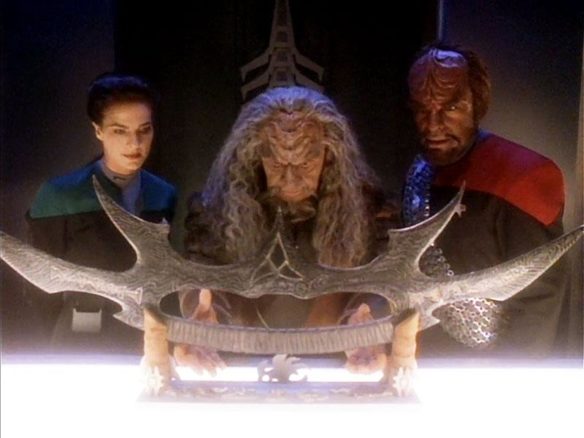
November 20, 1995 — Deep Space Nine‘s “The Sword Of Kahless”

“Did you see the look on the face of that Klingon that I killed? It was as if he understood the honor bestowed upon him. The first man in a thousand years to be killed by the Sword of Kahless.” — Kor

“I’m sure he was very proud.”  – Dax

On this evening thirty-one years ago in syndication, Deep Space Nine‘s “The Sword Of Kahless” was brought to us for our enjoyment. 

The story was created by Richard Danus and was turned into a script by Hans Beimler. 

The episode was directed by LeVar Burton. It features the return of John Colicos as Kor. Colicos had first appeared as Kor, the very first Klingon in all of Trek, in Trek’s “Errand of Mercy” and had previously appeared in this series in the episode “Blood Oath”. 

GO GET YOURSELF A CUP OF WARM KLINGON BLOODWINE AS SPOILERS LIKE BLOOD OFF A BATLEFF FOLLOW NOW.

Kor has returned to the Deep Space Nine to get the help of Worf and  Dax to help to find the ancient Sword of Kahless. It was the very first bat’leth forged by the founder of the Klingon Empire, Kahless the Unforgettable. After they find the sword, they are forced to evade the forces of Toral, son of Duras, and Worf and Kor starting fighting to the death.

Worf and Kor realize that the Sword is partially sentient and has turned them against each other, and will lead to the end of the Empire. 

Worf ponders if they really were meant to find it; Kor firmly asserts that they were, but notes that they were also not meant to keep it. So they teleport the sword into space where hopefully it will stay forever. 

IF YOU HAVE DRUNK ENOUGH OF THAT WINE, COME ON BACK BY THE WARMING FIRE. 

The sword itself was created specifically for the episode, and was made to seem more elaborate than the bat’leths previously seen in Trek, including hand etchings to make it appear similar to Damascus steel. 

This episode was somewhat unpopular with many viewers when it first aired, something which disappointed writer Hans Beimler and producer René Echevarria. What particularly disappointed them was the fact that many viewers were unable to accept the notion that the bat’leth itself had no actual power. According to Echevarria, “A lot of fan reaction was that there must be a tech explanation, that the sword must be emitting something. I was astonished.” — Star Trek: Deep Space Nine — The Office Poster Magazine 

Michelle Erica Green, who watched the episode in April 2013 for TrekNation, thought that it was not a typical Deep Space Nine episode and that it required that the viewer had knowledge of Worf’s history from the Next Generation. It rated slightly off the “Little Green Men” episode that preceded it and the “Our Man Bashir” that followed it.

It of course is streaming at Paramount + and other places. 

(9) COMICS SECTION.

My latest books cartoon for @theguardian.com #tolkien

— Tom Gauld (@tomgauld.bsky.social) 2026-11-15T16:48:06.522Z

Note: Gocomics.com links return error messages for some but not all browsers. This is a known but as yet unexplained problem.

(10) GAMING’S PAST FUTURE. [Item by Steven French.] In the latest “Pushing Buttons” newsletter, Keith Stuart shifts the focus from the release of the latest iteration Grand Theft Auto to a couple of devices that also changed the trajectory of gaming worldwide: “Twenty years ago, the Wii and PS3 predicted the future of gaming – did they get it right?” asks the Guardian.

The main focus of the games industry this week is, of course, the release of Grand Theft Auto VI– a game that could define the next decade for the industry. For this week’s newsletter though, I wanted to direct your attention two decades into the past. In November 2006, two console manufacturers launched their competing – and wildly different – visions of what the future of video games would look like. Twenty years later, it’s clear that somehow they were both right. And yet, in some ways, they were both wrong.

For Nintendo, the Wii was the natural extension of its famous maxim, Kareta Gijutsu no Suihei Shikō – roughly translated as lateral thinking with withered technology. Coined by the company’s legendary engineer Gunpei Yokoi, father of the Game Boy, the phrase described a philosophy in which old tech could be combined with smart ideas to provide amazing new gaming possibilities. The Game Boy itself used a slow, old Sharp LR35902 processor and a sickly green monochrome screen, but it also came with Tetris and worked for ages on four AA batteries. With sales of 65m, it was vastly more successful than hi-tech rivals such as the Atari Lynx and Sega Game Gear.

Before its release, the Wii was famously described as “two GameCubes duct-taped together” by game developer Chris Hecker, and its limited hardware specs drew almost as much derisive laughter as its weird name. But … it came with a motion controller that everyone could use and understand, and in Wii Sports, it had a game so perfectly compulsive it became a must at family gatherings for a decade. In fact, Wii Sports bowling leagues are still operating to this day….

(11) AND NOW FOR SOMETHING HOT… “Spacecraft reaches Mercury on second-ever mission to enter its orbit” reports the Guardian.

After a voyage of more than eight years and 6bn miles, a joint European-Japanese space mission has arrived at Mercury and is preparing to swing into orbit around the tiny, barely explored world.

The BepiColombo mission will become only the second in history to circle the first rock from the sun and the smallest planet in the solar system when flight controllers fire the spacecraft’s thrusters on Saturday and send it into orbit.

For researchers, the €1.6bn (£1.4bn) mission is the best hope yet of understanding how Mercury formed so close to the sun, why it has a magnetic field, and what makes up the frozen ice that lurks in the planet’s permanently shadowed craters.

“We’re very excited, it’s been a long wait,” said Prof Emma Bunce at the University of Leicester, who has worked on the project for 20 years.

Getting to Mercury poses unusual difficulties. Because the planet is near the centre of the solar system, spacecraft accelerate under the sun’s gravity and must spend much of their time braking to avoid shooting straight past. “It’s a very complex and challenging mission,” said Bunce, the principal investigator on an instrument called the Mercury Imaging X-ray Spectrometer, or MIXS, which will analyse the geochemical composition of the planet’s surface.It will be some months before scientists can start observing Mercury. In early December, the spacecraft will separate into two orbiters, one European, the other Japanese, which will manoeuvre to different polar orbits around the planet. Science operations are due to start in April next year….

(12) MARTIAN ILLUSION. “NASA Orbiter Snaps What Looks Like an Eerie Forest Growing on The Frozen Dunes of Mars” – ScienceAlert shared the image.

To the best of all humanity’s understanding – which is significant – nothing seems to grow on the red planet.

Nary a rover nor an orbiter has ever caught wind of a single alga, cactus, or spindly tumbleweed.

Which makes a photograph snapped by NASA’s Mars Reconnaissance Orbiter in 2008 all the more startling.

In it, thickets of scraggly trees appear to stand bolt upright from the crests of the frozen dunes near the Martian north pole.

But really, it’s all a matter of perspective.

Flip the image upside down, and suddenly those long, shadowy streaks against the pale ice and sand look much more like what they really are: dark sand from inside the dune, disrupted and sent tumbling down the dune’s side by the seasonal sublimation of carbon dioxide ice….

[Thanks to SF Concatenation’s Jonathan Cowie, Kathy Sullivan, Mark Roth-Whitworth, Joey Eschrich, Mike Kennedy, Andrew Porter, John King Tarpinian, and Steven French for some of these stories. Title credit belongs to File 770 contributing editor of the day Our Good Ten-Foot-Tall Host.]

Project Gutenberg Blames Vandalism for Downtime

The Project Gutenberg Literary Foundation today announced that “The gutenberg.org website is undergoing a deep rebuilding due to vandalism. Our volunteers are working to bring it back shortly.”

Since Sunday, they have been periodically updating this r/projectgutenberg Reddit post with status information. Here are the entries to date — start at the bottom, they are in reverse chronological order.

Friday 8am PT: Still working on things.

Thursday 8am PT: https://pglaf.org is the non-profit behind Project Gutenberg. The landing page for this org has the donation link and mail address where you can help support Project Gutenberg.

Wednesday 4pm PT: We’re not bringing the site up until we’re 100% sure the site is safe; that will take a while. We apologize for the inconvenience.

Tuesday 9pm PT: A likely source of the primary entry into the root access has been found and is now permanently removed from the site. The team is now focusing on recoding the operations tools while the hosting service rebuilds and carefully restores data files.

Tuesday 6am PT: We are continuing to find additional evidence of the vandalism and the chain of exploits used. NOTE FOR MIRRORS: If you have been mirroring the library, please let us know if any of your books have the text “asiafilm” in them.

Monday 12pm PT: The site will continue to be offline for the time being. Our crew is working to rebuild the main and support servers, not just the web site and books.

Monday 8am PT: we are expecting the site to be down for multiple days. Traces of the vandalism are more extensive than we saw on first review.

Monday 5am PT: The gutenberg.org has been actively re-vandalized by the attackers. The site will be offline until further notice.

Sunday 9pm PT: We are still finding more injected code in the site. The books are now clear, but we are finding injected code in some of the static page footers. Please be patient. The crew is still working.

Sunday 3pm PT: We are still finding additional injected code in the site. The text files and EPUB files seem to be clear. The live HTML pages seem to be targeted. The crew is still working on this.

Sunday 2pm PT: The site is mostly available, but the latest books are still being re-built.

Sunday 11am PT: We don’t have an estimate for the time to return. There are a small core team (single digits) of volunteers working on it. In the Guess/Hope/Worry framework the Guess is 6 hours, Hope is 2 hours, and Worry is a couple days.

Sunday 9am PT: Will be back soon. Looks like a spammer trying to send people to a porn site via various links in our catalog front-end.

They are asking for donations.

The PGLAF foundation operates to support Project Gutenberg. PGLAF administers the finances of the Project, including collecting donations, the sole source of ongoing monetary support.

Donations can be made thru PayPal.

Bank checks and money orders can be sent to:

Project Gutenberg Literary Archive Foundation, 41 Watchung Plaza #516, Montclair, NJ 07042

[Based on a press release.]

Pixel Scroll 11/19/26 Pixel ScrollRight Of The Mounties

(1) PROJECT GUTENBERG AND AO3 STATUS. The Project Gutenberg website was taken down temporarily yesterday and remains down at this writing. The administrators said they have called on “elite security professionals”.

Today the Archive of Our Own was also taken down for the second time in less than a month. However, a few hours later they were back in service with the same previously-announced limitations. See their announcement on Bluesky.

See more details in File 770’s post “Project Gutenberg and Archive of Our Own Sites Both Taken Down “For Maintenance”.

(2) DUBLIN LITERARY AWARD. The nominees for the Dublin Literary Award can be seen at the link.

Seventy-one novels, including 30 translated from 21 languages, have been nominated by 90 libraries in 41 countries for the award, which is sponsored by Dublin City Council.

The award, set up in 1994, is the most valuable prize in the world for a single work of fiction, worth €100,000 to the winner. If the winning book has been translated, the author receives €75,000 and the translator €25,000. Unique among literary prizes, nominations are submitted by libraries around the world.

A longlist of up to 20 titles will be announced on February 16th next year, while the shortlist of six titles will be revealed on April 7th. The winner of the Dublin Literary Award will be announced on May 20th as part of the International Literature Festival Dublin.

(3) NYPL SAYS: READ THIS. The New York Public Library’s list of “NYPL’s Best Books of 2026” is out.

…Our annual recommendations of the best books for adults, kids, and teens—curated by our expert staff and librarians—encompass fiction, nonfiction, graphic novels, poetry, kids’ books in Spanish, and much more….

The 85 titles under “Best Books for Adults 2026” include fantasy novels The Poet Empress by Shen Tao and The Red Winter by Cameron Sullivan; science fiction books After the Fall by Edward Ashton and What We Are Seeking by Cameron Reed; and works of horror such as Mazywood by Tananarive Due.

(4) NEW SFF IMPRINT. “HarperVoyager Launches Between Worlds” — Publishers Lunch has the story.

Harper Voyager UK has launched a new imprint called Between Worlds. The Bookseller reports that the imprint will publish fantasy, romantasy, dark academia, horror and dystopia, and will also include a community which the publisher says, “will help decide which books are created next, influence cover designs, have a say about character art and help choose the merch on offer.” The community decisions will be made using surveys and discussions and a community book club will launch in March 2027.

Voyager UK and Magpie publisher Natasha Bardon will lead; brand manager Lily Capewell will be in charge of community engagement; and Voyager UK and Magpie commissioning editor Kate Norman will be in charge of the editorial side.

(5) MAGIC, INDEED. Wizards of the Coast will let its authors have the entire Anthropic settlement payout James Lowder told Facebook readers today.

Some amazing Anthropic settlement news. Wizards of the Coast is foregoing its share of the Anthropic payout and giving all the money to the authors. Letters are going out to writers now, and they note:

“Because Wizards is the registered owner of the Works, Wizards filed the claims in its name. While Wizards is the copyright holder, our priority here is to recognize the creators who built these amazing worlds. Dungeons & Dragons became what it is because of the people who wrote for it. So as a thank-you to you and the other authors who helped build this world, Wizards has decided to voluntarily forgo its share of the proceeds and pass its share of the Settlement payments for the Works on to you and the other authors.”

This will all take some sorting out. Some payments will go out through the Anthropic settlement mechanism. Some of the money Wizards will collect and then pass on.

This is remarkable and amounts to hundreds of thousands of dollars WotC could have collected going to the writers…

(6) FRAZETTA HEIRS WIN AGAIN. “Court affirms ruling in Frazetta copyright case against Vanguard” – US Laws briefs its readers.

The Eleventh Circuit Court of Appeals has upheld a district court ruling that found Vanguard Productions, LLC, and Jesse David Spurlock liable for copyright infringement against Frazetta Properties, LLC. This decision, issued on November 17, 2026, centers on the unauthorized use of iconic artwork created by the late Frank Frazetta, a renowned fantasy artist. The ruling reinforces the importance of copyright protections in the creative industry.

The court’s decision is significant as it clarifies the boundaries of licensing agreements and the fair use doctrine in copyright law. It sends a strong message to publishers and creators about the necessity of obtaining proper permissions before using copyrighted material.

The parties involved in this case are Frazetta Properties, LLC, the owner of Frank Frazetta’s copyrights, and Vanguard Productions, LLC, along with its representative, Jesse David Spurlock. Frank Frazetta is well-known for his distinctive fantasy artwork, particularly his book cover illustrations for science fiction and fantasy novels.

The dispute arose when Vanguard published a book titled “Frazetta Book Cover Art – Definitive Reference” in 2022, which included reproductions of Frazetta’s works, specifically “Death Dealer II” and “Death Dealer V.” Frazetta Properties claimed that Vanguard did not have the necessary licenses to reproduce these works, leading to a lawsuit for copyright infringement under the Copyright Act.

The case reached the Eleventh Circuit after the district court granted summary judgment in favor of Frazetta Properties in February 2024. The district court ruled that Vanguard did not have a valid license for the artwork and that their use did not qualify as fair use.

The Ruling

The Eleventh Circuit affirmed the district court’s decision, stating that Vanguard/Spurlock failed to demonstrate any genuine issue of material fact regarding their defenses of license and fair use. The court emphasized that Vanguard’s use of Frazetta’s works was unauthorized, as the licensing agreements they relied upon did not cover the specific use in question….

…The court also addressed Vanguard’s argument regarding fair use, which allows for limited use of copyrighted material under certain conditions. The judges concluded that Vanguard’s use of the artwork was not transformative and primarily served a commercial purpose, which weighed against a fair use finding. The court noted that the captions added to the artwork did not change its original meaning or message…

(7) 3 BODY PROBLEM REVIEW. Defector’s Patrick Redford says “The Problem With ‘3 Body Problem’ Is That It Stinks”. His review begins —

Adaptation is a tricky process. Representing source material created in one medium within the formal and aesthetic environment of another, without changing the original material in the process, is impossible. As is the case with any sort of translation, the adapter must digest and synthesize the source material, then find some way to reproduce its poetic truths while accommodating as much of its structural skeleton as they care to or are capable of. The concept of a “faithful adaptation” supposes a perfectly reflective surface that does not exist.

That said, Netflix’s adaptation of Cixin Liu’s brilliant novel The Three-Body Problem is a disaster. I hated it. Not necessarily because it changed key parts of the foundational Remembrance of Earth’s Past sci-fi trilogy, though it did, but more because it failed to represent any of the thematic or conceptual gnarliness that made the books so good. The show’s first season, overseen by Game of Thrones duo David Benioff and D. B. Weiss and stylized as 3 Body Problem for some reason, debuted in March 2024, and the second season drops this coming January, as revealed in a trailer earlier this week….

See the trailer here.

(8) WHEN WAS THAT? Kate Macdonald gives advice for “Avoiding Anachronism in Your Historical Fantasy Writing” at SFWA’s Planetside blog.

…Above all, focus on authenticity. Accurate daily details from a historical period create the scaffolding for your plot and give reasons for your characters’ actions. 

You have a soldier in Ancient Rome jingling the coins in his waist pouch. Did you check the denominations and their size? A denarius is pretty small and higher in value than the more common as, which is tiny and easily lost. Your soldier would more likely wrap his pay in a cloth to stow in his boot for safety. (For more on Roman coins, check out numismatics.org/ocre.)

You have a maid dressing her mistress, a Japanese noblewoman. Have you checked how many kimonos a woman of her rank would wear together and in which seasonal color combinations? Where would they be kept? And don’t forget the lighting, since high-ranking medieval Japanese women were confined to windowless rooms. (Read the court memoir The Pillow Book by Sei Shōnagon for more on 10th-century Japanese palace life.)

Your character is a warlock’s apprentice in medieval Francia who has to wait for a certain time before adding hellebore to a nearly finished potion. Clocks have not yet been invented, and there is no church bell within hearing, but everyone knows how long it takes to say three Ave Marias. (Time it yourself!)

When you’ve done the research, don’t be shy about owning it. Lindsey Davis’s crime thriller Shadows in Bronze (1990) used the sponges in the communal lavatories of Ancient Rome as a splendid villain-revealing plot twist. History opens up so many possibilities for the elaborations of fantasy. If you are attentive to the world your fantasy plot springs from, it will spring brighter and higher.

(9) VIRUS (1996) ANNOTATED. [Item by Joey Eschrich.] The Imagination, Annotated series presents compelling works of speculative fiction for new readers and contemporary concerns. Inspired by the MIT Press edition of Frankenstein, each volume is annotated by a diverse group of scientists, scholars, and other experts to illuminate the historical context and enduring questions that animate these visions of the future.

The latest title in the series, published this week, is Virus: Annotated for Today’s Global Digital Humans (and Aliens). Expertly edited by science fiction scholar and documentary producer Sami Ahmad Khan, the book presents the 1996 cyber-thriller novel by acclaimed astrophysicist Jayant V. Narlikar with more than 200 annotations, plus essays by scholars Nilam Ingole, Priteegandha Naik, and Dibyadyuti Roy. This edition also features an exclusive conversation with Narlikar and a bonus short story.  

Virus dramatizes timely anxieties about digital security. An advanced species of aliens disables Earth’s digital infrastructure with a potent virus, as a prelude to an invasion. The novel, first published in Marathi, explores how scientific and technical communities in India and around the world engage with and respond to the crisis.

Making this powerful story readily available in English for the first time in decades, our edition of Virus is designed for use in classrooms and reading groups, but also for science fiction fans and students and scholars of the genre. 

20% Discount. If you order the book directly from Penguin Random House, you can receive a 20% discount using the code READMIT20. The discount works only if you are shipping to an address in the United States. More details about the discount code are here.

(10) SIX APPEAL. “New ‘The Prisoner’ Series in the Works as Amazon Picks Up Rights” says The Hollywood Reporter.

Hollywood has spent a good many years trying to adapt British cult classic TV series The Prisoner into a feature film.

Now, however, a producer and a streamer are taking a ride on the penny-farthing back to the original medium.

Amazon Studios has picked up the rights to The Prisoner for a modern take on the series. Angry Films’ Susan Montford and Don Murphy, lifelong fans of the 1967 series who secured the rights, will executive produce, as will Philippe Maigret and Lucienne Papon of ITV, the company that originally distributed the show.

The new potential series is a priority for the streamer, which is already out to showrunners. The new story will be set in modern times…

There was…a poorly received TV remake. In 2009, AMC aired a six-part miniseries that starred Jim Caviezel and Ian McKellan.

Murphy is one of the producers of the long-running Transformers franchise, the latest of which will gear up next year…

(11) REED WALLER REMEMBRANCE PLANNED. Comic book artist and musician Reed Waller died November 17 at the age of 77. Geri Sullivan has forwarded details for the “Time of Remembrance” being held for Reed Waller‘s family and friends:

  • Time of Remembrance for Reed Waller
  • Wednesday, December 2, 2026; 1:00–3:00 p.m.
  • Prairie Senior Cottages, 113 Ash Ave S, New Richland, MN 56072

(12) MEMORY LANE.

[Written by Cat Eldridge.]

The Empire Strikes Back (1980)

Let’s talk about my favorite Star Wars film. No, not the first one, The Empire Strikes Back. Released forty-six years ago but please note not on this date. I think it’s the best written, best performed and simply most interesting of the trilogy.

It was as you know the sequel to the original film which Leigh Brackett was hired to write before she died way too soon, just several weeks after turning in her script, so Lucas hired Lawrence Kasdan to write but gave Leigh Brackett co-writing credit on it as much of her script is still in the final script. 

Now they did meet several times in late 1977 to hash out an outline for what was called then Star Wars II. They figured out the framework of plot, which remained pretty much intact in later drafts, although there were some differences such as Darth Vader wasn’t Luke’s father in their outline.

Den of Geek has this quote, “Writing has never been something I have enjoyed, and so, ultimately, on the second film I hired Leigh Brackett. Unfortunately, it didn’t work out; she turned in the first draft, and then she passed away, I didn’t like the first script, but I gave Leigh credit because I liked her a lot. She was sick at the time she wrote the script, and she really tried her best.”

Does her script exist for reading? I’ve seen it referred to in articles over and but can’t find it online. 

Now the co-written script is quite fine and the performance here by everyone I think far outshines the first film. The addition of Darth Vader makes Luke Skywalker into a more interesting character, and the expansion of the cast and setting in general makes this a more believe story. Yes, it’s far darker, more sinister, but a galactic empire would be so.

Even Yoda who could be cute isn’t. (That sentence structure is deliberate.) Look it’s a muppet! It’s voiced by Frank Oz! Perfectly designed to sell lots of plushies! 

Lucas had intended to have a new mentor character for Luke who in his original design was a diminutive frog-like creature named Minch Yoda. No, I’m not kidding. 

Side-note: I still find our two droids far too irritating. They just always come off as being that for me, particularly the C-3PO. I like my droids darker which I why I prefer the ones in Neal Asher’s polity series. Aren’t they darker in The Culture series as well? 

Is there anything I don’t like here? No. I’ve watched it a half dozen times and I think it well deserves generally positive reviews, the half billion box office on a budget of under fifty million dollars, and the audience rating at Rotten Tomatoes of 97%. 

It of course, like everything Star Wars, is streaming on Disney +. 

(13) TODAY’S BIRTHDAY.

[Written by Rogers Cadenhead.] 

Born November 19, 1975 — Alex Shvartsman, 51 

By Rogers Cadenhead: After his family moved from Ukraine to the United States, Alex Shvartsman was growing up in Brooklyn when he began learning English at age 13. His belief that his command wasn’t good enough kept him from writing fiction in the language until his thirties. “I decided to just write short stories and see if any magazine will buy them as the means of figuring out whether I could write publishable fiction,” he said in an interview with Michael A. Ventrella. He sold 30 stories his first three years and another 90 since then. Ты догадался, Алекс!

His love of science fiction came from reading Russian translations of writers such as Harry Harrison, Fredric Brown and the Roberts Sheckley and Silverberg. He has produced many SFF translations from Russian, including 12 stories in K.A. Teryna’s collection Black Hole Heart and Other Stories, which was a finalist for a World Fantasy Award this year.

Alex Shvartsman in 2024.

Shvartsman’s short story “Explaining Cthulhu to Grandma” is his personal favorite, the winner of a WSFA Small Press Award and the title of his 2015 collection. It’s about what happens when the oldest pawn shop in the world acquires the slumbering dread god in a pocket dimension.

Believing that there aren’t enough places to sell funny SFF, Shvartsman began the book anthology series Unidentified Funny Objects, which released volume 10 this May under his editorship. He lives in Brooklyn with his wife Zoya and son Josh.

Shvartsman will be appearing this weekend at four events and a signing during the 90th anniversary Philcon. His most recent novel is The Best of All Possible Planets, which was inspired by his son reading Candide at school and wanting to talk about it with him.

From 1996 to 2001, Shvartsman was a professional Magic: The Gathering player, reaching a world rank of third as he traveled to 30 countries and took home $100,000 in prize money. He won four Grand Prix events and set a world record of top 8 finishes that stood for six years. He went so many places that he was rejected for entry into Malaysia because his passport was too full. “If there isn’t a place to stamp it, you can’t be admitted,” a border agent told him. Sent back across the bridge to Singapore, he was told by that side, “Your passport is full.”

He recounted the harrowing hours in 2011 for Star City Games. “These days, I do not travel very much anymore,” he wrote. “Instead, I recently began to write science fiction and fantasy short stories.”

(14) COMICS SECTION.

  • Bound and Gagged is ready for surgery in Oz.
  • Frazz mixes Darwin and Napoleon.
  • Lio gets the mild version.
  • Nancy shears through the fourth wall. (Or is it the fifth wall?)
  • Reality Check makes an illuminating pun.
  • Shoe sees what is missing.

Note: Gocomics.com links return error messages for some but not all browsers. This is a known but as yet unexplained problem.

(15) BALMING TIGER VIDEO. “Esoteric Rituals Meet K-Pop in a Stop-Motion Music Video for Balming Tiger’s ‘Janjan’” – Colossal introduces the video.

Deep in a phantasmagorical cave, a gathering of uncanny figures and critters emerges from dark waters in the music video for “Janjan” by alternative K-pop group Balming Tiger. Both playful and a little eerie, the animated work celebrates collectivity and freedom of expression.

Directed and animated by Takahashi Riku, a.k.a. DOKUZEN, the surreal music video is composed predominantly of stop-motion scenes set to a thumping rhythm to which fantastical paper figures dance as if performing esoteric rituals. It also features an interlude of drawn animations—a kind of world within a world…

(16) A FAKE ASTRONAUT SURVIVES A FAKE MARTIAN MISSION. [Item by SF Concatenation’s Jonathan Cowie.] In this week’s Nature journal there is news of a Mars mission completed by humans.  OK, so it was not for real, but even though they grew their own crops NASA could, surely, have made it more realistic by getting him to grow potatoes using his own poo??? “He spent a year on ‘Mars’: NASA science officer emerges from mock mission”.

Four engineers now have a well-informed take on the answer. On 31 October, the four emerged from a 158-square-metre, 3D-printed habitat at NASA’s Johnson Space Centre in Houston, Texas, after spending just more than a year inside it for a simulated mission on the red planet.

The exercise was the second in a series of extended NASA simulations that aim to test how long-duration space missions affect astronauts’ health and performance….

The article is here.

(17) WHICH IS THE RIGHT INTERPRETATION OF THE TWILIGHT ZONE’S “TIME ENOUGH AT LAST”? [Item by SF Concatenation’s Jonathan Cowie.] Richard Rempel’s YouTube Channel Vintage SF began as he had retired and had time enough at last to read the sizeable unread part of his SF book collection. This is something with which I can sympathize as I myself took early retirement from formal work in order to do the same (plus – it must be said – a few other things). Richard in his first Vintage video referred to the Twilight Zone episode ‘Time Enough at Last’ in which our protagonist, a coercively controlled by his wife, and bullied by his boss, protagonist takes solace in reading and so spends his break time reading in his work place’s vault. This enables him to survive an atomic bomb attack. He emerges to find himself the sole survivor. He finds a library with many books – immune from radiation – that have also survived. At last he can read to his heart’s content undisturbed… but he accidentally breaks his glasses.

Here’s the thing. Is this story a ‘morality tale’ about a misanthrope who cannot get on with people who then gets his just desserts? Or is it a ‘tragedy’ about a person who finds his own personal heaven only to quickly lose it? I have to say I hadn’t thought of it this way.

Richard invites us to consider each option and decide.

You can see his video here or below

“Is Henry Bemis a misanthrope? ‘Time Enough at Last’ from Season 1 of The Twilight Zone.”

[Thanks to Steven French, SF Concatenation’s Jonathan Cowie, Kathy Sullivan, Rogers Cadenhead, Mlex, Joey Eschrich, Geri Sullivan, Mark Roth-Whitworth, Mike Kennedy, Andrew Porter, and John King Tarpinian for some of these stories. Title credit belongs to File 770 contributing editor of the day Jon Meltzer.]

Project Gutenberg and Archive of Our Own Sites Both Taken Down “For Maintenance”

The Project Gutenberg website was taken down temporarily yesterday and remains down at this writing. The administrators said they have called on “elite security professionals”.

Today the Archive of Our Own was also taken down for the second time in less than a month. It had been just four days since it restored service following a two-week hiatus attributed to a “security incident”. No reasons for the current interruption have been made public.

Project Gutenberg administrators told Facebook readers:  

PG has been suffering some problems with its site and has had to take the site down to correct these. The site will either be down or have limited availability while we complete necessary maintenance.

However, their Bluesky post sounds more ominous:

In the meantime, Project Gutenberg has reminded readers that their holdings are also available through “Project Gutenberg at the Internet Archive”.

The Archive of Our Own current returns this message.

The Archive of Our Own Status account on Bluesky says:


UPDATE 11/19/2026: Archive of Our Own is back in service with the same previously-announced limitations. Here is their announcement on Bluesky:

Pixel Scroll 11/18/26 Hey, Rocky! Watch Me Pull A Pixel Out Of My Scroll!

(1) AMAZING STORIES RELEASES 100TH ANNIVERSARY ISSUE. Amazing Stories celebrates its 100th anniversary in the Fall 2026 issue, featuring new fiction and a special tribute to the late Steve Davidson, the publisher who revived the legendary magazine and brought it back into print in 2018.

Davidson, who passed away November 4, 2026, acquired Amazing Stories in 2012 and dedicated himself to preserving its legacy while ensuring its future. This issue honors his contributions and celebrates the continuing adventure of a magazine first published by Hugo Gernsback in 1926.

The issue features fiction from an impressive lineup of authors, including award-winning science fiction writer David Gerrold, with “Three of Me”; publisher and author Tom Easton, with “The Eden Fail”; and Dave Creek, with “Inflection Point.”

Other stories explore alien encounters, superheroes, environmental catastrophe, artificial intelligence, and the unexpected consequences of scientific discovery. The issue also includes poetry and Steve Fahnestalk’s continuing film column, “The Best Films, Part II.”

“This issue is particularly meaningful as we celebrate a century of Amazing Stories while remembering Steve Davidson, whose vision brought the magazine back to life,” said current publisher Kermit Woodall. “Steve understood that Amazing Stories wasn’t just about preserving history. It was about giving new generations of writers and readers a place to share their imagination. We’re committed to carrying that tradition forward.”

First published March 10, 1926, by Hugo Gernsback, Amazing Stories helped establish science fiction as a literary genre and introduced generations of readers to imaginative new worlds and ideas.

(2) CRYPTIDS GO POSTAL. The US Postal Service will issue a set of “Mythical Creatures” stamps in 2027, drawn by Nat Power, an artist at Royal Legion Tattoo in Austin, TX. The on sale date has yet to be announced. [Click for larger image.]

CHRON reports “How an Austin tattoo artist’s cryptids ended up on USPS forever stamps”.

…Power, a UT Austin grad, drew the creatures featured on the stamps, which were designed by USPS stamp art director Antonio Alcalá. The stamps show five legendary cryptids in their natural environment: Mothman, Jackalope, Squonk, Sasquatch and Champ. The cryptids are done in the American traditional art style, which Power primarily works in. 

In an interview with Chron, Power said that Alcalá reached out to her last year about collaborating for a new set of forever stamps, which she said was “definitely one of the most exciting emails I’ve ever received!” Power was a perfect fit, given that she’s always loved folklore and urban legends. Her personal favorite of the cryptids is the Jackelope, which she depicts in vivid pinks, whites and oranges. 

“I’ve always been drawn to fantastical and chimerical animals,” Power said. “Much of my art features creatures in that vein and many cryptids fit right in.”… 

(3) GAME ART GOING UNDER THE HAMMER.  Heritage Auctions’ Intelligent Collector magazine explains the appeal of “The Art of the Cartridge”.

…Before Aizawa was a veteran in the animation industry, he was an aspiring illustrator, fresh out of the Art Center College of Design in Pasadena, California, and eager to take advantage of whatever career opportunities he could find. One particularly consequential connection came from an unexpected source: a regular customer at his father’s restaurant.

“I visited my father at his small Japanese restaurant in Portland, Oregon. We were at the counter, and I was showing my father my portfolio, and one of my father’s regular customers, Yash Terakura, overheard our conversation and asked if he could see my portfolio,” Aizawa recalls…

…Terakura was the head of HAL America Inc., the North American subsidiary of Japanese video game developer HAL Laboratory Inc. At the time, HAL America was working with Nintendo to publish several of their Nintendo Entertainment System titles in the West. To complete the project, the company needed new cover and cartridge artwork for the Nintendo games, and Terakura brought in Aizawa to spearhead the task.

What began as a chance encounter in a restaurant led to Aizawa creating the cover artwork for over a dozen Nintendo Entertainment System and Game Boy games, including Adventures of Lolo 1-3, Millipede, Joust, Kabuki: Quantum Fighter, Defender II, Air Fortress, Revenge of the Gator, and many others.

In early 1988, Aizawa’s work with HAL America led him and his team to visit the Nintendo of America offices in Redmond, Washington, where he was introduced to the team working on a new project: a video game magazine offering player strategies and the latest Nintendo news.

“I met the team at Nintendo of America, and they introduced me to the people working on the new Nintendo Power magazine,” Aizawa says. “They asked if I would be interested in doing the artwork for the fold-out posters, and I was excited to be a part of it.”

The team tasked Aizawa with illustrating the fold-out poster for the magazine’s first issue, to be published in July/August of 1988. Little did Aizawa realize the then unknown magazine would ultimately have a 24-year run, resulting in 285 volumes and garnering countless readers throughout the world. In addition to creating the fold-out poster artwork for the first issue, Aizawa created two additional posters, one for issue No. 2 and one for No. 4….

… Now, nearly four decades later, those works are making their public debut as a featured collection in Heritage’s November 20-21 Video Games Signature® Auction….

(4) IT WAS A PAIN IN THE ANTENNA. Slashfilm tells “What Starship Troopers Author Robert A. Heinlein Thought Of His Hollywood Experiences”.

Robert A. Heinlein wasn’t fond of working as a screenwriter in Hollywood, and he definitely hated working in TV.

The famed sci-fi author loved the movies, but was always more comfortable sticking to his preferred medium of the printed page. Heinlein was quoted in a 1994 issue of Cinefantastique Magazine saying that working on a Hollywood screenplay meant a great deal of stress, but also that seeing a completed movie he had worked on was a rewarding experience. Heinlein, however, was pretty negative about his experience working on 1960s TV. That, he recalls, was totally miserable….

… It was when he was approached in the 1960s to write the pilot for an unmade TV series called “XXII Century,” however, that Heinlein’s experience in Hollywood turned sour. That show, it seems, was a huge headache…

… A producer named Howie Horowitz called Heinlein about making a TV pilot, and the result was a script called “XXII Century” (also called “Century XXII” various places online). The script can be purchased on the Heinlein archive website, and that edition contains pages and pages of notes, seemingly requiring that Heinlein repeatedly alter his work….

… The basics behind the pilot of “XXII Century” can be found on the Libertarian Futurist Society website. “XXII Century” was to take place in the year 2163, and followed the plight of a secret society of powerful superhumans who had the ability to think rationally at all times, even if it pained them. They had cordoned themselves off from the rest of society, and developed a benevolent dictatorship. 

The LFS website notes that this premise was culled from Robert A. Heinlein’s 1949 novella “Gulf.” In the pilot episode, called “The Man Who Wasn’t There,” it was explained that the United States, Russia, and China engaged in a devastating war in the year 1984. Thereafter, the former two affected authoritarian governments founded moon colonies, and eventually began sending criminals and undesirables there. Fast forward a few centuries, and “XXII Century” can begin. The moon colonies were matriarchal in nature, as there were far fewer women than men, and were also meant to reflect a post-racism future, where prejudice was left behind. And all of this was written before “Star Trek” ever made it to the air in 1966. 

Why did the show fall apart? The Space Review has some commentary on “XXII Century” from noted Heinlein scholar Bill Patterson, and he said that the script was way too daring for its own good, and that there was no way it could have ever made its way to the small screen. The project was abandoned, Heinlein lost interest in television, and he went back to writing hit novels. The TV show sounds great, but Heinlein was likely better off in his preferred medium….

(5) TRANSLATORS DEMAND PROTECTION FROM AI. Publishers Weekly reports translators have contributed a brief supporting those suing OpenAI and Microsoft for copyright violation: “Literary Translators Warn AI Threatens Their Livelihoods in Copyright Case”.

The American Literary Translators Association (ALTA) has joined a coalition of 11 other organizations representing writers, journalists, photographers, and other creative professionals in supporting authors suing OpenAI and Microsoft, arguing that the companies’ use of copyrighted works to develop AI tools threatens their livelihoods.

In an October 30 brief filed in the high-profile copyright case brought by the Authors Guild and other authors, ALTA argues that the potential economic harm from generative AI extends beyond book authors to other creative professionals, including literary translators.

The brief was co-signed by 11 other professional organizations, including the American Society of Journalists and Authors, the National Writers Union, Romance Writers of America, and the Dramatists Guild of America.

ALTA argues that widespread adoption of AI translation tools could turn translators “from interpreters into primarily editors of large language model outputs,” the brief states, echoing a concern PW reported on in September. The organization also said literary translations are original works protected by copyright, even though they are based on and licensed from another author’s work. Translators make their own creative decisions in carrying an author’s words, voice, and style into another language, ALTA argues, and should be recognized as authors in their own right….

(6) REED WALLER (1949-2026). Comic book artist and musician Reed Waller died November 17 at the age of 77. He was best known for his work on the sexually explicit comic book series Omaha the Cat Dancer, with writer Kate Worley, an Eisner Awards nominee.

Surprisingly, I see Reed Waller had a fillo in the first issue of File 770 (1978). Since I didn’t know Reed myself, a mutual friend must have given it to me — I knew Minneapolis fans and several other fanartists who were his friends and part of Vootie.

Vootie, “The Fanzine of the Funny Animal Liberation Front”, run by Reed Waller and Ken Fletcher of Minneapolis fandom is where furry fandom began. Vootie was an amateur publishing association (apa), and lasted from April 1976 to February 1983, when the editors lost interest.

Omaha the Cat Dancer No. 1, featuring the principal characters, Charles Tabey Jr. aka Chuck Katt and Omaha.

Waller began writing and drawing Omaha for Vootie in 1978, as a series of strips. Publisher Denis Kitchen, impressed with those stories, suggested that Reed take a second pass at the material with the goal of getting it published professionally. The Kitchen Sink Press’ bestselling underground title Bizarre Sex was chosen to debut the series in 1981. Omaha launched as a separate comic book series in 1984 from Minneapolis publisher SteelDragon Press. (It would later move back to Kitchen Sink and eventually to Fantagraphics.) 

Waller suffered writer’s block and soon invited his partner Kate Worley to take over as the series’ writer.

Due to the comic’s sexual content there were recurring attempts to censor the series. In 1986, a comics store manager was charged with distributing obscene material including Omaha, leading to the founding of the Comic Book Legal Defense Fund. In 1988, Diamond Comics Distributors temporarily refused to distribute the series to stores, and in 1989 a comics bindery refused to put together a collection. However, the series was critically acclaimed, and was nominated for five Eisners between 1989-1991.

Omaha ceased publication in 1995 as the creators went their separate ways. Reed added to his body of work by writing and drawing the one-shot Tumbling Boxes comic and a continuing feature, Grlz-R-Us, for Larry Flynt Publications.

Waller received a Lifetime Achievement Good Furry Award in 2023.

(7) COMICS SECTION.

Note: Gocomics.com links return error messages for some but not all browsers. This is a known but as yet unexplained problem.

(8) GRENDEL COMING TO TV. “’Grendel’ Comic-Based Animated Series Ordered By Netflix” reports Deadline.

 Matt Wagner‘s signature comic book character Hunter Rose is coming to the screen, this time for real. Netflix has ordered Grendel, an adult animated action series based on Wagner’s long-running comic book series published by Dark Horse.

Bobak Esfarjani (Widow’s Bay, WandaVision, Alien: Earth) is writer, executive producer and showrunner on the TV adaptation. In it, after the woman he loves is shockingly murdered, Hunter Rose devotes himself to one thing: vengeance. But as he tears through street gangs, the elite, and New York City’s supernatural underworld in pursuit of her killer, a chance at a real life forces him to choose: walk away from ultimate power, or become the very monster he hunts.

(9) ROBERT PATTINSON’S 10 BEST FILMS BEYOND THE BLOCKBUSTERS. JustWatch supplies the where-to-watch links for each here.

With all the buzz around Robert Pattinson, here’s a look back at some of his best work beyond the blockbusters. From David Cronenberg and Claire Denis to the Safdie brothers and Robert Eggers, we’ve rounded up 10 of his best-reviewed films, ranked by critics’ scores, with details on where to stream them in the US:

  1. Good Time (2017) – 91% on Rotten Tomatoes. The Safdies’ adrenaline shot, and the role that changed how critics saw him. Only available to rent or buy in the US (Free on JustWatch TV in Spain).
  2. The Childhood of a Leader (2015) – 90%. A small but haunting part in Brady Corbet’s debut. On MUBI.
  3. The Lighthouse (2019) – 90%. Robert Eggers, Willem Dafoe and the most unhinged performance of his career. On HBO Max.
  4. Primetime (2026) – 86%. As To Catch a Predator host Chris Hansen, in his latest film. To rent or buy.
  5. The Lost City of Z (2016) – 85%. Unrecognisable, and quietly brilliant, in James Gray’s jungle epic. On Prime Video.
  6. High Life (2018) – 83%. Claire Denis’ haunting space odyssey, with Pattinson at his most stripped back. Streaming for free in the US on JustWatch TV.
  7. The Drama (2026) – 76%. A wedding-week meltdown opposite Zendaya. On HBO Max.
  8. The King (2019) – 71%. Barely ten minutes on screen, and he steals the whole film. On Netflix.
  9. Cosmopolis (2012) – 67%. David Cronenberg cast him as an icy billionaire gliding through Manhattan in a limo. On Starz.
  10. The Rover (2014) – 67%. A raw, twitchy turn opposite Guy Pearce in the Australian outback. On HBO Max.

(10) JACK KIRBY’S NEIGHBORHOOD. The New York Times profiles a pop-up exhibit about comics artist Jack Kirby in “Birthplace of Many Marvel Superheroes? The Mind of a Lower East Side Boy”.

Jack Kirby was a titan of the comic book industry. He cocreated many of the major Marvel superheroes including the X-Men and Captain America, who have dominated movie screens for almost two decades.

He was also an editorial cartoonist, a soldier who fought Nazis in World War II, and more — a colorful history highlighted in “The Jack Kirby Way: How a Boy From the Lower East Side Became the King of Comics” at the American Jewish Historical Society in Manhattan. The exhibit was curated by Roy Schwartz, a pop culture historian, and Rand Hoppe, the founder of the Jack Kirby Museum and Research Center, a virtual museum that occasionally mounts pop-up exhibits….

Childhood Street

“Street Code” is a short biographic comic written and drawn by Kirby that was commissioned in 1983. It focuses on his hardscrabble childhood in Lower Manhattan, where Kirby was born in 1917. (He died in 1994 at 76.) “It’s a historical artifact that really reflects New York’s Lower East Side in a very vibrant, very lively way,” Schwartz said in a telephone interview. He noted that Kirby often reflected on his cultural background and upbringing in this work, but it was usually through metaphor. “This marked the first time that he ever created an explicitly autobiographical work.”…

A New Milestone

On May 11, Kirby was honored on the corner of Delancey and Essex Streets with a sign that designated that block as Jack Kirby Way. It was the culmination of years of effort by many, including Schwartz, Hoppe of the Jack Kirby Museum and Karen Green, the curator for comics and cartoons at Columbia University. There is also a documentary, “Kirbyvision,” being filmed, and Hoppe said he and others are working on opening a permanent museum near his birthplace.

The Jack Kirby Way: How a Boy From the Lower East Side Became the King of Comics

Through Nov. 30. American Jewish Historical Society, 15 West 16th Street, Manhattan; 212-294-8301, ajhs.org.

The AJHS has also shared video of their panel “It Started on Delancey Street! New York’s Lower East Side in Jack Kirby’s Comics”.

[Thanks to John King Tarpinian, Steven French, SF Concatenation’s Jonathan Cowie, Kermit Woodall, Arnie Fenner, Kathy Sullivan, Mark Roth-Whitworth, Mike Kennedy, and Andrew Porter for some of these stories. Title credit belongs to File 770 contributing editor of the day Jon Meltzer.]