

LLM benchmarks are standardized datasets, tasks and evaluation methods used to measure the capabilities and limitations of Large Language Models (LLMs). They evaluate models across areas such as knowledge, reasoning, mathematics, coding, multilingual understanding and agentic tasks.
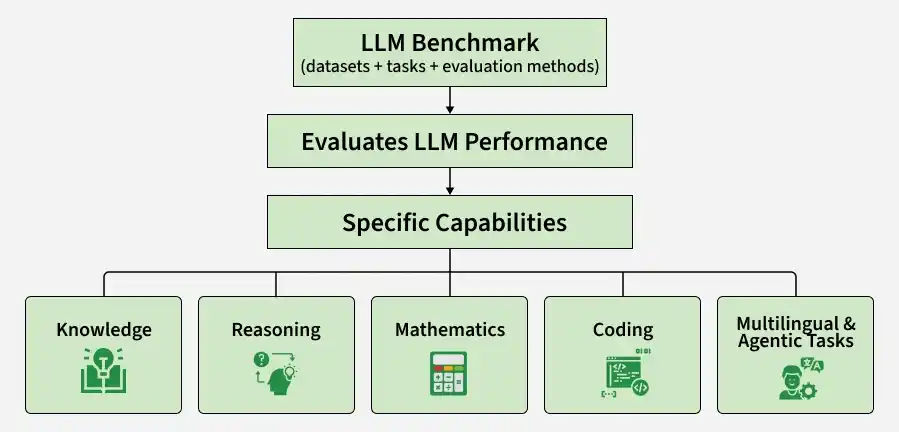
Benchmarks help compare models, track progress and identify strengths and weaknesses. They use metrics such as accuracy, F1 score or Pass@k to measure performance, depending on the task. However, no single benchmark can capture all aspects of an LLM, so multiple benchmarks are typically used for a broader evaluation.
Common Types
1. Knowledge & General Reasoning
These benchmarks evaluate an LLM's knowledge and reasoning abilities.
- MMLU (Massive Multitask Language Understanding): Tests knowledge across 57 subjects, including mathematics, science, law and computer science.
- MMLU-Pro: Provides more challenging questions for stronger knowledge and reasoning evaluation.
- GPQA (Graduate-Level Google-Proof Q&A): Tests difficult graduate-level questions in physics, chemistry and biology.
- Humanity's Last Exam (HLE): Contains 2,500 expert-level questions covering diverse academic subjects.
- LiveBench: Uses frequently refreshed questions across reasoning, mathematics, coding, language, instruction following and data analysis.
2. Mathematical Reasoning
These benchmarks measure an LLM's ability to solve mathematical problems.
- MATH: Contains challenging competition-style mathematics problems.
- GSM8K: Tests multi-step reasoning using grade-school math word problems.
- AIME: Uses advanced mathematics problems from the American Invitational Mathematics Examination.
- Omni-MATH: Evaluates advanced mathematical reasoning across challenging problems.
3. Coding & Software Engineering
These benchmarks evaluate code generation, understanding, debugging and software engineering.
- HumanEval: Tests whether generated Python code correctly solves programming problems.
- MBPP (Mostly Basic Python Problems): Evaluates code generation on basic Python tasks.
- LiveCodeBench: Uses newly released programming problems for more contamination-resistant evaluation.
- SWE-bench: Tests an AI system's ability to resolve real-world software engineering issues in repositories.
- Aider Polyglot: Evaluates coding performance across multiple programming languages.
4. Instruction Following
These benchmarks measure how reliably an LLM follows instructions and output requirements.
- IFEval (Instruction-Following Evaluation): Tests verifiable instructions involving formatting, length, keywords and other constraints.
- HELM Instruct: Evaluates instruction-following models across criteria such as helpfulness, completeness and conciseness.
5. Multimodal Understanding
These benchmarks evaluate models that work with text and other modalities such as images and charts.
- MMMU (Massive Multi-discipline Multimodal Understanding): Tests multimodal reasoning across academic and professional subjects.
- HLE: Includes both text-based and multimodal expert-level questions.
- OSWorld: Evaluates multimodal agents on real computer tasks involving applications, files and websites.
6. Multilingual Capabilities
These benchmarks evaluate LLM performance across multiple languages.
- MMMLU: Provides MMLU evaluations in 14 languages, including Hindi, Bengali, Arabic, Chinese and Japanese.
- MMLU-ProX: Extends multilingual evaluation to more challenging cross-lingual reasoning.
- MuBench: A 2026 benchmark covering 61 languages and 3.9 million samples to evaluate multilingual capabilities.
7. Agentic & Real-World Tasks
These benchmarks test LLMs as AI agents that interact with tools, websites, terminals and computer environments.
- SWE-bench: Evaluates real-world software engineering tasks.
- Terminal-Bench: Tests an agent's ability to complete tasks through a terminal.
- OSWorld: Evaluates computer-use agents on desktop and web-based workflows.
- BrowseComp: Tests challenging information-seeking and browsing tasks.
- LiveBench Agentic Coding: Evaluates agentic coding capabilities.
8. Safety, Truthfulness & Robustness
These benchmarks evaluate the reliability, safety and potential biases of LLM outputs.
- TruthfulQA: Tests whether models provide truthful answers rather than common misconceptions.
- BBQ (Bias Benchmark for Question Answering): Evaluates social biases in question-answering scenarios.
- RealToxicityPrompts: Measures the tendency to generate toxic content.
- HELM Safety: Evaluates models across multiple safety-related risks.
Popular LLM Benchmark Suites & Evaluation Platforms
Rather than relying on a single benchmark, researchers use benchmark suites and evaluation platforms to assess LLMs across multiple capabilities.
1. HELM
- HELM (Holistic Evaluation of Language Models) is stanford framework for transparent and reproducible LLM evaluation across capabilities, instruction following, safety, multilingual tasks and other areas.
- Focuses on selected benchmarks such as MMLU-Pro, GPQA, IFEval, WildBench and Omni-MATH.
2. LiveBench
- A contamination-resistant benchmark with regularly updated questions covering reasoning, coding, agentic coding, mathematics, data analysis, language and instruction following.
- Its frequently refreshed tasks help evaluate newer models on data less likely to have appeared in training.
3. Hugging Face Leaderboards and Evaluations
- Provides benchmark results, community leaderboards and evaluation tools for comparing LLM performance.
- Its original Open LLM Leaderboard was archived in 2024 and should not be confused with a continuously updated leaderboard.
Usage
Benchmark scores should be treated as one part of model evaluation rather than a universal ranking. A practical evaluation process is:
- Identify the capabilities required for the application.
- Select benchmarks that measure those capabilities.
- Compare models using the same benchmark version and evaluation setup.
- Check for contamination, tool access and prompting differences.
- Evaluate the shortlisted models on real-world tasks and application-specific data.
For example:
A coding assistant should not be selected only from its general reasoning score. Coding benchmarks such as SWE-bench and LiveCodeBench may provide more relevant information about its software-development capabilities.
Challenges
- Benchmark Contamination: Test examples may appear in model training data, making high scores less reliable as evidence of generalization.
- Benchmark Saturation: Older benchmarks can become too easy as models improve. This is one reason newer evaluations such as LiveBench and HLE were developed.
- Limited Real-World Coverage: A model can perform well on academic questions but still struggle with long, multi-step or interactive tasks.
- Evaluation Variability: Scores can change depending on prompting, number of attempts, tool access, model settings and evaluation methodology.
- Subjective Evaluation: Open-ended tasks such as writing and dialogue may require human or AI judges, introducing evaluator bias.
- Rapidly Changing Models: New model versions and reasoning methods can quickly change leaderboard rankings, making benchmark results time-sensitive.
