

The ovaries are a pair of small, almond-shaped endocrine glands present in the female reproductive system. They are an essential part of both the reproductive and endocrine systems. The ovaries produce female gametes (ova) and secrete female sex hormones such as estrogen and progesterone that regulate reproduction, the menstrual cycle, and the development of secondary sexual characteristics.
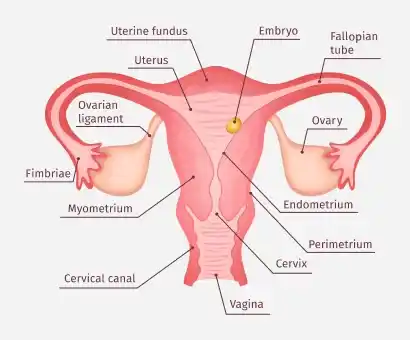
Characteristics of the Ovary
- The ovaries are paired reproductive organs found only in females.
- Each ovary is almond-shaped and slightly flattened.
- The average size of an ovary is approximately 3 centimetres long, 1.5 centimetres wide, and 1 centimetre thick.
- Each ovary weighs about 3 to 5 grams in adult females.
- The ovaries are pale white or slightly pinkish in colour.
- They remain functionally active from puberty until menopause.
- The ovaries contain numerous ovarian follicles in different stages of development.
- They function both as reproductive organs and endocrine glands.
- The ovaries undergo cyclic structural and hormonal changes during the menstrual cycle.
Structure of the Ovary
Each ovary is covered externally by a thin layer of cuboidal epithelium called the germinal epithelium. Beneath this layer lies a dense connective tissue layer known as the tunica albuginea. Internally, the ovary is divided into two main regions called the cortex and medulla.

1. Outer Cortex
- The cortex is the outer region of the ovary and forms the major functional part of the organ. It contains numerous ovarian follicles embedded within connective tissue. These follicles are present in different stages of development.
- An ovarian follicle consists of a developing ovum surrounded by follicular cells. During each menstrual cycle, some follicles begin to grow under the influence of hormones, but usually only one follicle becomes fully mature and releases an ovum during ovulation.
- The cortex also contains structures formed after ovulation, such as the corpus luteum and corpus albicans.
2. Inner Medulla
- The medulla forms the inner region of the ovary and consists mainly of loose connective tissue. It contains numerous blood vessels, lymph vessels, nerves, and smooth muscle fibres.
- The medulla provides nourishment and support to the ovarian tissues and helps transport hormones produced by the ovary into the bloodstream.
Ovarian Follicles
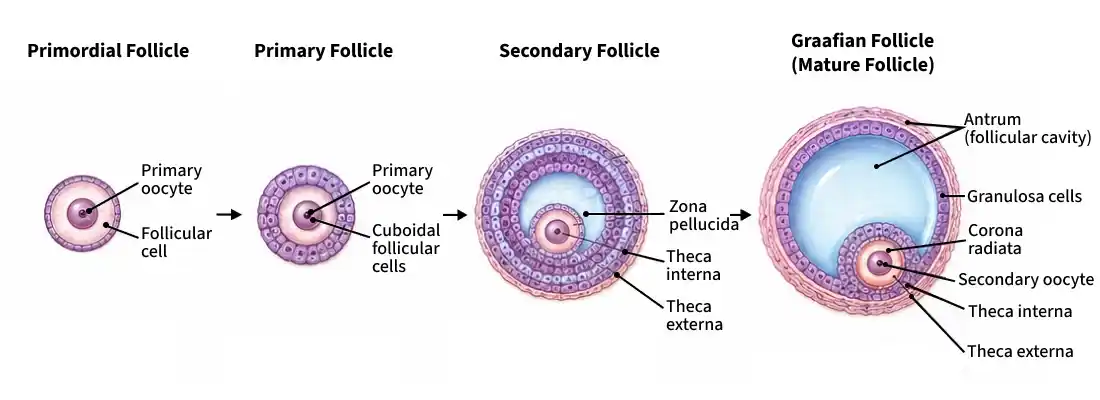
The ovarian follicles are the most important structures present in the ovary. They contain immature ova that develop into mature eggs. The follicles pass through different stages of development:
1. Primordial Follicle
This is the earliest stage of the follicle containing an immature primary oocyte surrounded by a single layer of follicular cells.
- Primary Follicle: The follicular cells become cuboidal and begin active growth.
- Secondary Follicle: The follicle enlarges and develops multiple layers of granulosa cells.
- Graafian Follicle: This is the fully mature follicle containing a mature ovum ready for ovulation.
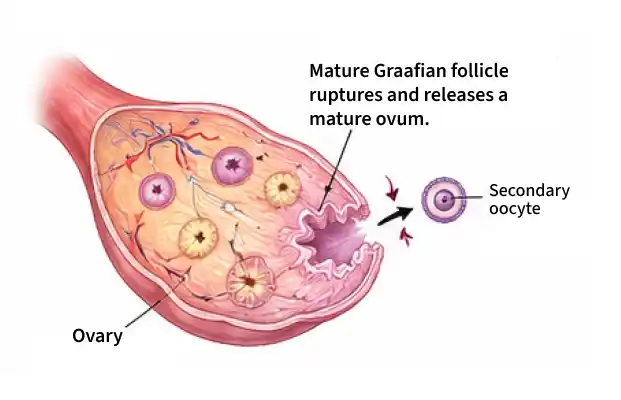
2. Ovulation
Ovulation is the process by which a mature Graafian follicle ruptures and releases a mature ovum from the ovary. This usually occurs around the middle of the menstrual cycle under the influence of luteinizing hormone (LH). After ovulation, the ruptured follicle transforms into a temporary endocrine structure called the corpus luteum.
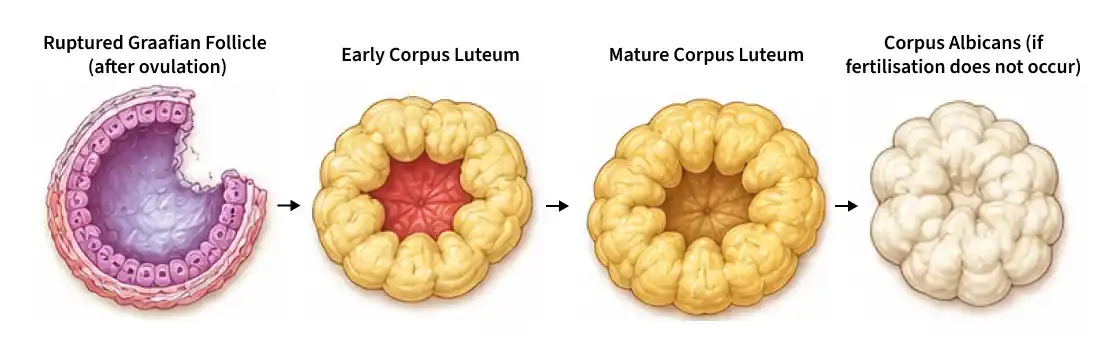
3. Corpus Luteum
The corpus luteum is a yellow-coloured glandular structure formed from the ruptured Graafian follicle after ovulation. It secretes large amounts of progesterone and small amounts of estrogen.
- Prepares the uterus for implantation
- Maintains the uterine lining during pregnancy
- Supports early stages of pregnancy
- If fertilisation does not occur, the corpus luteum degenerates into a scar-like structure called the corpus albicans.
Hormones Secreted by the Ovary
The ovaries secrete two major female reproductive hormones: estrogen and progesterone.
1. Estrogen
- Estrogen is mainly secreted by the developing ovarian follicles.
- Promotes the development of female secondary sexual characteristics.
- Stimulates growth of reproductive organs.
- Regulates the menstrual cycle.
- Helps in the development of breasts.
- Maintains skin texture and bone health.
- Stimulates growth of the uterine lining.
- Secondary sexual characteristics produced by estrogen include widening of hips, development of breasts, growth of pubic hair, and changes in body shape.
2. Progesterone
- Progesterone is mainly secreted by the corpus luteum formed after ovulation.
- Prepares the uterus for implantation of the embryo.
- Maintains pregnancy by supporting the endometrium.
- Prevents contraction of uterine muscles during pregnancy.
- Helps prepare mammary glands for lactation.
- Regulates menstrual cycle changes.
- Progesterone is often called the “pregnancy hormone” because of its important role in maintaining pregnancy.
Functions of the Ovary
The ovaries perform several important reproductive and endocrine functions.
- The ovaries produce and release female gametes known as ova through the process of oogenesis.
- The ovaries secrete estrogen and progesterone, which regulate female reproductive functions.
- The cyclic secretion of ovarian hormones controls the menstrual cycle and ovulation.
- Ovarian hormones prepare the uterus for implantation and support pregnancy.
- The ovaries regulate the development of female body features during puberty.
- The ovaries maintain the normal functioning of reproductive organs and reproductive capability.
Disorders Related to the Ovary
Several disorders may affect the ovaries and interfere with reproductive functions.
- Polycystic Ovary Syndrome (PCOS): A hormonal disorder characterised by multiple cysts in the ovaries and irregular menstrual cycles.
- Ovarian Cysts: Fluid-filled sacs that may develop within the ovary.
- Ovarian Cancer: Abnormal uncontrolled growth of ovarian cells.
- Premature Ovarian Failure: Loss of ovarian function before the normal age of menopause.
