

The Peripheral Nervous System (PNS) is the part of the nervous system that consists of all the nerves and ganglia located outside the brain and spinal cord. While the brain and spinal cord together form the Central Nervous System (CNS), the peripheral nervous system acts as a communication network that connects the central nervous system with various parts of the body.
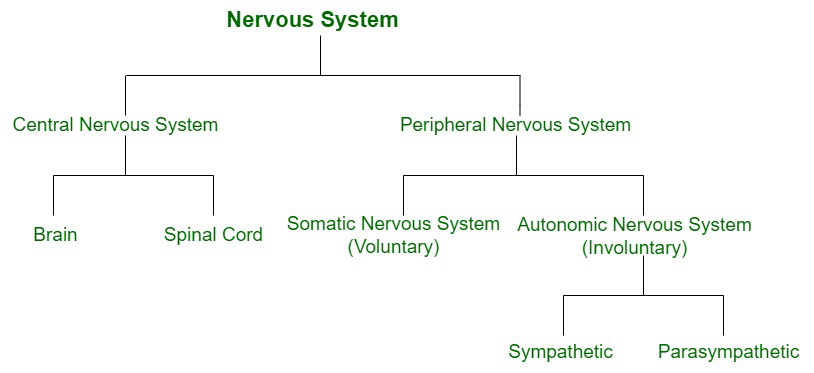
The peripheral nervous system plays a vital role in receiving sensory information from the environment and the internal organs and carrying it to the central nervous system for processing. It also transmits motor commands from the central nervous system to muscles and glands, enabling the body to respond appropriately to different stimuli.
Divisions of the Peripheral Nervous System
The peripheral nervous system is broadly divided into two major divisions, namely the Somatic Nervous System and the Autonomic Nervous System.
1. Somatic Nervous System

- The Somatic Nervous System is the division of the peripheral nervous system that controls voluntary activities of the body. It connects the central nervous system with skeletal muscles and sensory receptors present in the skin, muscles, and joints.
- This system is responsible for carrying sensory information from various receptors to the brain and spinal cord.
- It also transmits motor commands from the central nervous system to skeletal muscles, thereby enabling voluntary movements.
- Activities such as walking, running, writing, speaking, lifting objects, and playing sports are all controlled by the somatic nervous system.
- The somatic nervous system allows an individual to consciously interact with the external environment. Whenever a person touches a hot object, feels pain, or deliberately moves a limb, the somatic nervous system is involved in transmitting and processing the necessary nerve impulses.
2. Autonomic Nervous System
The Autonomic Nervous System (ANS) is the division of the peripheral nervous system that regulates involuntary activities of the body. The autonomic nervous system continuously regulates various physiological functions without conscious effort. It controls heart rate, blood pressure, digestion, respiration, glandular secretions, body temperature, and many other essential activities required for maintaining homeostasis.
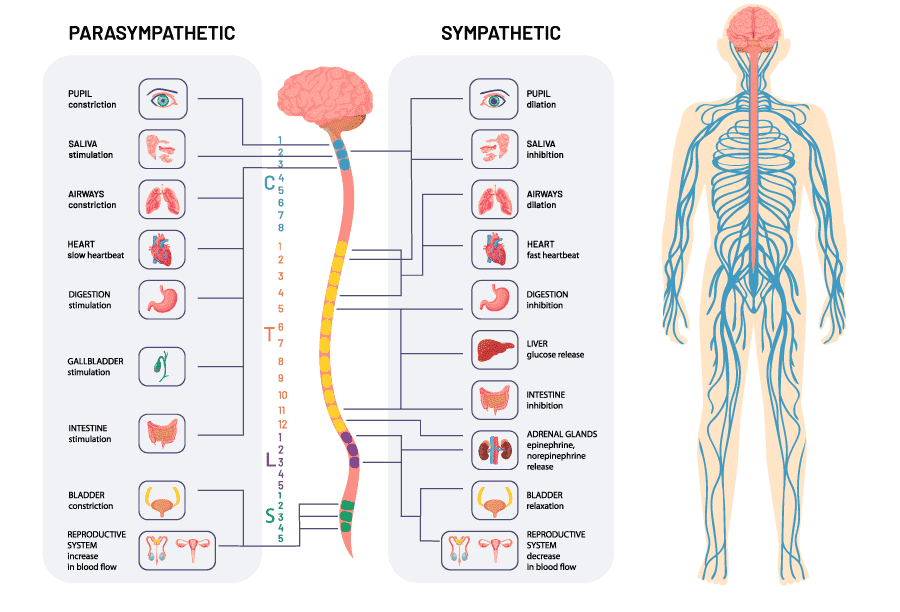
The autonomic nervous system is further divided into two subdivisions, known as the sympathetic nervous system and the parasympathetic nervous system.
A. Sympathetic Nervous System
- The sympathetic nervous system prepares the body to respond to stressful, dangerous, or emergencies.
- It is commonly referred to as the "fight-or-flight" division because it enables the body to react quickly during conditions of fear, excitement, anxiety, or physical stress.
- When the sympathetic nervous system is activated, a series of physiological changes occurs throughout the body. The heart begins to beat more rapidly, blood pressure rises, and breathing becomes faster and deeper.
- The pupils of the eyes dilate to allow more light to enter, thereby improving vision. Blood flow to skeletal muscles increases so that the body can respond quickly to potential threats.
- At the same time, digestive activities are reduced because energy is redirected toward muscles and vital organs.
- These changes prepare the body to either confront a dangerous situation or escape from it, thereby increasing the chances of survival during emergencies.
B. Parasympathetic Nervous System
- The parasympathetic nervous system performs functions that are generally opposite to those of the sympathetic nervous system. It is often referred to as the "rest-and-digest" division because it promotes relaxation, recovery, and conservation of energy.
- When the parasympathetic nervous system is active, the heart rate decreases, blood pressure falls, and breathing becomes slower.
- Digestive activities are stimulated, allowing food to be properly digested and nutrients to be absorbed. Glandular secretions increase, and the body's energy reserves are replenished.
- The parasympathetic nervous system becomes most active during periods of rest. Promoting normal physiological functions and conserving energy, it helps maintain internal balance and supports long-term health.
- The sympathetic and parasympathetic divisions work together in a coordinated manner to regulate body functions and maintain homeostasis. Their opposing actions ensure that the body's organs function efficiently under different conditions.
Components of the Peripheral Nervous System
The peripheral nervous system is composed of cranial nerves, spinal nerves, and ganglia. These structures form an extensive network that extends throughout the body and connects all organs and tissues with the central nervous system.
1. Cranial Nerves
- Cranial nerves are the nerves that arise directly from the brain. In human beings, there are twelve pairs of cranial nerves.
- These nerves mainly supply the structures of the head and neck, although some of them extend to the thoracic and abdominal organs.
- Cranial nerves may be sensory, motor, or mixed in function. Sensory cranial nerves carry impulses from sensory organs to the brain, motor cranial nerves carry impulses from the brain to muscles, and mixed cranial nerves perform both sensory and motor functions.
- The cranial nerves are responsible for important activities such as vision, hearing, smell, taste, movement of the eyes, facial expressions, swallowing, and regulation of certain internal organs.
- The vagus nerve, which is one of the longest cranial nerves, extends to the heart, lungs, stomach, and other visceral organs and plays a major role in controlling involuntary body functions.
2. Spinal Nerves
- Spinal nerves arise from the spinal cord and extend to different parts of the body. Human beings possess thirty-one pairs of spinal nerves.
- Each spinal nerve is formed by the union of a dorsal sensory root and a ventral motor root. As a result, spinal nerves are mixed nerves that contain both sensory and motor fibres.
- These nerves transmit sensory impulses from the skin, muscles, and internal organs to the spinal cord and carry motor impulses from the spinal cord to muscles and glands.
- Through this communication system, spinal nerves help coordinate body movements and responses to environmental changes. They also play a major role in reflex actions that occur without conscious control.
3. Ganglia
- Ganglia are groups of nerve cell bodies located outside the central nervous system.
- They function as relay centres where nerve impulses are received, processed, and transmitted.
- Ganglia are associated with both sensory and autonomic nerves and help in the efficient transmission of information throughout the nervous system.
Functions of the Peripheral Nervous System
- The peripheral nervous system performs several essential functions that are necessary for the survival and proper functioning of the body.
- One of its most important functions is the transmission of sensory information from receptors located throughout the body to the central nervous system.
- Sensory receptors detect changes in the environment, such as temperature, pressure, pain, light, sound, taste, and smell. The information collected by these receptors is carried to the brain and spinal cord for interpretation.
- Another important function of the peripheral nervous system is the transmission of motor impulses from the central nervous system to muscles and glands. These motor commands enable the body to perform voluntary movements and regulate involuntary physiological processes.
- The peripheral nervous system also plays a crucial role in coordinating body activities and maintaining communication between different organs and tissues. Through its extensive network of nerves, it ensures that various parts of the body work together harmoniously.
- In addition, the peripheral nervous system participates in reflex actions, which are rapid and automatic responses to stimuli. Reflex actions help protect the body from injury by allowing immediate responses before the brain becomes consciously aware of the stimulus.
