

Living organisms show a wide range of structural and functional diversity. Along with true living organisms, some borderline forms of life show characteristics of both living and non-living things. Viruses, viroids, prions, and lichens are important examples studied in biology because they help us understand the complexity of life.
Viruses
Viruses are non-cellular organisms and are in an inactive state while outside the host body. They reproduce and replicate when they get inside the host body. This process often kills the host. Some of the most common diseases caused by viruses are Mumps, measles, Rubella, etc.
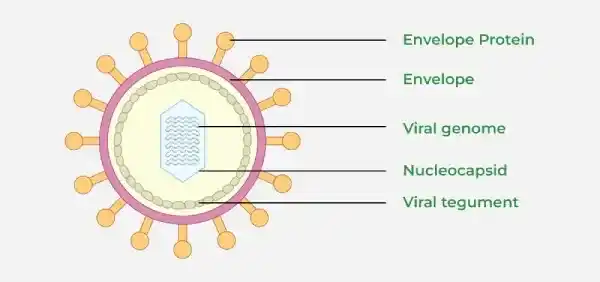
The most popular disease caused by the virus is the mosaic disease of tobacco. An experiment carried out by M.W. Beijerinck introduced a new pathogen called "virus" and "Contagium Vivum Fluidum" (infectious living fluid). W. M. Stanley demonstrated that viruses could be crystallized and that crystals are mostly made up of proteins. Outside of their unique host cell, they are dormant. Viruses are parasitic on other organisms.
Viroid
After the discovery of viruses, scientists found another pathogen that was smaller than a virus. It was discovered by T.O. Diener in 1971.
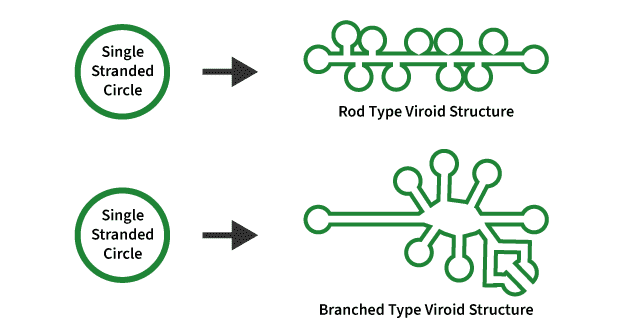
Viroids are the smallest known infectious agents, consisting of a short, circular strand of single-stranded RNA (ssRNA). Unlike viruses, viroids do not have a protein coat (capsid) and do not encode any proteins. They infect plants, causing a variety of plant diseases that can reduce crop yield and quality.
Prions
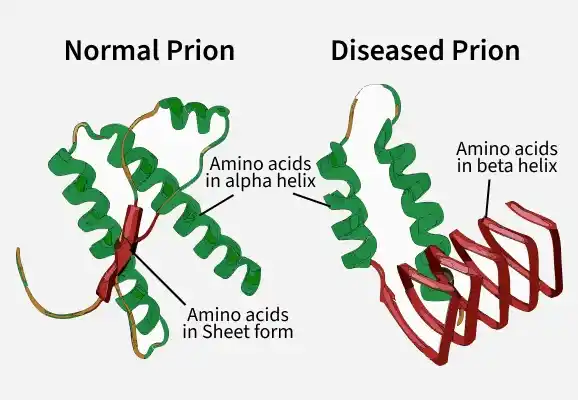
These are abnormally folded proteins, which can transmit several diseases. The word "prion" is derived from "proteinaceous infectious particle." They were discovered by American biologist Stanley B. Prusiner.
Lichens
Lichens are symbiotic relationships between algae and fungi in which algae prepare food and fungi provide shelter. In this relationship, algae are known as photobionts, and fungi are known as mycobionts. Lichens have properties different from those of their component organisms.

The differences between viruses, viroids, prions, and lichens are given below:
Feature | Viruses | Viroids | Prions | Lichens |
|---|---|---|---|---|
Nature | Infectious agents are composed of nucleic acid (DNA or RNA) and a protein coat (capsid) | Infectious agents are composed of small, circular RNA molecules | Infectious proteins that cause the abnormal folding of normal proteins | Symbiotic association between fungi and photosynthetic organisms (algae or cyanobacteria) |
Size | 20-300 nanometers | 246-401 nucleotides in length | Very small, typically around 10 nm | Macroscopic, visible to the naked eye |
Genetic Material | DNA or RNA | RNA | No nucleic acid, only protein | N/A, composed of fungal and algal/cyanobacterial cells |
Replication | Requires a host cell to replicate, using the host's machinery | Replicates autonomously in the host plant cells | Induces abnormal folding in normal proteins and does not replicate like typical pathogens. | Reproduces through a symbiotic relationship, either sexually or asexually |
Infects | Plants, animals, bacteria, archaea | Plants | Animals, mainly affecting the nervous system | Not an infectious agent, but a mutualistic organism |
Disease Example | Influenza, HIV, COVID-19 | Potato spindle tuber disease | Creutzfeldt-Jakob disease, mad cow disease | No disease is caused, but it contributes to ecological balance and nutrient cycling. |
Treatment | Antiviral drugs, vaccines | No specific treatment | No known cure, only preventive measures | Not treated, as they are beneficial organisms |
