

Machine Learning (ML) is evolving with advances in AI agents, multimodal models, efficient architectures and specialized AI systems. Current ML development is increasingly focused not only on improving model performance but also on making models more capable, efficient, deployable and trustworthy.
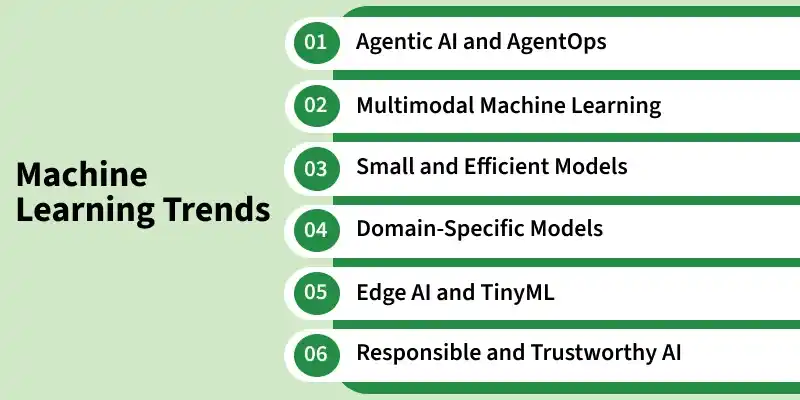
1. Agentic AI and AgentOps
- Agentic AI: ML systems are evolving from models that simply generate outputs to AI agents that can plan tasks, reason through problems, use tools and perform multi-step actions with limited human intervention.
- AgentOps: As AI agents become more widely deployed, organizations need practices for developing, monitoring, evaluating and managing their behavior, performance and reliability in production.
Example:
An AI software development agent can analyze a coding task, modify files, run tests and fix errors through multiple steps instead of only generating code.
2. Multimodal Machine Learning
- Multiple Data Types: Multimodal ML enables models to process and combine different types of data, such as text, images, audio and video.
- Cross-Modal Understanding: Models can use information from one modality to understand or generate information in another, enabling more comprehensive AI applications.
Example:
A healthcare system can analyze a medical image along with a patient's clinical notes to assist with diagnosis.
3. Small and Efficient Models
- Small Language Models (SLMs): Smaller models are increasingly being developed to perform specific tasks while requiring less computing power and memory than large models.
- Efficient Inference: Techniques such as quantization, pruning and knowledge distillation can reduce model size and inference costs while maintaining useful performance.
Example:
A small language model can run locally on a smartphone to provide text summarization without sending the data to a cloud-based model.
4. Domain-Specific Models
- Specialized Models: Instead of relying only on general-purpose models, organizations are adapting ML models for specific domains such as healthcare, finance, law and scientific research.
- Domain Adaptation: Fine-tuning, continued pretraining and domain-specific datasets can help models better understand specialized terminology, tasks and requirements.
Example:
A financial institution can adapt a language model using financial documents and terminology for analyzing reports and extracting relevant information.
5. Edge AI & TinyML
- Edge AI: ML inference is increasingly being performed directly on devices such as smartphones, cameras, vehicles and IoT devices instead of relying entirely on cloud servers.
- TinyML: TinyML focuses on running ML models on highly resource-constrained devices such as microcontrollers with limited memory and processing power.
Example:
A smart sensor can run a small anomaly-detection model locally to identify equipment problems without continuously sending sensor data to the cloud.
6. Responsible & Trustworthy AI
- Explainable AI (XAI): XAI techniques help make ML predictions more understandable by providing information about which features or factors contributed to a model's output.
- Algorithmic Governance: Organizations are increasingly establishing processes for monitoring AI systems, managing risks, documenting models and ensuring compliance with applicable requirements.
- Responsible Development: Fairness, privacy, security, transparency and accountability are becoming important considerations throughout the ML lifecycle.
Example:
A lending system can provide explanations for the factors that contributed to a loan decision, while governance processes monitor the system for potential bias and compliance risks.
