

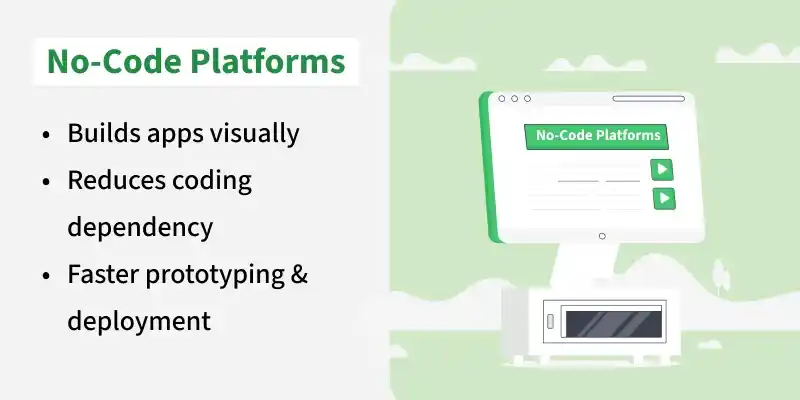
No-code platforms allow users to design software through visual interfaces instead of programming languages. They typically include layout builders, databases, workflows, and integrations. This approach makes software creation more accessible to non-developers while still supporting many practical business needs.
- Builds apps through visual design tools
- Reduces dependency on traditional coding
- Supports faster prototyping and deployment
1. Bubble
Bubble is a powerful no-code platform for building custom web applications. It supports databases, workflows, user authentication, and complex logic through a visual editor. It is often used for marketplaces, SaaS products, and full web apps.
- Strong for complex web applications
- Supports custom logic and data structures
- Useful for startups and product MVPs
2. Webflow
Webflow is a design-focused no-code platform for building professional websites. It combines visual design control with CMS and hosting features. It is popular for marketing sites, portfolios, blogs, and content-driven websites.
- Excellent visual design control
- Strong CMS for content sites
- Suitable for marketing and brand websites
3. Airtable
Airtable blends spreadsheet simplicity with database capabilities. It is widely used for organizing data, managing projects, and building lightweight operational tools. Many teams use it as a flexible backend for workflows and internal systems.
- Easy data organization and collaboration
- Useful for CRM-style and project workflows
- Works well as a structured data foundation
4. Glide
Glide turns spreadsheets and structured data into polished apps quickly. It is especially useful for simple mobile-friendly business tools and internal apps. It is a strong option when speed and ease of use matter most.
- Fast spreadsheet-to-app workflow
- Good for simple business tools
- Low learning curve for beginners
5. Adalo
Adalo focuses on building mobile apps through a visual interface. It supports app design, data management, and publishing workflows for native-style mobile experiences. It is useful for startups and teams creating mobile MVPs.
- Designed for mobile app creation
- Supports rapid prototyping
- Useful for simple native-style apps
6. Zoho Creator
Zoho Creator is a business-focused no-code platform for custom applications. It supports process automation, internal tools, and operational workflows. It integrates well with other Zoho products and business systems.
- Strong for business process apps
- Useful for internal tools and portals
- Fits teams already using Zoho software
7. Thunkable
Thunkable is a no-code platform for building cross-platform mobile apps. It uses a visual block-based approach that is approachable for beginners and educators. It is suitable for simple mobile projects and learning-focused app development.
- Beginner-friendly mobile app builder
- Supports cross-platform mobile projects
- Useful for education and small apps
8. OutSystems
OutSystems is an enterprise-oriented low-code and no-code platform. It is designed for large organizations that need scalable business applications. It supports complex processes, integrations, and governed development environments.
- Built for enterprise-scale applications
- Supports complex business systems
- Useful for modernization and process automation
9. Mendix
Mendix is another enterprise low-code platform for building business applications. It focuses on rapid development with governance, collaboration, and scalability. It is commonly used in larger organizations with structured application needs.
- Strong enterprise application support
- Useful for process automation
- Designed for team-based development
10. FlutterFlow
FlutterFlow is a visual app builder that helps create cross-platform applications with a design-first approach. It is popular for teams that want mobile apps with stronger UI control. It is a modern option for product teams building polished multi-platform experiences.
- Strong visual mobile app design
- Useful for cross-platform product builds
- Appeals to design-focused teams
Benefits of No-Code Platforms
No-code tools can shorten development time and lower costs for many projects. They help teams test ideas quickly and launch simple products without large engineering teams. They are especially useful when speed and flexibility matter more than deep custom code control.
- Faster development and iteration
- Lower initial development cost
- Easier access for non-technical users
