

Carrier Sense Multiple Access (CSMA) is a medium access control method used when multiple devices share the same communication channel. Before transmitting, a device senses the channel to check whether another device is already transmitting.
- If the channel is idle, the device can start transmission.
- If the channel is busy, the device waits according to the access method being used.
- CSMA reduces the chances of collisions but cannot completely eliminate them.
- It is used as the basis for protocols such as CSMA/CD and CSMA/CA.
Vulnerable Time in CSMA
Vulnerable time is the short window in which there's a risk of collision between two devices trying to send data on the network at the same time. In CSMA-based networks like Ethernet or Wi-Fi, each device listens to the channel before transmitting.
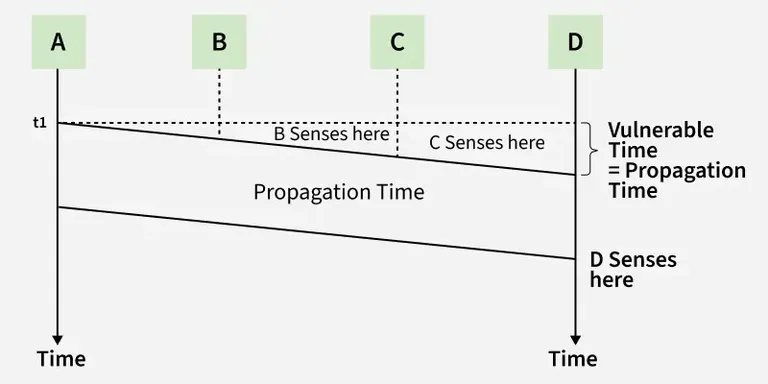
- If the channel seems free, the device waits a tiny moment and then begins sending.
- However, another device might also sense the channel as free at the same time, and both devices may start transmitting, causing a collision.
- This small time window, where such collisions can still happen even after sensing, is called the vulnerable time.
Note: Note: Vulnerable Time = Propagation Time (Tₚ). It is the time required for a signal to travel from one device to another.
Types of CSMA Access Modes
CSMA has four main access modes. These modes define how a device behaves when the shared channel is busy or becomes idle.
- 1-Persistent: The device continuously senses the channel. If the channel is idle, it transmits immediately. If the channel is busy, it keeps sensing until the channel becomes free. This can increase the chance of collisions when multiple devices are waiting.
- Non-Persistent: If the channel is busy, the device waits for a random period before sensing again. This reduces the chance of collisions but may increase the waiting time.
- P-Persistent: When the channel is idle, the device transmits with probability p. With probability 1 − p, it waits for the next time slot and tries again. It is generally used with slotted channels.
- O-Persistent: A central controller assigns a transmission order to the devices. Each device waits for its assigned turn before transmitting when the channel is idle.
Types of CSMA Protocol
CSMA/CD (Collision Detection)
CSMA/CD (Carrier Sense Multiple Access with Collision Detection) is used to detect collisions in shared wired networks.
- A device first senses the channel before transmitting.
- If the channel is idle, it starts transmission.
- If a collision occurs, the device stops transmitting.
- It waits for a random backoff period and then retransmits the frame.
Used in: Traditional shared Ethernet networks.
CSMA/CA (Collision Avoidance)
CSMA/CA (Carrier Sense Multiple Access with Collision Avoidance) is mainly used in wireless networks such as Wi-Fi.
- The device senses the channel before transmission.
- If the channel is busy, it waits.
- If the channel is idle, it uses a random backoff before transmitting.
- An acknowledgment (ACK) is generally used to confirm successful delivery.
Used in: Wi-Fi and other wireless networks.
Advantages
- Reduces collisions: Devices check the channel before transmitting.
- Better channel utilization: Multiple devices can share the same medium efficiently.
- Simple access method: No dedicated connection is required between communicating devices.
- Flexible: Different CSMA variants can be used for different network conditions.
- Suitable for shared networks: Works well when multiple devices compete for the same communication channel.
Disadvantages
- Collisions can still occur: Channel sensing cannot completely eliminate collisions.
- Waiting delay: Devices may have to wait when the channel is busy.
- Performance decreases with heavy traffic: More competing devices can increase collisions and waiting time.
- Propagation delay affects sensing: A device may not immediately know that another device has started transmitting.
- Not suitable for all networks: Its performance depends on traffic, propagation delay and the number of competing devices.
