

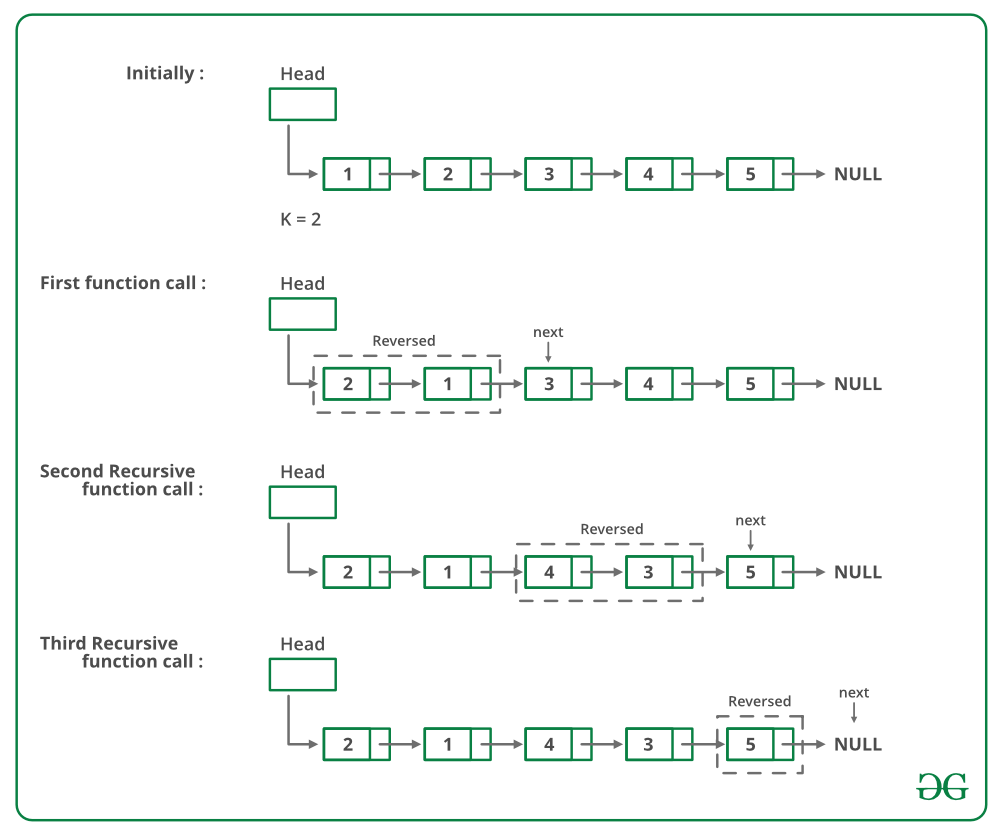
Reversing a linked list in groups of size K means dividing the linked list into consecutive groups of K nodes and reversing the nodes within each group. In C++, this can be implemented efficiently by modifying the links between nodes without changing their data.
- Each complete group of K nodes is reversed independently.
- The links between groups are updated to maintain the linked list.
Input: 1 -> 2 -> 3 -> 4 -> 5 -> 6 -> 7 -> 8 -> NULL, K = 3
Groups: [1 -> 2 -> 3] [4 -> 5 -> 6] [7 -> 8]
After Reversal: [3 -> 2 -> 1] [6 -> 5 -> 4] [7 -> 8]
Output: 3 -> 2 -> 1 -> 6 -> 5 -> 4 -> 7 -> 8 -> NULL
Here, each complete group of three nodes is reversed. The last group contains only two nodes, so it remains unchanged.
Note: Some variations of this problem also reverse the final incomplete group. In this article, only complete groups of K nodes are reversed.
Approach: Iterative Reversal of K Nodes
The iterative approach reverses one group at a time by updating the next pointers of the nodes. The main idea is to identify a complete group of K nodes, reverse its links, and connect it to the previously processed group.
Algorithm
- Create a dummy node pointing to the head of the linked list.
- Check whether at least K nodes remain in the current group.
- Reverse the links of those K nodes.
- Connect the reversed group with the previous and next parts of the linked list.
- Repeat until fewer than K nodes remain.
- Return the updated head of the linked list.
Example: Program reverses a singly linked list in groups of K nodes using an iterative approach.
#include <iostream>
using namespace std;

struct Node{
    int data;
    Node* next;

    Node(int value) : data(value), next(nullptr) {}
};

// Reverse only complete groups of k nodes
Node* reverseKGroup(Node* head, int k) {
    if (head == nullptr || k <= 1)
        return head;

    Node dummy(0);
    dummy.next = head;

    Node* groupPrev = &dummy;

    while (true){

        // Find the kth node of the current group
        Node* kth = groupPrev;

        for (int i = 0; i < k && kth != nullptr; i++)
            kth = kth->next;

        // Leave incomplete group unchanged
        if (kth == nullptr)
            break;

        Node* groupNext = kth->next;
        Node* prev = groupNext;
        Node* curr = groupPrev->next;

        // Reverse k nodes
        while (curr != groupNext) {
            Node* nextNode = curr->next;
            curr->next = prev;
            prev = curr;
            curr = nextNode;
        }

        // Connect reversed group
        Node* oldStart = groupPrev->next;
        groupPrev->next = kth;
        groupPrev = oldStart;
    }

    return dummy.next;
}

// Print linked list
void printList(Node* head){

    while (head != nullptr){

        cout << head->data;
        if (head->next != nullptr)
            cout << " -> ";
        head = head->next;
    }
    cout << endl;
}

int main(){

    Node* head = new Node(1);
    Node* temp = head;

    for (int i = 2; i <= 8; i++) {
        temp->next = new Node(i);
        temp = temp->next;
    }

    int k = 3;

    cout << "Original List: ";
    printList(head);

    head = reverseKGroup(head, k);

    cout << "Reversed List: ";
    printList(head);

    // Free allocated memory
    while (head != nullptr) {
        Node* nextNode = head->next;
        delete head;
        head = nextNode;
    }

    return 0;
}
Output
Original List: 1 -> 2 -> 3 -> 4 -> 5 -> 6 -> 7 -> 8
Reversed List: 3 -> 2 -> 1 -> 6 -> 5 -> 4 -> 7 -> 8
Alternative Approach: Recursive Reversal
The problem can also be solved using recursion. In this approach, each complete group of K nodes is reversed, and the function recursively processes the remaining linked list.
#include <iostream>
using namespace std;

struct Node {
    int data;
    Node* next;

    Node(int val) {
        data = val;
        next = nullptr;
    }
};

// Reverse linked list in groups of k
Node* reverseKGroup(Node* head, int k) {
    if (!head || k <= 1)
        return head;

    // Check if k nodes are available
    Node* temp = head;
    for (int i = 0; i < k; i++) {
        if (!temp)
            return head;
        temp = temp->next;
    }

    // Reverse current group
    Node* prev = nullptr;
    Node* curr = head;

    for (int i = 0; i < k; i++) {
        Node* nextNode = curr->next;
        curr->next = prev;
        prev = curr;
        curr = nextNode;
    }

    // Connect remaining groups recursively
    head->next = reverseKGroup(temp, k);

    return prev;
}

// Print linked list
void printList(Node* head) {
    while (head) {
        cout << head->data;
        if (head->next)
            cout << " -> ";
        head = head->next;
    }
    cout << endl;
}

int main() {
    Node* head = new Node(1);
    Node* temp = head;

    for (int i = 2; i <= 8; i++) {
        temp->next = new Node(i);
        temp = temp->next;
    }

    int k = 3;

    cout << "Original List: ";
    printList(head);

    head = reverseKGroup(head, k);

    cout << "Reversed List: ";
    printList(head);

    // Free allocated memory
    while (head) {
        Node* nextNode = head->next;
        delete head;
        head = nextNode;
    }

    return 0;
}
Output
Original List: 1 -> 2 -> 3 -> 4 -> 5 -> 6 -> 7 -> 8
Reversed List: 3 -> 2 -> 1 -> 6 -> 5 -> 4 -> 7 -> 8
