

As a data scientist, you can leverage ChatGPT as a valuable tool to streamline various tasks, enhance productivity, and generate insights more efficiently. Whether you're cleaning data, developing models, or reporting results, ChatGPT offers ways to automate and enhance your workflow. ChatGPT, a large language model developed by OpenAI, has advanced capabilities beyond text generation. As a data scientist, you can utilize ChatGPT to accelerate various aspects of your work. From assisting in coding tasks to generating insights from data, ChatGPT can transform your daily routine.
In this article, we will explore the different areas where ChatGPT can assist data scientists, from data preprocessing to model building, evaluation, and collaboration.
Table of Content
ChatGPT for Data Preprocessing
Data Cleaning
Data preprocessing is one of the most time-consuming tasks in data science. ChatGPT can assist by helping you write functions for:
- Handling missing data (e.g., imputing values, removing missing entries)
- Detecting outliers
- Standardizing and normalizing data
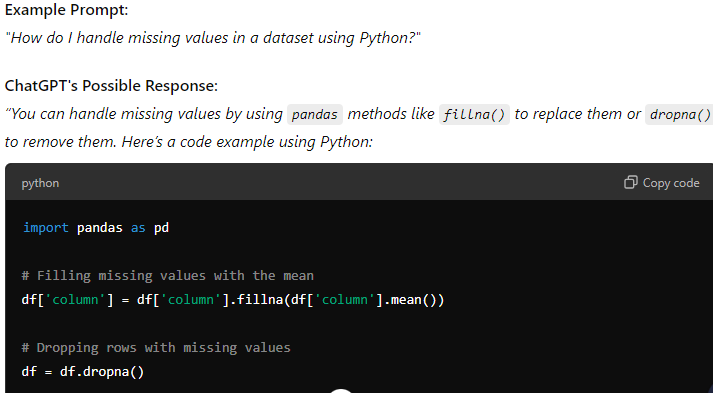
Data Transformation
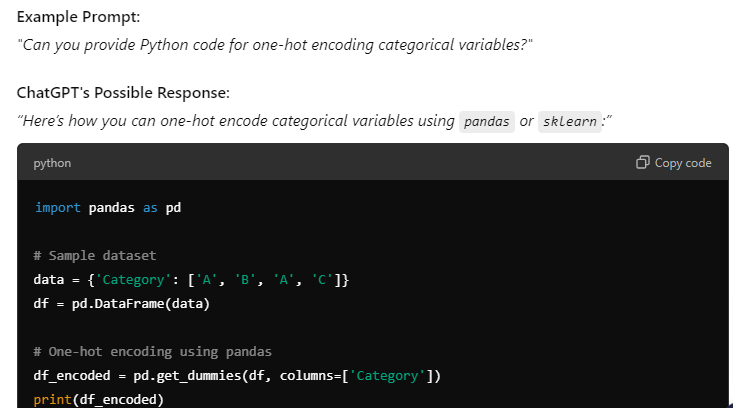
Data transformation tasks such as encoding categorical variables or scaling numeric features can also be automated with the help of ChatGPT. You can prompt it to:
- Provide Python code for one-hot encoding
- Help with log-transforming skewed data
- Generate code snippets for data normalization or standardization
ChatGPT for Exploratory Data Analysis (EDA)
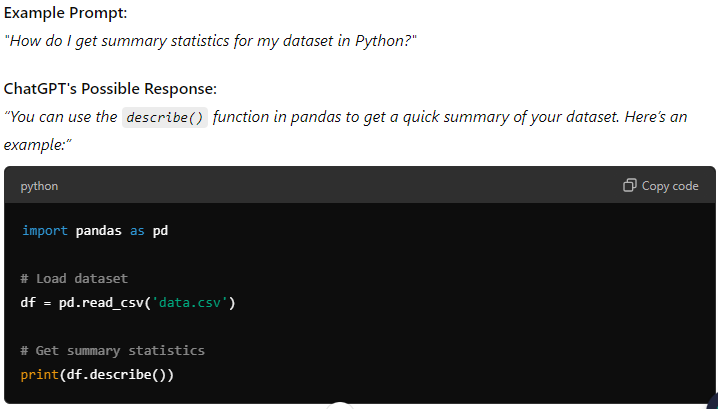
Descriptive Statistics
You can use ChatGPT to help you quickly generate descriptive statistics. It can:
- Create code to compute measures like mean, median, mode, standard deviation, and percentiles.
- Help identify distribution trends in your dataset.
Data Visualization Assistance
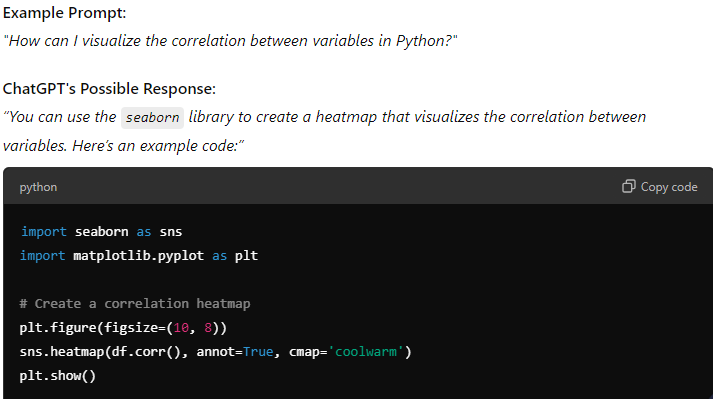
Data visualization is a key part of EDA. ChatGPT can:
- Write code snippets to generate charts (e.g., histograms, box plots, scatter plots) using libraries like Matplotlib and Seaborn.
- Assist in explaining what each visualization reveals about the data (e.g., distribution, correlation between variables).
ChatGPT for Data Wrangling and Feature Engineering
Handling Missing Data
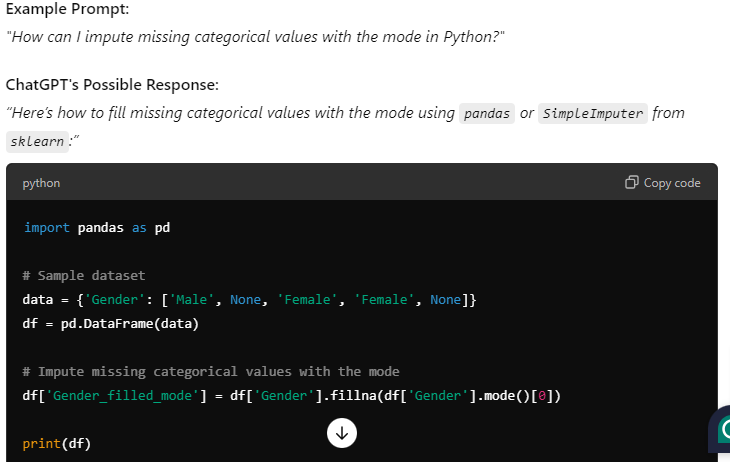
Cleaning and imputing missing values is a crucial step in data wrangling. ChatGPT can provide various strategies and corresponding code to address missing data. For instance, it can:
- Generate code for imputing missing values based on statistical methods or machine learning models.
- Help create pipelines that handle missing data efficiently.
Feature Selection and Creation
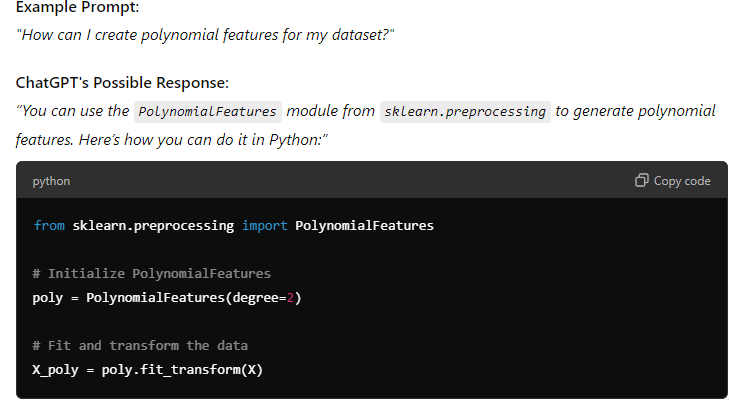
Feature engineering is often complex, but ChatGPT can assist with:
- Recommending new features based on existing ones.
- Writing code for feature scaling, polynomial feature creation, or interaction terms.
- Providing techniques like Recursive Feature Elimination (RFE) or Principal Component Analysis (PCA) to select the best features.
ChatGPT for Model Building
Model Recommendations
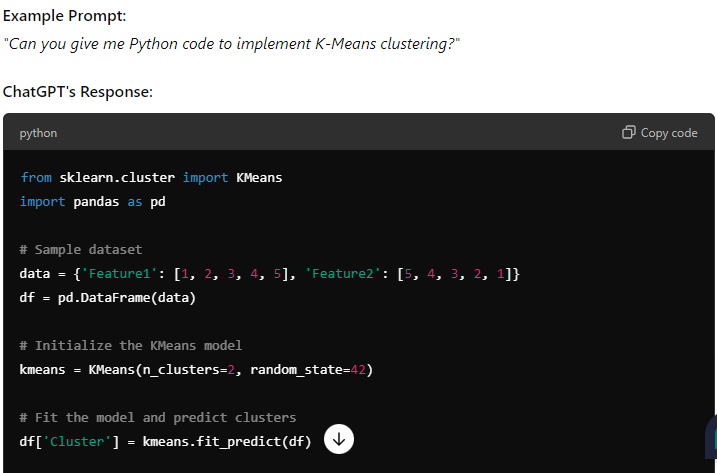
Based on your problem type (classification, regression, clustering, etc.), ChatGPT can:
- Suggest appropriate models (e.g., decision trees, random forests, k-means).
- Write code to implement these models using Scikit-learn, TensorFlow, or PyTorch.
Hyperparameter Tuning
ChatGPT can also help optimize your models by:
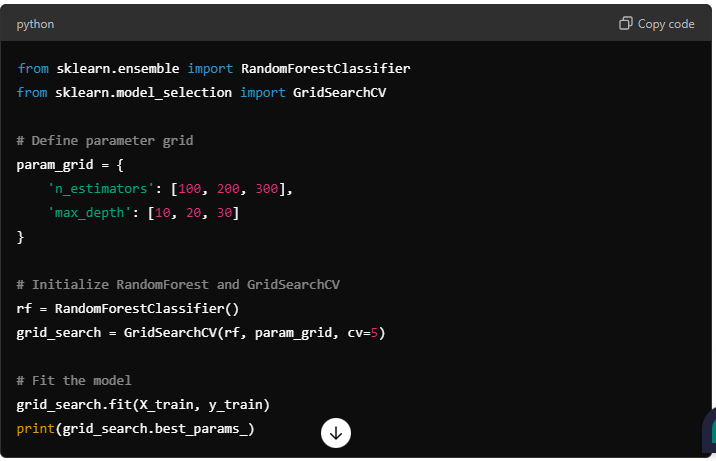
- Suggesting methods like Grid Search or Randomized Search for hyperparameter tuning.
- Generating code that automates hyperparameter optimization using tools like Scikit-learn’s GridSearchCV or RandomizedSearchCV.
Example Prompt:
"How can I use GridSearchCV to tune hyperparameters for my Random Forest model?"
ChatGPT for Model Evaluation and Validation
Performance Metrics
Once the model is built, evaluating it with the correct metrics is essential. ChatGPT can assist in:
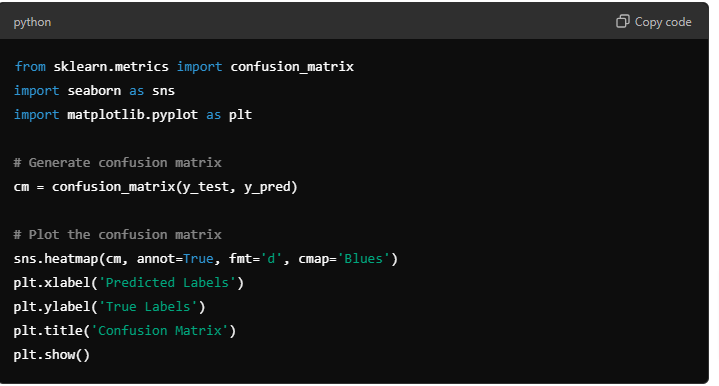
- Choosing appropriate performance metrics (e.g., accuracy, precision, recall, F1 score, ROC-AUC for classification, or R-squared for regression).
- Generating Python code for calculating and visualizing these metrics.
Example Prompt for Regression:
"Can you generate code to evaluate a regression model using R-squared, MSE, RMSE, and MAE?"
Cross-Validation
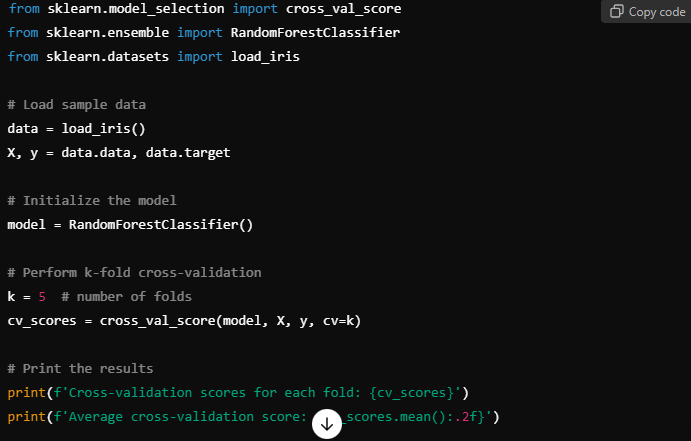
For robust model evaluation, cross-validation is crucial. You can use ChatGPT to:
- Create cross-validation pipelines.
- Evaluate your model's performance using techniques such as k-fold cross-validation or leave-one-out cross-validation.
Example Prompt:
"Can you help me implement k-fold cross-validation in Python for a classification model?"
ChatGPT for Documentation and Reporting
Code Documentation
- Automatically generate docstrings for your functions and classes.
- Provide explanations for complex code segments, making it easier for others to understand.
Report Writing
ChatGPT can generate sections of reports summarizing data analysis results. It can:
- Produce text summaries of findings, key metrics, and visualizations.
- Help write comprehensive project reports, explaining model results and implications.
ChatGPT for Collaboration and Knowledge Sharing
Explaining Concepts to Non-Technical Stakeholders
Data scientists often need to present findings to non-technical stakeholders. ChatGPT can help:
- Translate complex statistical or machine learning concepts into simple, easy-to-understand language.
- Draft concise explanations that make it easier to communicate insights.
Conclusion
Incorporating ChatGPT into your data science workflow can significantly enhance productivity, streamline processes, and foster creativity. By leveraging its capabilities in data exploration, preprocessing, model development, evaluation, and collaboration, data scientists can focus more on analysis and less on repetitive tasks. As AI continues to evolve, tools like ChatGPT will play an increasingly vital role in empowering data scientists to achieve more with less effort. Embrace this innovative technology and take your data science projects to new heights!
