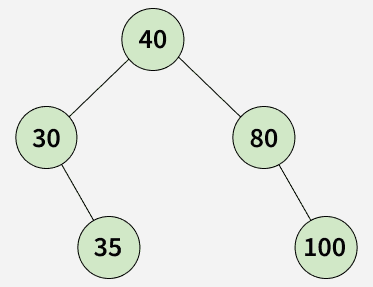
[Naive Approach] One by One Insert - O(n log n) Time O(1) Space
1. Create an empty BST 2. Traverse through the given pre array and one by one insert every item into the BST
C++
#include<bits/stdc++.h>usingnamespacestd;classNode{public:intdata;Node*left,*right;Node(intval){data=val;left=right=nullptr;}};// Function to insert a key into BSTNode*insertBST(Node*root,intkey){Node*newNode=newNode(key);if(root==nullptr)returnnewNode;Node*curr=root;Node*parent=nullptr;while(curr!=nullptr){parent=curr;if(key<curr->data)curr=curr->left;elsecurr=curr->right;}if(key<parent->data)parent->left=newNode;elseparent->right=newNode;returnroot;}// Function to construct BST from preorder traversalNode*preToBST(vector<int>&pre){Node*root=nullptr;// Insert elements one by one into BSTfor(intx:pre){root=insertBST(root,x);}returnroot;}// Driver Codeintmain(){vector<int>pre={40,30,35,80,100};Node*root=preToBST(pre);// Function to print Postorder traversalfunction<void(Node*)>postorder=[&](Node*node){if(node==nullptr)return;postorder(node->left);postorder(node->right);cout<<node->data<<" ";};postorder(root);return0;}
classNode:def__init__(self,val):self.data=valself.left=self.right=NonedefinsertBST(root,key):newNode=Node(key)ifrootisNone:returnnewNodecurr=rootparent=NonewhilecurrisnotNone:parent=currifkey<curr.data:curr=curr.leftelse:curr=curr.rightifkey<parent.data:parent.left=newNodeelse:parent.right=newNodereturnrootdefpreToBST(pre):root=Noneforxinpre:root=insertBST(root,x)returnrootdefpostorder(node):ifnodeisNone:returnpostorder(node.left)postorder(node.right)print(node.data,end=' ')# This ensures main runs only when file is executed directlyif__name__=="__main__":# Driver Codepre=[40,30,35,80,100]root=preToBST(pre)postorder(root)
JavaScript
classNode{constructor(val){this.data=val;this.left=this.right=null;}}functioninsertBST(root,key){constnewNode=newNode(key);if(root===null)returnnewNode;letcurr=root;letparent=null;while(curr!==null){parent=curr;if(key<curr.data)curr=curr.left;elsecurr=curr.right;}if(key<parent.data)parent.left=newNode;elseparent.right=newNode;returnroot;}functionpreToBST(pre){letroot=null;for(constxofpre){root=insertBST(root,x);}returnroot;}// Driver Code{// Input preorder arrayconstpre=[40,30,35,80,100];letroot=preToBST(pre);// Function to print Postorder traversalconstpostorder=(node)=>{if(node===null)return;postorder(node.left);postorder(node.right);console.log(node.data+" ");};postorder(root);}
Output
35 30 100 80 40
[Better Approach] Find First Greater than Root - O(n²)Time O(h) Space
The first element of preorder traversal is always the root.
First construct root using first element.
Then we find the index of the first element which is greater than the root. Let the index be 'i'.
The values between root (lowest index) and 'i' will be part of the left subtree, and the values between 'i'(inclusive) and 'n-1' will be part of the right subtree.
Divide the given pre[] at index "i" and recur for left and right sub-trees.
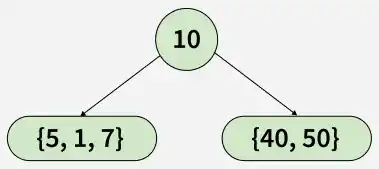
For example in {10, 5, 1, 7, 40, 50}, 10 is the first element, so we make it root. Now we look for the first element greater than 10, we find 40. So we know the structure of BST is as follows.:
We recursively follow the above steps for subarrays {5, 1, 7} and {40, 50}, and get the complete tree.
C++
#include<bits/stdc++.h>usingnamespacestd;classNode{public:intdata;Node*left;Node*right;Node(intx){data=x;left=nullptr;right=nullptr;}};// Helper function to construct BST from preorder// using range [low, high]Node*constructUtil(vector<int>&pre,intlow,inthigh){// Base Case: If range is invalid, return NULLif(low>high)returnnullptr;// Create root node with first element// of current subarrayNode*root=newNode(pre[low]);// If only one element is present,// return the rootif(low==high)returnroot;// Find the first element greater than root// to divide left and right subtreesinti;for(i=low+1;i<=high;i++){if(pre[i]>root->data)break;}// Recursively construct the left subtree// using elements smaller than rootroot->left=constructUtil(pre,low+1,i-1);// Recursively construct the right subtree// using elements greater than rootroot->right=constructUtil(pre,i,high);// Return the constructed rootreturnroot;}// Function to construct BST from preorder traversalNode*preToBST(vector<int>&pre){// Call helper function with full rangereturnconstructUtil(pre,0,pre.size()-1);}// Driver codeintmain(){vector<int>pre={40,30,35,80,100};Node*root=preToBST(pre);// Function to print Postorder traversalfunction<void(Node*)>postOrder=[&](Node*root){if(root==NULL)return;postOrder(root->left);postOrder(root->right);cout<<root->data<<" ";};postOrder(root);return0;}
C
#include<stdio.h>#include<stdlib.h>// Node structurestructNode{intdata;structNode*left;structNode*right;};// Helper function to create new NodestructNode*newNode(intdata){structNode*node=(structNode*)malloc(sizeof(structNode));node->data=data;node->left=NULL;node->right=NULL;returnnode;}// Helper function to construct BST from preorder// using range [low, high]structNode*constructUtil(intpre[],intlow,inthigh){// Base Case: If range is invalid, return NULLif(low>high)returnNULL;// Create root node with first element// of current subarraystructNode*root=newNode(pre[low]);// If only one element is present,// return the rootif(low==high)returnroot;// Find the first element greater than root// to divide left and right subtreesinti;for(i=low+1;i<=high;i++)if(pre[i]>root->data)break;// Recursively construct the left subtree// using elements smaller than rootroot->left=constructUtil(pre,low+1,i-1);// Recursively construct the right subtree// using elements greater than rootroot->right=constructUtil(pre,i,high);// Return the constructed rootreturnroot;}// Function to construct BST from preorder traversalstructNode*preToBST(intpre[],intsize){// Call helper function with full rangereturnconstructUtil(pre,0,size-1);}// Function to print Postorder traversalvoidpostOrder(structNode*root){if(root==NULL)return;postOrder(root->left);postOrder(root->right);printf("%d ",root->data);}// Driver codeintmain(){// Input preorder arrayintpre[]={40,30,35,80,100};intsize=sizeof(pre)/sizeof(pre[0]);structNode*root=preToBST(pre,size);postOrder(root);return0;}
Java
importjava.util.*;classNode{publicintdata;publicNodeleft;publicNoderight;publicNode(intx){data=x;left=null;right=null;}}classGfG{// Helper function to construct BST from preorder// using index range [low, high]publicstaticNodeconstructUtil(int[]pre,intlow,inthigh){// Base case: invalid rangeif(low>high)returnnull;// First element in current range is rootNoderoot=newNode(pre[low]);// If only one element, return nodeif(low==high)returnroot;inti;// Find first element greater than root// This divides left and right subtreefor(i=low+1;i<=high;i++){if(pre[i]>root.data)break;}// Elements smaller than root → left subtreeroot.left=constructUtil(pre,low+1,i-1);// Elements greater than root → right subtreeroot.right=constructUtil(pre,i,high);returnroot;}// Main function to build BST from preorder arraypublicstaticNodepreToBST(int[]pre){// Call helper with full array rangereturnconstructUtil(pre,0,pre.length-1);}// Postorder traversal (Left → Right → Root)publicstaticvoidpostOrder(Noderoot){if(root==null)return;postOrder(root.left);postOrder(root.right);System.out.print(root.data+" ");}// Driver codepublicstaticvoidmain(String[]args){int[]pre={40,30,35,80,100};Noderoot=preToBST(pre);postOrder(root);}}
[Efficient Approach 1] Pass Range in Recursion - O(n) Time O(h) Space
The trick is to set a range {min .. max} for every node.
Initialize range as [-inf, +inf].
Begin with the first element of the preorder traversal, create a node with the given key.
Set the range as [-inf, key] for left subtree and [key, inf] for right subtree.
C++
#include<bits/stdc++.h>usingnamespacestd;classNode{public:intdata;Node*left,*right;Node(intval){data=val;left=right=nullptr;}};// A recursive function to construct BST from pre[].// idx is used to keep track of index in pre[].Node*constructUtil(vector<int>&pre,int&idx,intmin,intmax){if(idx>=pre.size())returnnullptr;intkey=pre[idx];if(key<=min||key>=max)returnnullptr;// If current element of pre[] is in range,// then only it is part of the current subtreeNode*root=newNode(key);idx++;// All nodes in range {min .. key}// go to the left subtreeif(idx<pre.size())root->left=constructUtil(pre,idx,min,key);// All nodes in range {key .. max}// go to the right subtreeif(idx<pre.size())root->right=constructUtil(pre,idx,key,max);returnroot;}// The main function to construct BST from// given preorder traversal.Node*preToBST(vector<int>&pre){intidx=0;returnconstructUtil(pre,idx,INT_MIN,INT_MAX);}voidpostorder(Node*node){if(node==nullptr)return;postorder(node->left);postorder(node->right);cout<<node->data<<" ";}// Driver codeintmain(){vector<int>pre={40,30,35,80,100};Node*root=preToBST(pre);postorder(root);return0;}
C
#include<stdio.h>#include<stdlib.h>#include<limits.h>// Structure of a tree nodestructNode{intdata;structNode*left,*right;};// Function to create a new nodestructNode*newNode(intval){structNode*node=(structNode*)malloc(sizeof(structNode));node->data=val;node->left=node->right=NULL;returnnode;}// A recursive function to construct BST from preorder.// idx is used to keep track of index in preorder array.structNode*constructUtil(intpre[],intsize,int*idx,intmin,intmax){// Base caseif(*idx>=size)returnNULL;intkey=pre[*idx];// If current element is not in range, return NULLif(key<=min||key>=max)returnNULL;// Create root nodestructNode*root=newNode(key);(*idx)++;// Construct left subtreeif(*idx<size)root->left=constructUtil(pre,size,idx,min,key);// Construct right subtreeif(*idx<size)root->right=constructUtil(pre,size,idx,key,max);returnroot;}// Function to construct BST from preorder traversalstructNode*preToBST(intpre[],intsize){intidx=0;returnconstructUtil(pre,size,&idx,INT_MIN,INT_MAX);}// Function to print postorder traversalvoidpostorder(structNode*root){if(root==NULL)return;postorder(root->left);postorder(root->right);printf("%d ",root->data);}// Driver codeintmain(){intpre[]={40,30,35,80,100};intsize=sizeof(pre)/sizeof(pre[0]);structNode*root=preToBST(pre,size);postorder(root);return0;}
Java
importjava.util.*;// Class representing a node of BSTclassNode{intdata;Nodeleft,right;Node(intval){data=val;left=right=null;}}classSolution{// A recursive function to construct BST from preorder// idx is passed as array to simulate pass by referencepublicstaticNodeconstructUtil(int[]pre,int[]idx,intmin,intmax){// Base caseif(idx[0]>=pre.length)returnnull;intkey=pre[idx[0]];// If key is not in valid rangeif(key<=min||key>=max)returnnull;// Create root nodeNoderoot=newNode(key);idx[0]++;// Construct left subtreeif(idx[0]<pre.length)root.left=constructUtil(pre,idx,min,key);// Construct right subtreeif(idx[0]<pre.length)root.right=constructUtil(pre,idx,key,max);returnroot;}// Function to construct BSTpublicstaticNodepreToBST(int[]pre){int[]idx=newint[1];returnconstructUtil(pre,idx,Integer.MIN_VALUE,Integer.MAX_VALUE);}// Function to print postorder traversalpublicstaticvoidpostorder(Noderoot){if(root==null)return;postorder(root.left);postorder(root.right);System.out.print(root.data+" ");}publicstaticvoidmain(String[]args){int[]pre={40,30,35,80,100};Noderoot=preToBST(pre);postorder(root);}}
Python
# Class representing a nodeclassNode:def__init__(self,val):self.data=valself.left=Noneself.right=None# A recursive function to construct BST from preorderdefconstructUtil(pre,idx,min_val,max_val):# Base caseifidx[0]>=len(pre):returnNonekey=pre[idx[0]]# If key is not in rangeifkey<=min_valorkey>=max_val:returnNone# Create root noderoot=Node(key)idx[0]+=1# Construct left subtreeifidx[0]<len(pre):root.left=constructUtil(pre,idx,min_val,key)# Construct right subtreeifidx[0]<len(pre):root.right=constructUtil(pre,idx,key,max_val)returnroot# Function to construct BSTdefpreToBST(pre):idx=[0]returnconstructUtil(pre,idx,float('-inf'),float('inf'))# Function to print postorder traversaldefpostorder(root):ifnotroot:returnpostorder(root.left)postorder(root.right)print(root.data,end=" ")# Driver codepre=[40,30,35,80,100]root=preToBST(pre)postorder(root)
C#
usingSystem;// Class representing a nodeclassNode{publicintdata;publicNodeleft,right;publicNode(intval){data=val;left=right=null;}}classProgram{// Recursive function to construct BSTstaticNodeconstructUtil(int[]pre,refintidx,intmin,intmax){// Base caseif(idx>=pre.Length)returnnull;intkey=pre[idx];// If not in rangeif(key<=min||key>=max)returnnull;// Create nodeNoderoot=newNode(key);idx++;// Construct left subtreeif(idx<pre.Length)root.left=constructUtil(pre,refidx,min,key);// Construct right subtreeif(idx<pre.Length)root.right=constructUtil(pre,refidx,key,max);returnroot;}// Function to construct BSTstaticNodepreToBST(int[]pre){intidx=0;returnconstructUtil(pre,refidx,int.MinValue,int.MaxValue);}// Postorder traversalstaticvoidpostorder(Noderoot){if(root==null)return;postorder(root.left);postorder(root.right);Console.Write(root.data+" ");}staticvoidMain(){int[]pre={40,30,35,80,100};Noderoot=preToBST(pre);postorder(root);}}
JavaScript
// Class representing a nodeclassNode{constructor(val){this.data=val;this.left=null;this.right=null;}}// Recursive function to construct BSTfunctionconstructUtil(pre,idx,min,max){// Base caseif(idx.value>=pre.length)returnnull;letkey=pre[idx.value];// If not in rangeif(key<=min||key>=max)returnnull;// Create nodeletroot=newNode(key);idx.value++;// Construct left subtreeif(idx.value<pre.length)root.left=constructUtil(pre,idx,min,key);// Construct right subtreeif(idx.value<pre.length)root.right=constructUtil(pre,idx,key,max);returnroot;}// Function to construct BSTfunctionpreToBST(pre){letidx={value:0};returnconstructUtil(pre,idx,-Infinity,Infinity);}// Postorder traversalfunctionpostorder(root){if(!root)return;postorder(root.left);postorder(root.right);console.log(root.data+" ");}// Driver codeletpre=[40,30,35,80,100];letroot=preToBST(pre);postorder(root);
Output
35 30 100 80 40
[Expected Approach - 2] Using Stack - O(n) Time O(h) Space
The Idea is that the first element of preorder traversal is always the root. We create the root node and push it into a stack. The stack is used to keep track of nodes whose right child is not yet assigned.
Now for every next element in preorder:
If the current value is less than the top of stack, it means it belongs to the left subtree, so we attach it as the left child of the stack’s top node.
If the current value is greater than the top of stack, we keep popping from the stack until we find a node smaller than the current value. The last popped node becomes the parent, and we attach the current node as its right child.
We push the current element into the stack.
C++
#include<bits/stdc++.h>usingnamespacestd;// Class definition for a tree nodeclassNode{public:intdata;Node*left;Node*right;Node(intval){data=val;left=nullptr;right=nullptr;}};Node*preToBST(vector<int>&pre){intn=pre.size();// Stack to keep track of ancestorsstack<Node*>st;// First element is rootNode*root=newNode(pre[0]);st.push(root);// Process remaining elementsfor(inti=1;i<n;i++){// To store last popped nodeNode*temp=nullptr;// Find correct parent by popping smaller elementswhile(!st.empty()&&pre[i]>st.top()->data){temp=st.top();st.pop();}// If popped, attach as right childif(temp!=nullptr){temp->right=newNode(pre[i]);st.push(temp->right);}else{// Else attach as left childst.top()->left=newNode(pre[i]);st.push(st.top()->left);}}returnroot;}voidpostorder(Node*root){if(!root)return;postorder(root->left);postorder(root->right);cout<<root->data<<" ";}// Driver codeintmain(){vector<int>arr={40,30,35,80,100};Node*root=preToBST(arr);postorder(root);return0;}
C
#include<stdio.h>#include<stdlib.h>#include<stdbool.h>// Class definition for a tree nodetypedefstructNode{intdata;structNode*left;structNode*right;}Node;// Constructor to initialize nodeNode*newNode(intval){Node*node=(Node*)malloc(sizeof(Node));node->data=val;node->left=NULL;node->right=NULL;returnnode;}Node*preToBST(intpre[],intn){// Stack to keep track of ancestorsNode**st=(Node**)malloc(n*sizeof(Node*));inttop=-1;// First element is rootNode*root=newNode(pre[0]);st[++top]=root;// Process remaining elementsfor(inti=1;i<n;i++){Node*temp=NULL;// Find correct parent by popping smaller elementswhile(top>=0&&pre[i]>st[top]->data){temp=st[top--];}// If popped, attach as right childif(temp!=NULL){temp->right=newNode(pre[i]);st[++top]=temp->right;}else{// Else attach as left childst[top]->left=newNode(pre[i]);st[++top]=st[top]->left;}}free(st);returnroot;}voidpostorder(Node*root){if(!root)return;postorder(root->left);postorder(root->right);printf("%d ",root->data);}// Driver codeintmain(){intarr[]={40,30,35,80,100};intn=sizeof(arr)/sizeof(arr[0]);Node*root=preToBST(arr,n);postorder(root);return0;}
Java
importjava.util.Stack;// Class definition for a tree nodeclassNode{publicintdata;publicNodeleft;publicNoderight;publicNode(intval){data=val;left=null;right=null;}}publicclassGFG{publicstaticNodepreToBST(int[]pre){intn=pre.length;// Stack to keep track of ancestorsStack<Node>st=newStack<>();// First element is rootNoderoot=newNode(pre[0]);st.push(root);// Process remaining elementsfor(inti=1;i<n;i++){Nodetemp=null;// Find correct parent by popping smaller elementswhile(!st.isEmpty()&&pre[i]>st.peek().data){temp=st.pop();}// If popped, attach as right childif(temp!=null){temp.right=newNode(pre[i]);st.push(temp.right);}else{// Else attach as left childst.peek().left=newNode(pre[i]);st.push(st.peek().left);}}returnroot;}publicstaticvoidpostorder(Noderoot){if(root==null)return;postorder(root.left);postorder(root.right);System.out.print(root.data+" ");}publicstaticvoidmain(String[]args){int[]arr={40,30,35,80,100};Noderoot=preToBST(arr);postorder(root);}}
usingSystem;usingSystem.Collections.Generic;// Class definition for a tree nodepublicclassNode{publicintdata;publicNodeleft;publicNoderight;publicNode(intval){data=val;left=null;right=null;}}publicclassGfG{publicstaticNodepreToBST(int[]pre){intn=pre.Length;// Stack to keep track of ancestorsStack<Node>st=newStack<Node>();// First element is rootNoderoot=newNode(pre[0]);st.Push(root);// Process remaining elementsfor(inti=1;i<n;i++){// To store last popped nodeNodetemp=null;// Find correct parent by popping smaller elementswhile(st.Count>0&&pre[i]>st.Peek().data){temp=st.Pop();}// If popped, attach as right childif(temp!=null){temp.right=newNode(pre[i]);st.Push(temp.right);}else{// Else attach as left childst.Peek().left=newNode(pre[i]);st.Push(st.Peek().left);}}returnroot;}publicstaticvoidpostorder(Noderoot){if(root==null)return;postorder(root.left);postorder(root.right);Console.Write(root.data+" ");}// Driver codepublicstaticvoidMain(string[]args){int[]arr={40,30,35,80,100};Noderoot=preToBST(arr);postorder(root);}}
JavaScript
// Class definition for a tree nodeclassNode{constructor(val){this.data=val;this.left=null;this.right=null;}}functionpreToBST(pre){letn=pre.length;// Stack to keep track of ancestorsletst=[];// First element is rootletroot=newNode(pre[0]);st.push(root);// Process remaining elementsfor(leti=1;i<n;i++){// To store last popped nodelettemp=null;// Find correct parent by popping smaller elementswhile(st.length>0&&pre[i]>st[st.length-1].data){temp=st.pop();}// If popped, attach as right childif(temp!==null){temp.right=newNode(pre[i]);st.push(temp.right);}else{// Else attach as left childst[st.length-1].left=newNode(pre[i]);st.push(st[st.length-1].left);}}returnroot;}functionpostorder(root){if(!root)return;postorder(root.left);postorder(root.right);console.log(root.data+" ");}// Driver codeletarr=[40,30,35,80,100];letroot=preToBST(arr);postorder(root);