

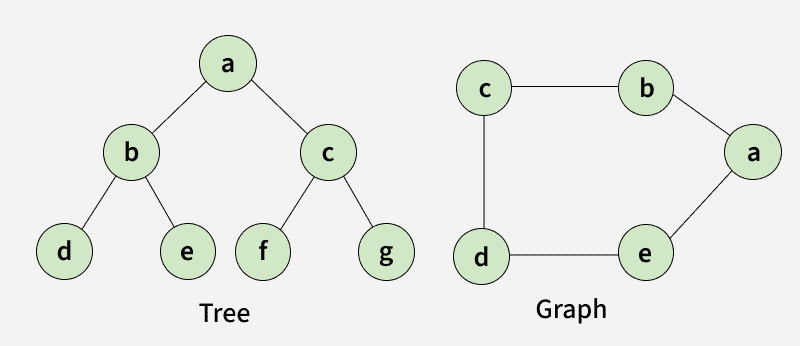
A tree is a special type of undirected graph that is connected and contains no cycles. A tree with V vertices has exactly V - 1 edges.
A general graph does not necessarily follow these restrictions. It may contain cycles, multiple connected components, or other structures, depending on its type.
- Graphs are used to model a wide variety of real-world systems, such as social networks, transportation networks, and computer networks.
- Trees are often used to represent hierarchical data, such as file systems, XML documents, and organizational charts.
| Feature | Graph | Tree |
|---|---|---|
| Definition | A collection of nodes (vertices) and edges, where edges connect nodes. | A hierarchical data structure consisting of nodes connected by edges with a single root node. |
| Structure | Can have cycles (loops) and disconnected components. | No cycles; connected structure with exactly one path between any two nodes. |
| Root Node | No root node; nodes may have multiple parents or no parents at all. | Has a designated root node that has no parent. |
| Node Relationship | Relationships between nodes are arbitrary. | Parent-child relationship; each node (except the root) has exactly one parent. |
| Edges | Each node can have any number of edges. | If there are n nodes then there would be n-1 number of edges |
| Traversal Complexity | Traversal can be complex due to cycles and disconnected components. | Traversal is straightforward. |
| Application | Used in various scenarios like social networks, maps, network optimization, etc. | Commonly used for hierarchical data representation like file systems, organization charts, HTML DOM, XML documents, etc. |
| Examples | Social networks, road networks, computer networks. | File systems, family trees, HTML DOM structure. |
