

Given an unsorted array arr[] of size n, containing elements from the range 1 to n, it is known that one number in this range is missing, and another number occurs twice in the array, find both the duplicate number and the missing number.
Examples:
Input: arr[] = [3, 1, 3]
Output: [3, 2]
Explanation: 3 is occurs twice and 2 is missing.Input: arr[] = [4, 3, 6, 2, 1, 1]
Output: [1, 5]
Explanation: 1 is occurs twice and 5 is missing.

Table of Content
Frequency Array - O(n) Time and O(n) Space
- Use a frequency array of size n+1 to keep track of how many times each number appears.
- Since each number exactly once,, any number appearing twice is the repeating number.
- Any number with zero frequency is the missing number.
#include <iostream>
#include <vector>
using namespace std;

vector<int> findTwoElement(vector<int>& arr) {

    int n = arr.size();

    // frequency array to count occurrences
    vector<int> freq(n + 1, 0);
    int repeating = -1, missing = -1;

    // count frequency of each element
    for (int i = 0; i < n; i++) {
        freq[arr[i]]++;
    }

    // identify repeating and missing elements
    for (int i = 1; i <= n; i++) {
        if (freq[i] == 0) missing = i;
        else if (freq[i] == 2) repeating = i;
    }

    return {repeating, missing};
}

int main() {
    vector<int> arr = {3, 1, 3};
    vector<int> ans = findTwoElement(arr);
    cout << ans[0] << " " << ans[1] << endl;
    return 0;
}
import java.util.ArrayList;

class GfG {

    static ArrayList<Integer> findTwoElement(int[] arr) {
        int n = arr.length;

        // frequency array to count occurrences
        int[] freq = new int[n + 1];
        int repeating = -1;
        int missing = -1;

        // count frequency of each element
        for (int i = 0; i < n; i++) {
            freq[arr[i]]++;
        }

        // identify missing and repeating numbers
        for (int i = 1; i <= n; i++) {
            if (freq[i] == 0) missing = i;
            else if (freq[i] == 2) repeating = i;
        }

        ArrayList<Integer> result = new ArrayList<>();
        result.add(repeating);
        result.add(missing);
        return result;
    }

    public static void main(String[] args) {
        int[] arr = {3, 1, 3};
        ArrayList<Integer> ans = findTwoElement(arr);

        System.out.println(ans.get(0) + " " + ans.get(1));
    }
}
def findTwoElement(arr):
    n = len(arr)

    # frequency array to count occurrences
    freq = [0] * (n + 1)
    repeating = -1
    missing = -1

    # count frequency of each element
    for num in arr:
        freq[num] += 1

    # identify missing and repeating numbers
    for i in range(1, n + 1):
        if freq[i] == 0:
            missing = i
        elif freq[i] == 2:
            repeating = i

    return [repeating, missing]

if __name__ == "__main__":
    arr = [3, 1, 3]
    ans = findTwoElement(arr)
    print(ans[0], ans[1])
using System;
using System.Collections.Generic;

class GfG {

    static List<int> findTwoElement(int[] arr) {
        int n = arr.Length;

        // frequency array to count occurrences
        int[] freq = new int[n + 1];
        int repeating = -1, missing = -1;

        // count frequency of each element
        for (int i = 0; i < n; i++) {
            freq[arr[i]]++;
        }

        // identify missing and repeating numbers
        for (int i = 1; i <= n; i++) {
            if (freq[i] == 0) missing = i;
            else if (freq[i] == 2) repeating = i;
        }

        return new List<int> { repeating, missing };
    }

    static void Main() {
        int[] arr = {3, 1, 3};
        List<int> ans = findTwoElement(arr);

        Console.WriteLine(ans[0] + " " + ans[1]);
    }
}
function findTwoElement(arr) {
    let n = arr.length;

    // frequency array to count occurrences
    let freq = new Array(n + 1).fill(0);
    let repeating = -1, missing = -1;

    // count frequency of each element
    for (let i = 0; i < n; i++) {
        freq[arr[i]]++;
    }

    // identify missing and repeating numbers
    for (let i = 1; i <= n; i++) {
        if (freq[i] === 0) missing = i;
        else if (freq[i] === 2) repeating = i;
    }

    return [repeating, missing];
}

// Driver Code
let arr = [3, 1, 3];
let ans = findTwoElement(arr);
console.log(ans[0], ans[1]);
Output
3 2
Array Marking - O(n) Time and O(1) Space
- Use the input array itself to track whether each number has been visited by negating the value at its corresponding index.
- If a value is already negated when encountered again, that number is the repeating number.
- In a second pass, the index whose value remains positive corresponds to the missing number.
#include <iostream>
#include <vector>
using namespace std;

vector<int> findTwoElement(vector<int>& arr) {
    int n = arr.size();
    int repeating = -1;

    // mark visited indices by negating the value at
    // that index
    for (int i = 0; i < n; i++) {
        int val = abs(arr[i]);

        if (arr[val - 1] > 0) {
            arr[val - 1] = -arr[val - 1];
        } else {
            // found the repeating element
            repeating = val;
        }
    }

    int missing = -1;

    // the index with a positive value is the
    // missing number
    for (int i = 0; i < n; i++) {
        if (arr[i] > 0) {
            missing = i + 1;
            break;
        }
    }

    return {repeating, missing};
}

int main() {
    vector<int> arr = {3, 1, 3};
    vector<int> ans = findTwoElement(arr);

    cout << ans[0] << " " << ans[1] << endl;
    return 0;
}
import java.util.ArrayList;

class GfG {

    static ArrayList<Integer> findTwoElement(int[] arr) {
        int n = arr.length;
        int repeating = -1;

        // traverse the array and mark visited indices
        // by negating the value at index arr[i] - 1
        for (int i = 0; i < n; i++) {
            int val = Math.abs(arr[i]);

            // if the value at index val - 1 is already negative
            // it means we've seen this value before
            if (arr[val - 1] > 0) {
                arr[val - 1] = -arr[val - 1];
            } else {
                // if it's already negative, this value is
                // the repeating one
                repeating = val;
            }
        }

        int missing = -1;

        // after marking, the index with a positive value
        // corresponds to the missing number
        for (int i = 0; i < n; i++) {
            if (arr[i] > 0) {
                missing = i + 1;
                break;
            }
        }

        // return result: first repeating, then missing
        ArrayList<Integer> result = new ArrayList<>();
        result.add(repeating);
        result.add(missing);
        return result;
    }

    public static void main(String[] args) {
        int[] arr = {3, 1, 3};
        ArrayList<Integer> ans = findTwoElement(arr);

        System.out.println(ans.get(0) + " " + ans.get(1));
    }
}
def findTwoElement(arr):
    n = len(arr)
    repeating = -1

    # mark visited indices by negating the value
    # at that index
    for i in range(n):
        val = abs(arr[i])

        # if value at index val - 1 is already negative,
        # val is repeating
        if arr[val - 1] > 0:
            arr[val - 1] = -arr[val - 1]
        else:
            # Already visited → repeating element
            repeating = val

    missing = -1

    # the index with a positive value corresponds
    # to the missing number
    for i in range(n):
        if arr[i] > 0:
            missing = i + 1
            break

    return [repeating, missing]

if __name__ == "__main__":
    arr = [3, 1, 3]
    ans = findTwoElement(arr)
    print(ans[0], ans[1])
using System;
using System.Collections.Generic;

class GfG {

    static List<int> findTwoElement(int[] arr) {
        int n = arr.Length;
        int repeating = -1;

        // Mark visited indices by negating the
        // value at that index
        for (int i = 0; i < n; i++) {
            int val = Math.Abs(arr[i]);

            // If already negative, this value is repeating
            if (arr[val - 1] > 0) {
                arr[val - 1] = -arr[val - 1];
            }
            else {
                // Repeated element found
                repeating = val;
            }
        }

        int missing = -1;

        // the index with a positive value corresponds
        // to the missing number
        for (int i = 0; i < n; i++) {
            if (arr[i] > 0) {
                missing = i + 1;
                break;
            }
        }

        return new List<int> { repeating, missing };
    }

    static void Main() {
        int[] arr = {3, 1, 3};
        List<int> ans = findTwoElement(arr);

        Console.WriteLine(ans[0] + " " + ans[1]);
    }
}
function findTwoElement(arr) {
    let n = arr.length;
    let repeating = -1;

    // Mark visited indices by negating the value
    // at the target index
    for (let i = 0; i < n; i++) {
        let val = Math.abs(arr[i]);

        // If already negative, the number is repeating
        if (arr[val - 1] > 0) {
            arr[val - 1] = -arr[val - 1];
        } else {
            repeating = val;
        }
    }

    let missing = -1;

    // The index with a positive value corresponds
    // to the missing number
    for (let i = 0; i < n; i++) {
        if (arr[i] > 0) {
            missing = i + 1;
            break;
        }
    }

    return [repeating, missing];
}

// Driver Code
let arr = [3, 1, 3];
let ans = findTwoElement(arr);
console.log(ans[0], ans[1]);
Output
3 2
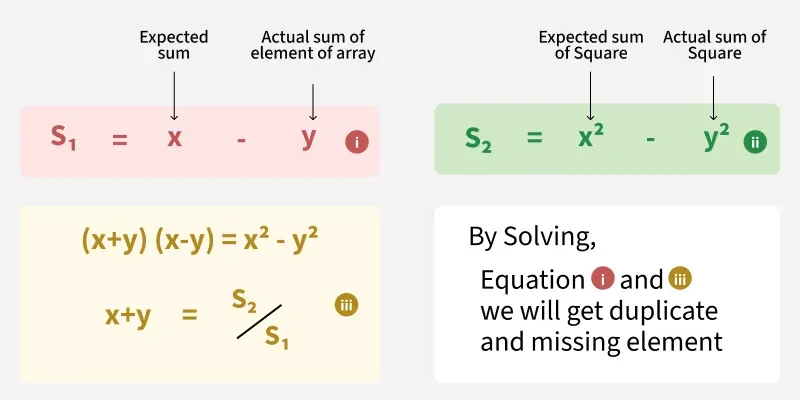
Making Two Equations - O(n) Time and O(1) Space
- Use mathematical equations based on the sum and sum of squares of numbers from 1 to n.
- The difference between the expected and actual sums gives one equation, while the difference between the expected and actual sum of squares gives another.
- Solving these two equations gives the missing and repeating numbers.
Illustration:
Note: This method can cause arithmetic overflow as we calculate the sum of squares (or product) and sum of all array elements.
#include <iostream>
#include <vector>
using namespace std;

vector<int> findTwoElement(vector<int>& arr) {
    long long n = arr.size();

    // Sum of first n natural numbers
    long long s = (n * (n + 1)) / 2;
    // Sum of squares of first n natural numbers
    long long ssq = (n * (n + 1) * (2 * n + 1)) / 6;

    // Subtract actual values from expected sums
    for (int i = 0; i < n; i++) {
        s -= arr[i];
        ssq -= 1LL * arr[i] * arr[i];
    }

    // Using the equations: missing - repeating = s
    // missing^2 - repeating^2 = ssq
    long long missing = (s + ssq / s) / 2;
    long long repeating = missing - s;

    return {(int)repeating, (int)missing};
}

int main() {
    vector<int> arr = {3, 1, 3};
    vector<int> ans = findTwoElement(arr);

    cout << ans[0] << " " << ans[1] << endl;
    return 0;
}
import java.util.ArrayList;

class GfG {
    static ArrayList<Integer> findTwoElement(int[] arr) {
        long n = arr.length;

        // Expected sum and sum of squares for numbers from 1 to n
        long s = (n * (n + 1)) / 2;
        long ssq = (n * (n + 1) * (2 * n + 1)) / 6;

        long missing = 0, repeating = 0;

        // Subtract actual values from expected sums
        for (int i = 0; i < n; i++) {
            s -= arr[i];
            ssq -= (long) arr[i] * arr[i];
        }

        // Let x = missing, y = repeating
        // s = x - y
        // ssq = x^2 - y^2 = (x - y)(x + y) = s * (x + y)
        // => x + y = ssq / s
        // => x = (s + ssq / s) / 2
        // => y = x - s
        missing = (s + ssq / s) / 2;
        repeating = missing - s;

        ArrayList<Integer> res = new ArrayList<>();
        res.add((int) repeating);
        res.add((int) missing);
        return res;
    }

    public static void main(String[] args) {
        int[] arr = {3, 1, 3};
        ArrayList<Integer> ans = findTwoElement(arr);

        System.out.println(ans.get(0) + " " + ans.get(1));
    }
}
def findTwoElement(arr):
    n = len(arr)

    # Expected sum and sum of squares for numbers from 1 to n
    s = (n * (n + 1)) // 2
    ssq = (n * (n + 1) * (2 * n + 1)) // 6

    missing = 0
    repeating = 0

    # Subtract actual sum and sum of squares from expected values
    for num in arr:
        s -= num
        ssq -= num * num

    # Let s = x - y and ssq = x^2 - y^2 = (x - y)(x + y)
    # => x = (s + ssq // s) // 2, y = x - s
    missing = (s + ssq // s) // 2
    repeating = missing - s

    return [repeating, missing]

if __name__ == "__main__":
    arr = [3, 1, 3]
    ans = findTwoElement(arr)

    print(ans[0], ans[1])
using System;
using System.Collections.Generic;

class GfG {
    static List<int> findTwoElement(int[] arr) {
        long n = arr.Length;

        // Expected sum and sum of squares from 1 to n
        long s = (n * (n + 1)) / 2;
        long ssq = (n * (n + 1) * (2 * n + 1)) / 6;

        long missing = 0, repeating = 0;

        // Subtract actual values from expected ones
        for (int i = 0; i < n; i++) {
            s -= arr[i];
            ssq -= (long)arr[i] * arr[i];
        }

        // Let s = x - y, ssq = x^2 - y^2 = (x - y)(x + y)
        // => x = (s + ssq / s) / 2, y = x - s
        missing = (s + ssq / s) / 2;
        repeating = missing - s;

        return new List<int> { (int)repeating, (int)missing };
    }

    static void Main() {
        int[] arr = { 3, 1, 3 };
        List<int> ans = findTwoElement(arr);

        Console.WriteLine(ans[0] + " " + ans[1]);
    }
}
function findTwoElement(arr) {
    let n = BigInt(arr.length);

    // Expected sum and sum of squares from 1 to n
    let s = (n * (n + 1n)) / 2n;
    let ssq = (n * (n + 1n) * (2n * n + 1n)) / 6n;

    let missing = 0n, repeating = 0n;

    // Subtract actual values from the expected ones
    for (let i = 0; i < Number(n); i++) {
        let ele = BigInt(arr[i]);
        s -= ele;
        ssq -= ele * ele;
    }

    // Let s = x - y, ssq = x^2 - y^2 = (x - y)(x + y)
    // Solve: x = (s + ssq / s) / 2, y = x - s
    missing = (s + ssq / s) / 2n;
    repeating = missing - s;

    return [Number(repeating), Number(missing)];
}


// Driver Code
let arr = [3, 1, 3];
let ans = findTwoElement(arr);
console.log(ans[0], ans[1]);
Output
3 2
An Alternate way to make two equations:
- Let x be the missing and y be the repeating element.
- Get the sum of all numbers using formula S = n(n+1)/2 - x + y
- Get product of all numbers using formula P = 1*2*3*...*n * y / x
- The above two steps give us two equations, we can solve the equations and get the values of x and y.
XOR - O(n) Time and O(1) Space
The idea is to use XOR operations to isolate the missing and repeating numbers.
- XOR all array elements with numbers from
1ton.- The non-repeating elements cancel out, leaving
X ⊕ Y, whereXandYare the missing and repeating numbers.- Use any set bit in
X ⊕ Yto divide the numbers into two groups. A set bit meansXandYhave different bits at that position.- XOR the elements in each group to find the missing and repeating numbers.
Illustration :
Given array: [3, 1, 3]
Step 1: Find X ⊕ Y
• XOR all array elements with numbers from 1 to n, where n = 3.
• 3 ^ 1 ^ 3 ^ 1 ^ 2 ^ 3 = 1
Step 2: Find the rightmost set bit
• 1 = 001, so the rightmost set bit is the last bit.
• Group 1 (bit set): [3, 1, 3, 1, 3]
• Group 2 (bit not set): [2]
Step 3: XOR both groups
• Group 1: 3 ^ 1 ^ 3 ^ 1 ^ 3 = 3
• Group 2: 2 = 2
• Therefore, the two numbers obtained are 3 and 2.
Step 4: Identify the duplicate and missing number
• 3 occurs twice in the array, so it is the duplicate.
• 2 does not occur in the array, so it is the missing number.
Final Answer: [3, 2]
#include <iostream>
#include <vector>
using namespace std;

vector<int> findTwoElement(vector<int>& arr) {
    int n = arr.size();
    int xorVal = 0;

    // get the xor of all array elements
    // and numbers from 1 to n
    for (int i = 0; i < n; i++) {
        xorVal ^= arr[i];
        xorVal ^= (i + 1);  // 1 to n numbers
    }

    // get the rightmost set bit in xorVal
    int setBitIndex = xorVal & ~(xorVal - 1);

    int x = 0, y = 0;

    // now divide elements into two sets
    // by comparing rightmost set bit
    for (int i = 0; i < n; i++) {

        // decide whether arr[i] is in first set
        // or second
        if (arr[i] & setBitIndex) {
            x ^= arr[i];
        }
        else {
            y ^= arr[i];
        }

        // decide whether (i+1) is in first set
        // or second
        if ((i+1) & setBitIndex) {
            x ^= (i + 1);
        }
        else {
            y ^= (i + 1);
        }
    }

    // x and y are the repeating and missing values.
    // to know which one is what, traverse the array
    int missing, repeating;

    int xCnt = 0;
    for (int i=0; i<n; i++) {
        if (arr[i] == x) {
            xCnt++;
        }
    }

    if (xCnt == 0) {
        missing = x;
        repeating = y;
    }
    else {
        missing = y;
        repeating = x;
    }

    return {repeating, missing};
}

int main() {
    vector<int> arr = {3, 1, 3};
    vector<int> ans = findTwoElement(arr);

    cout << ans[0] << " " << ans[1] << endl;
    return 0;
}
import java.util.ArrayList;

class GfG {

    static ArrayList<Integer> findTwoElement(int[] arr) {
        int n = arr.length;
        int xorVal = 0;

        // get the xor of all array elements
        // And numbers from 1 to n
        for (int i = 0; i < n; i++) {
            xorVal ^= arr[i];
            xorVal ^= (i + 1);  // 1 to n numbers
        }

        // get the rightmost set bit in xorVal
        int setBitIndex = xorVal & ~(xorVal - 1);

        int x = 0, y = 0;

        // now divide elements into two sets
        // by comparing rightmost set bit
        for (int i = 0; i < n; i++) {

            // decide whether arr[i] is in first set
            // or second
            if ((arr[i] & setBitIndex) != 0) {
                x ^= arr[i];
            }
            else {
                y ^= arr[i];
            }

            // decide whether (i+1) is in first set
            // or second
            if (((i + 1) & setBitIndex) != 0) {
                x ^= (i + 1);
            }
            else {
                y ^= (i + 1);
            }
        }

        // x and y are the repeating and missing values.
        // to know which one is what, traverse the array
        int missing, repeating;

        int xCnt = 0;
        for (int i = 0; i < n; i++) {
            if (arr[i] == x) {
                xCnt++;
            }
        }

        if (xCnt == 0) {
            missing = x;
            repeating = y;
        }
        else {
            missing = y;
            repeating = x;
        }

        ArrayList<Integer> result = new ArrayList<>();
        result.add(repeating);
        result.add(missing);
        return result;
    }

    public static void main(String[] args) {
        int[] arr = {3, 1, 3};
        ArrayList<Integer> ans = findTwoElement(arr);

        System.out.println(ans.get(0) +" "+ ans.get(1));
    }
}
def findTwoElement(arr):
    n = len(arr)
    xorVal = 0

    # get the xor of all array elements
    # And numbers from 1 to n
    for i in range(n):
        xorVal ^= arr[i]
        xorVal ^= (i + 1)  # 1 to n numbers

    # get the rightmost set bit in xorVal
    setBitIndex = xorVal & ~(xorVal - 1)

    x, y = 0, 0

    # now divide elements into two sets
    # by comparing rightmost set bit
    for i in range(n):

        # decide whether arr[i] is in first set
        # or second
        if arr[i] & setBitIndex:
            x ^= arr[i]
        else:
            y ^= arr[i]

        # decide whether (i+1) is in first set
        # or second
        if (i + 1) & setBitIndex:
            x ^= (i + 1)
        else:
            y ^= (i + 1)

    # x and y are the repeating and missing values.
    # to know which one is what, traverse the array
    xCnt = sum(1 for num in arr if num == x)

    if xCnt == 0:
        missing, repeating = x, y
    else:
        missing, repeating = y, x

    return [repeating, missing]

if __name__ == "__main__":
    arr = [3, 1, 3]
    ans = findTwoElement(arr)

    print(ans[0], ans[1])
using System;
using System.Collections.Generic;

class GfG {

    static List<int> findTwoElement(int[] arr) {
        int n = arr.Length;
        int xorVal = 0;

        // get the xor of all array elements
        // And numbers from 1 to n
        for (int i = 0; i < n; i++) {
            xorVal ^= arr[i];
            xorVal ^= (i + 1);  // 1 to n numbers
        }

        // get the rightmost set bit in xorVal
        int setBitIndex = xorVal & ~(xorVal - 1);

        int x = 0, y = 0;

        // now divide elements into two sets
        // by comparing rightmost set bit
        for (int i = 0; i < n; i++) {

            // decide whether arr[i] is in first set
            // or second
            if ((arr[i] & setBitIndex) != 0) {
                x ^= arr[i];
            }
            else {
                y ^= arr[i];
            }

            // decide whether (i+1) is in first set
            // or second
            if (((i + 1) & setBitIndex) != 0) {
                x ^= (i + 1);
            }
            else {
                y ^= (i + 1);
            }
        }

        // x and y are the repeating and missing values.
        // to know which one is what, traverse the array
        int missing, repeating;

        int xCnt = 0;
        for (int i = 0; i < n; i++) {
            if (arr[i] == x) {
                xCnt++;
            }
        }

        if (xCnt == 0) {
            missing = x;
            repeating = y;
        }
        else {
            missing = y;
            repeating = x;
        }

        return new List<int> { repeating, missing };
    }

    static void Main() {
        int[] arr = {3, 1, 3};
        List<int> ans = findTwoElement(arr);

        Console.WriteLine(ans[0] + " " + ans[1]);
    }
}
function findTwoElement(arr) {
    let n = arr.length;
    let xorVal = 0;

    // Get the xor of all array elements
    // And numbers from 1 to n
    for (let i = 0; i < n; i++) {
        xorVal ^= arr[i];
        xorVal ^= (i + 1);  // 1 to n numbers
    }

    // Get the rightmost set bit in xorVal
    let setBitIndex = xorVal & ~(xorVal - 1);

    let x = 0, y = 0;

    // Now divide elements into two sets
    // by comparing rightmost set bit
    for (let i = 0; i < n; i++) {

        // Decide whether arr[i] is in first set
        // or second
        if (arr[i] & setBitIndex) {
            x ^= arr[i];
        }
        else {
            y ^= arr[i];
        }

        // Decide whether (i+1) is in first set
        // or second
        if ((i + 1) & setBitIndex) {
            x ^= (i + 1);
        }
        else {
            y ^= (i + 1);
        }
    }

    let xCnt = arr.filter(num => num === x).length;

    let missing = xCnt === 0 ? x : y;
    let repeating = xCnt === 0 ? y : x;

    return [repeating, missing];
}

// Driver Code
let arr = [3, 1, 3];
let ans = findTwoElement(arr);
console.log(ans[0], ans[1]);
Output
3 2
