

A function is a block of code that performs a specific task and can be reused whenever needed.
- Avoids writing the same code again and again.
- Makes programs simple and easy to understand by breaking into smaller parts.
- Accepts input (parameters) and gives output.
- Finding and fixing errors become easier.
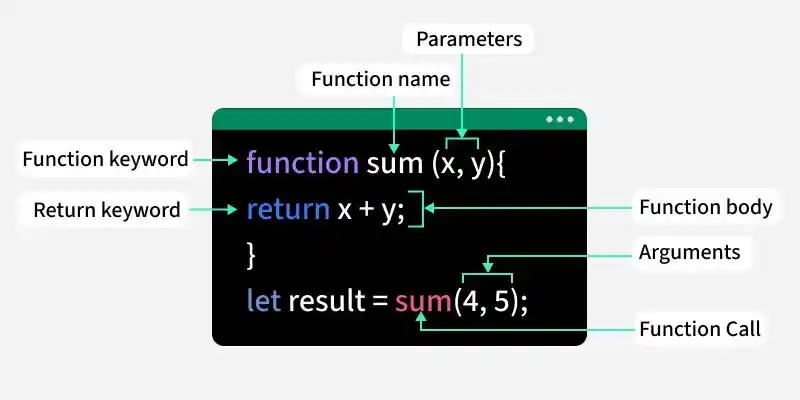
Built-in functions
- These are predefined functions provided by programming languages or libraries to perform common tasks such as mathematical calculations, input/output, or string operations.
- For example, the sqrt() function from the C++ <cmath> library calculates the square root of a number.
#include <iostream>
#include <cmath>
using namespace std;

int main() {

    // built-in function
    double result = sqrt(25.0);
    cout << "Square Root: " << result << endl;
    return 0;
}
#include <math.h>
#include <stdio.h>

int main()
{
    // built-in function
    double result = sqrt(25.0);
    printf("Square Root: %.2lf\n", result);
    return 0;
}
import java.lang.Math;

public class GFG {
    public static void main(String[] args)
    {
        // built-in function
        double result = Math.sqrt(25.0);
        System.out.println("Square Root: " + result);
    }
}
import math

# built-in function
result = math.sqrt(25.0)
print("Square Root:", result)
using System;

class GFG {
    static void Main()
    {
        // built-in function
        double result = Math.Sqrt(25.0);
        Console.WriteLine("Square Root: " + result);
    }
}
// built-in function
let result = Math.sqrt(25.0);
console.log("Square Root: " + result);
Output
Square Root: 5
User-defined functions
- These functions are functions written by programmers to perform specific tasks required in a program.
- They help organize code and allow reuse of logic whenever needed.
#include <iostream>
using namespace std;

void greet() {
    cout << "Hello, World!" << endl;
}

int main() {
    greet();  // calling user-defined function
    return 0;
}
#include <stdio.h>

void greet()
{
    printf("Hello, World!\n");
}

int main()
{
    greet(); // calling user-defined function
    return 0;
}
public class GFG {
    public static void greet()
    {
        System.out.println("Hello, World!");
    }

    public static void main(String[] args)
    {
        greet(); // calling user-defined function
    }
}
def greet():
    print("Hello, World!")

if __name__ == "__main__":
    # Calling user-defined function.
    greet()
using System;

class GFG {
    static void greet()
    {
        Console.WriteLine("Hello, World!");
    }

    static void Main()
    {
        greet(); // calling user-defined function
    }
}
function greet() {
    console.log('Hello, World!');
}

// calling user-defined function
greet();
Output
Hello, World!
Function Visualizer
Where are Functions Used in DSA?
In DSA, functions are used to implement algorithms and solve problems in a structured and reusable way.
- Implement algorithms like searching and sorting.
- Handle recursion (like factorial, tree traversal).
- Break problems into smaller subproblems.
- Operate on data structures like arrays, linked lists, trees, and graphs.
- Make code clean and easy to understand.
