

Given an array of integers arr[], find the sum of all its elements.
Examples:
Input : arr[] = [1, 2, 3]
Output : 6
Explanation: 1 + 2 + 3 = 6Input : arr[] = [15, 12, 13, 10]
Output : 50
Explanation: 15 + 12 + 13 + 10 = 50
Try It Yourself
Table of Content
Iterative Approch - O(n) Time and O(1) Space
Initialize a variable sum to 0 and traverse the array. Add each element to sum. After processing all elements, return sum.
Consider arr[] = [12, 3, 4, 15]
- Initialize : sum = 0
- i = 0, sum = 0 + 12 = 12
- i = 1, sum = 12 + 3 = 15
- i = 2, sum = 15 + 4 = 19
- i = 3, sum = 19 + 15 = 34
Final sum = 34
#include <iostream>
#include <vector>
using namespace std;

int arraySum(vector<int>& arr) {
    int sum = 0;

    // Iterate through all elements and add them to sum
    for (int i = 0; i < arr.size(); i++)
        sum += arr[i];

    return sum;
}

int main()
{
    vector<int> arr = {12, 3, 4, 15};

    cout << arraySum(arr);
    return 0;
}
#include <stdio.h>

int arraySum(int arr[], int n)
{
    int sum = 0;

    // Iterate through all elements and add them to sum
    for (int i = 0; i < n; i++)
        sum += arr[i];

    return sum;
}

int main()
{
    int arr[] = { 12, 3, 4, 15 };
    int n = sizeof(arr) / sizeof(arr[0]);

    printf("%d", arraySum(arr, n));
    return 0;
}
public class GFG {

    static int arraySum(int[] arr) {
        int sum = 0;

        // Iterate through all elements and add them to sum
        for (int i = 0; i < arr.length; i++) {
            sum += arr[i];
        }

        return sum;
    }

    public static void main(String[] args) {
        int[] arr = {12, 3, 4, 15};

        System.out.println(arraySum(arr));
    }
}
def arraySum(arr):
    sum = 0

    # Iterate through all elements and add them to sum
    for num in arr:
        sum += num

    return sum


if __name__ == "__main__":
    arr = [12, 3, 4, 15]
    print(arraySum(arr))
using System;

class GFG {
    static int arraySum(int[] arr) {
        int sum = 0;

        // Iterate through all elements and add them to sum
        for (int i = 0; i < arr.Length; i++) {
            sum += arr[i];
        }

        return sum;
    }

    static void Main() {
        int[] arr = { 12, 3, 4, 15 };

        Console.WriteLine(arraySum(arr));
    }
}
function arraySum(arr) {
    let sum = 0;

    // Iterate through all elements and add them to sum
    for (let i = 0; i < arr.length; i++)
        sum += arr[i];

    return sum;
}

// Driver code
let arr = [12, 3, 4, 15];
console.log(arraySum(arr));
Output
34
Recursive Approach - O(n) Time and O(n) Space
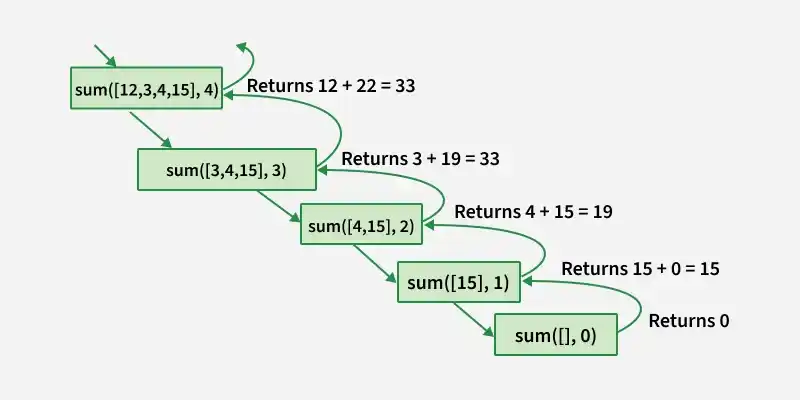
The recursive approach calculates the sum of array elements by calling the same function repeatedly.
- Start from the first element of the array.
- Add the current element to the sum returned by the recursive function for the remaining elements.
- When the index reaches the array length, return 0 to stop the recursion.
#include <iostream>
#include <vector>

using namespace std;

int sumHelper(const vector<int>& arr, int index) {

    // Base Case: when index reaches the end of the list
    if (index == arr.size()) {
        return 0;
    }

    // Current element + remaining elements ka recursive sum
    return arr[index] + sumHelper(arr, index + 1);
}

int arraySum(vector<int>& arr) {
    return sumHelper(arr, 0);
}

int main() {
    vector<int> arr = {12, 3, 4, 15};

    cout << arraySum(arr) << "\n";

    return 0;
}
#include <stdio.h>
#include <stdlib.h>
#include <string.h>

int arraySum(int arr[], int n)
{
    // base case
    if (n == 0) {
        return 0;
    }
    else {

        // recursively calling the function
        return arr[0] + arraySum(arr + 1, n - 1);
    }
}

int main()
{
    int arr[] = { 12, 3, 4, 15 };
    int n = sizeof(arr) / sizeof(arr[0]);

    printf("%d", arraySum(arr, n));

    return 0;
}
public class GFG {

    private static int sumHelper(int[] arr, int index) {

        // Base Case: when index reaches the end of the array
        if (index == arr.length) {
            return 0;
        }

        // Current element + recursive sum of remaining elements
        return arr[index] + sumHelper(arr, index + 1);
    }

    public static int arraySum(int[] arr) {
        return sumHelper(arr, 0);
    }

    public static void main(String[] args) {
        int[] arr = {12, 3, 4, 15};

        System.out.println(arraySum(arr));
    }
}
def sumHelper(arr, index):

    # Base Case: when index reaches the end of the list
    if index == len(arr):
        return 0

    # Current element + recursive sum of remaining elements
    return arr[index] + sumHelper(arr, index + 1)


def arraySum(arr):
    return sumHelper(arr, 0)


if __name__ == "__main__":
    arr = [12, 3, 4, 15]
    print(arraySum(arr))
using System;

class GFG {
    private static int sumHelper(int[] arr, int index) {

        // Base Case: when index reaches the end of the array
        if (index == arr.Length) {
            return 0;
        }

        // Current element + recursive sum of remaining elements
        return arr[index] + sumHelper(arr, index + 1);
    }

    public static int arraySum(int[] arr) {
        return sumHelper(arr, 0);
    }

    static void Main() {
        int[] arr = { 12, 3, 4, 15 };

        Console.WriteLine(arraySum(arr));
    }
}
function sumHelper(arr, index) {

    // Base Case: when index reaches the end of the array
    if (index === arr.length) {
        return 0;
    }

    // Current element + recursive sum of remaining elements
    return arr[index] + sumHelper(arr, index + 1);
}

function arraySum(arr) {
    return sumHelper(arr, 0);
}

// Driver code
const arr = [12, 3, 4, 15];
console.log(arraySum(arr));
Output
34
Inbuilt Methods - O(n) Time and O(1) Space
Use built-in functions to compute the sum of elements in a given array. These functions eliminate the need for explicit iteration and improve code simplicity.
#include <iostream>
#include <vector>
#include <numeric>

using namespace std;

int arraySum(vector<int>& arr) {
    return accumulate(arr.begin(), arr.end(), 0);
}

int main() {
    vector<int> arr = {12, 3, 4, 15};

    cout << arraySum(arr) << "\n";

    return 0;
}
import java.util.Arrays;

public class GFG {

    public static int arraySum(int[] arr) {
        return Arrays.stream(arr).sum();
    }

    public static void main(String[] args) {
        int[] arr = { 12, 3, 4, 15 };

        System.out.println(arraySum(arr));
    }
}
def arraySum(arr):
    return sum(arr)

if __name__ == "__main__":
    arr = [12, 3, 4, 15]
    print(arraySum(arr))
using System;
using System.Linq;

class GFG {
    static int arraySum(int[] arr) {
        return arr.Sum();
    }

    static void Main() {
        int[] arr = { 12, 3, 4, 15 };
        Console.WriteLine(arraySum(arr));
    }
}
function arraySum(arr) {
    return arr.reduce((acc, curr) => acc + curr, 0);
}

// Driver code
const arr = [12, 3, 4, 15];
console.log(arraySum(arr));
Output
34
