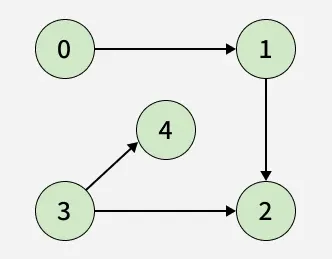
The Kahn’s Algorithm uses BFS and has the following steps.
Compute in-degree of every vertex — representing how many incoming edges each vertex has.
Add all vertices with an in-degree of 0 a queue, as they can appear first in the topological ordering.
Repeatedly remove a vertex from the queue, add it to result, and reduce in-degree of all its adjacent. If any of those vertices now have an in-degree of 0, add them also to the queue.
This process continues until the queue is empty
Illustration of the algorithm:
Below is the implementation of the above algorithm.
C++
//Driver Code Starts#include<vector>#include<iostream>#include<queue>usingnamespacestd;//Driver Code Endsvector<int>topoSort(vector<vector<int>>&adj){intn=adj.size();vector<int>indegree(n,0);queue<int>q;vector<int>list;// Compute indegreesfor(inti=0;i<n;i++){for(intnext:adj[i])indegree[next]++;}// Add all nodes with indegree 0 // into the queuefor(inti=0;i<n;i++)if(indegree[i]==0)q.push(i);// Kahn’s Algorithm (BFS)while(!q.empty()){inttop=q.front();q.pop();list.push_back(top);for(intnext:adj[top]){indegree[next]--;if(indegree[next]==0)q.push(next);}}returnlist;}//Driver Code StartsvoidaddEdge(vector<vector<int>>&adj,intu,intv){adj[u].push_back(v);}intmain(){intn=6;vector<vector<int>>adj(n);addEdge(adj,0,1);addEdge(adj,1,2);addEdge(adj,2,3);addEdge(adj,4,5);addEdge(adj,5,1);addEdge(adj,5,2);vector<int>res=topoSort(adj);for(intvertex:res)cout<<vertex<<" ";cout<<endl;}//Driver Code Ends
Java
//Driver Code Startsimportjava.util.ArrayList;importjava.util.Queue;importjava.util.LinkedList;classGFG{//Driver Code EndsstaticArrayList<Integer>topoSort(ArrayList<ArrayList<Integer>>adj){intn=adj.size();int[]indegree=newint[n];Queue<Integer>q=newLinkedList<>();ArrayList<Integer>result=newArrayList<>();// Compute indegreesfor(inti=0;i<n;i++){for(intnext:adj.get(i)){indegree[next]++;}}// Add all nodes with indegree 0 // into the queuefor(inti=0;i<n;i++){if(indegree[i]==0){q.add(i);}}// Kahn’s Algorithm (BFS)while(!q.isEmpty()){inttop=q.poll();result.add(top);for(intnext:adj.get(top)){indegree[next]--;if(indegree[next]==0){q.add(next);}}}returnresult;}//Driver Code StartsstaticvoidaddEdge(ArrayList<ArrayList<Integer>>adj,intu,intv){adj.get(u).add(v);}publicstaticvoidmain(String[]args){intn=6;ArrayList<ArrayList<Integer>>adj=newArrayList<>();for(inti=0;i<n;i++){adj.add(newArrayList<>());}addEdge(adj,0,1);addEdge(adj,1,2);addEdge(adj,2,3);addEdge(adj,4,5);addEdge(adj,5,1);addEdge(adj,5,2);ArrayList<Integer>res=topoSort(adj);for(intvertex:res){System.out.print(vertex+" ");}System.out.println();}}//Driver Code Ends
Python
#Driver Code Startsfromcollectionsimportdeque#Driver Code EndsdeftopoSort(adj):n=len(adj)indegree=[0]*nres=[]queue=deque()# Compute indegreesforiinrange(n):fornext_nodeinadj[i]:indegree[next_node]+=1# Add all nodes with indegree 0 # into the queueforiinrange(n):ifindegree[i]==0:queue.append(i)# Kahn’s Algorithmwhilequeue:top=queue.popleft()res.append(top)fornext_nodeinadj[top]:indegree[next_node]-=1ifindegree[next_node]==0:queue.append(next_node)returnresdefaddEdge(adj,u,v):adj[u].append(v)#Driver Code Starts# Examplen=6adj=[[]for_inrange(n)]addEdge(adj,0,1)addEdge(adj,1,2)addEdge(adj,2,3)addEdge(adj,4,5)addEdge(adj,5,1)addEdge(adj,5,2)res=topoSort(adj)print(*res)#Driver Code Ends
C#
//Driver Code StartsusingSystem;usingSystem.Collections.Generic;classGFG{//Driver Code EndspublicstaticList<int>topoSort(List<List<int>>adj){intn=adj.Count;int[]indegree=newint[n];List<int>list=newList<int>();Queue<int>queue=newQueue<int>();// Compute indegreesfor(inti=0;i<n;i++){foreach(intnextinadj[i])indegree[next]++;}// Add all nodes with indegree 0 // into the queuefor(inti=0;i<n;i++)if(indegree[i]==0)queue.Enqueue(i);// Kahn’s Algorithm (BFS)while(queue.Count>0){inttop=queue.Dequeue();list.Add(top);foreach(intnextinadj[top]){indegree[next]--;if(indegree[next]==0)queue.Enqueue(next);}}returnlist;}//Driver Code StartspublicstaticvoidaddEdge(List<List<int>>adj,intu,intv){adj[u].Add(v);}publicstaticvoidMain(){intn=6;List<List<int>>adj=newList<List<int>>();for(inti=0;i<n;i++)adj.Add(newList<int>());addEdge(adj,0,1);addEdge(adj,1,2);addEdge(adj,2,3);addEdge(adj,4,5);addEdge(adj,5,1);addEdge(adj,5,2);List<int>res=topoSort(adj);Console.WriteLine(string.Join(" ",res));}}//Driver Code Ends
JavaScript
functiontopoSort(adj){n=adj.lengthletindegree=newArray(n).fill(0);letqueue=[];letres=[];// Compute indegreesfor(leti=0;i<n;i++){for(letnextofadj[i])indegree[next]++;}// Add all nodes with indegree 0 // into the queuefor(leti=0;i<n;i++){if(indegree[i]===0)queue.push(i);}// Kahn’s Algorithmwhile(queue.length>0){lettop=queue.shift();res.push(top);for(letnextofadj[top]){indegree[next]--;if(indegree[next]===0)queue.push(next);}}returnres;}//Driver Code StartsfunctionaddEdge(adj,u,v){adj[u].push(v);}// Exampleletn=6;letadj=Array.from({length:n},()=>[]);addEdge(adj,0,1);addEdge(adj,1,2);addEdge(adj,2,3);addEdge(adj,4,5);addEdge(adj,5,1);addEdge(adj,5,2);letres=topoSort(adj);console.log(...res);//Driver Code Ends
Output
0 4 5 1 2 3
Time Complexity: O(V+E). For Performing BFS Auxiliary Space: O(V).