

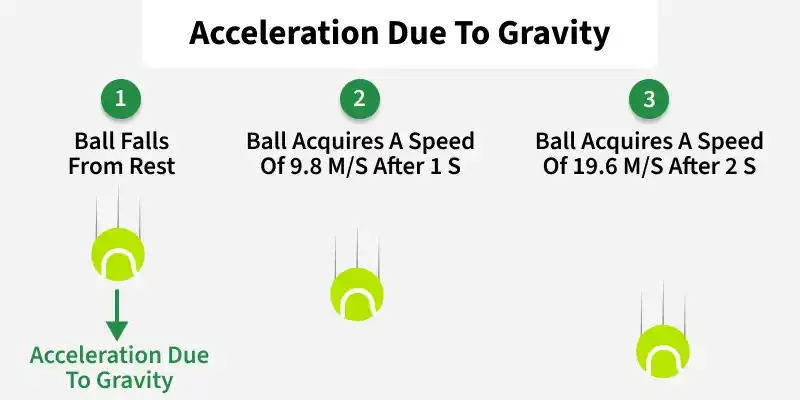
Acceleration due to gravity is the acceleration experienced by an object when it falls freely under the influence of Earth's gravitational force.
- It is denoted by g and acts vertically downward toward the centre of the Earth.
- Its value is approximately 9.8 m/s², which means the velocity of a freely falling object increases by 9.8 m/s every second.
- Since it has both magnitude and direction, acceleration due to gravity is a vector quantity.
- Its SI unit is metre per second squared (m/s²).
Formula
Mathematically, the acceleration due to gravity is directly proportional to the mass of the object and inversely proportional to the distance from the center of mass, so given as:
g\propto\dfrac{m}{r^2} or
g=\dfrac{Gm}{r^2} where,
- g is the acceleration due to gravity,
- G is the Gravitational constant,
- m is the mass of the body and
- r is the distance from the centre.
Units of Acceleration due to Gravity
- The SI unit of Acceleration due to Gravity is m/s2.
- The CGS unit of g is cm/s2.
- And the dimensional formula of Acceleration due to Gravity is [LT-2].
Derivation of Acceleration due to Gravity
According to Newton’s second law of motion:
F = ma
For a freely falling body, acceleration = g, so:
F = mg...(1)
According to the universal law of gravitation:
F = \frac{GMm}{r^2} ..... (2)On equating (1) and (2):
mg = \frac{GMm}{r^2} Cancelling mass m from both sides:
g = \frac{GM}{r^2}
Calculation of the Value of Acceleration due to Gravity
The acceleration due to gravity is stated as:
g=\dfrac{GM}{r^2} Here, substitute 6.67 × 10⁻¹¹ Nm2 kg-2 for G, 6 × 1024 kg for M and 6.4 × 10⁶ m for r in the above expression to calculate g at the surface of Earth.
\begin{aligned}g&=\dfrac{6.67\times10^{-11}\text{ N.m}^2/\text{ kg}^2\times6\times 10^{24}\text{ kg}}{\left(6.4\times10^6\text m\right)^2}\\&=9.8\text{ ms}^{-2}\end{aligned} Hence, the value of acceleration due to gravity on the surface of Earth is 9.8 m/s2.
Factor affecting Acceleration due to Gravity
- Shape of Earth: It is known that the shape of the earth is not spherical it's quite oval so the gravitational force is different at different places.
- The force of attraction is maximum at the pole of the earth approximately 9.82 m/s2 as the radius of the earth is minimum at the pole. While the force of gravitation is minimum at the equator of the earth at approximately 9.78 m/s2 as the radius of the earth is maximum at the equator
- Altitude: When a body moves away from the surface of the earth the force of attraction decreases as the distance between the earth and the body increases.
- Depth: When a body is put inside the earth's surface the acceleration due to gravity becomes less.
Effects on g due to Height (h)
Consider an object (of mass m) P at a height h from the surface of the earth, R be the radius of the earth as shown in the figure below:
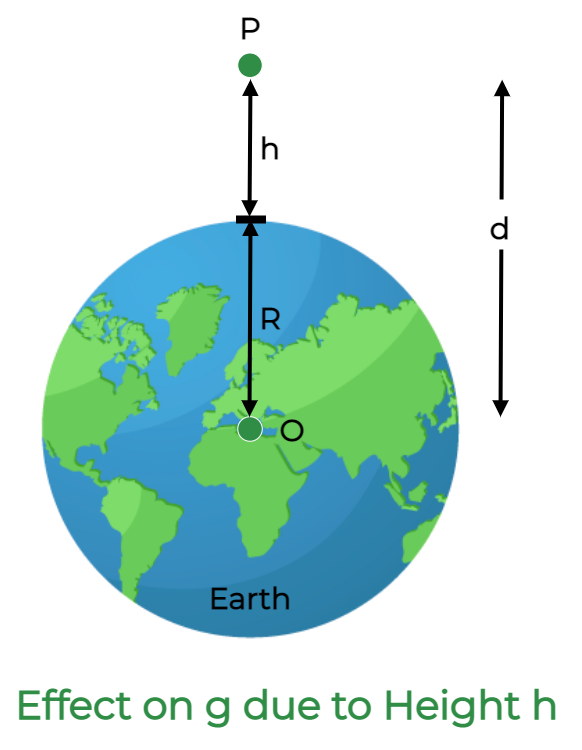
The gravitational force acting on a body of mass m at a height h above the Earth’s surface is given by:
F = \frac{GMm}{(R + h)^2} where M is the mass of the Earth and R is its radius.
Since F = mgh, where gh is the acceleration due to gravity at height h, we can write:
m g_h = \frac{GMm}{(R + h)^2} Cancelling m from both sides:
g_h = \frac{GM}{(R + h)^2} We know that acceleration due to gravity at the Earth’s surface is:
g = \frac{GM}{R^2} Therefore,
g_h = \frac{g}{\left(1 + \frac{h}{R}\right)^2} For small heights (h ≪ R), using approximation:
g_h \approx g \left(1 - \frac{2h}{R}\right)
Effects on g due to Depth (D)
Consider an object (of mass m) P at a depth D from the surface of the earth, R be the radius of the earth as shown in the figure below:
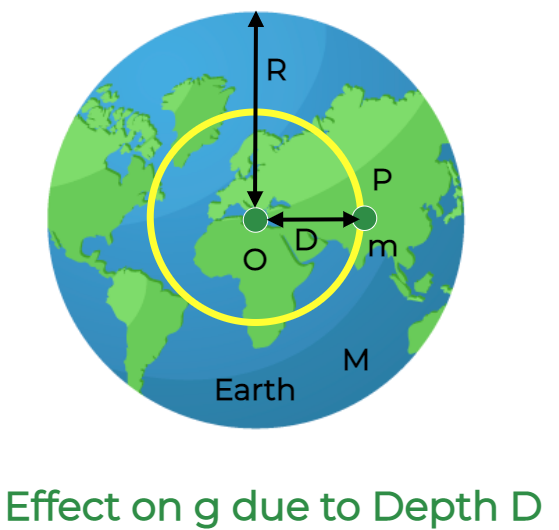
The acceleration due to gravity at the surface of the Earth in terms of density ρ is:
g = \frac{4}{3}\pi G \rho R At depth D, the distance from the centre becomes (R −D), so:
g_D = \frac{4}{3}\pi G \rho (R - D) On dividing both equations, we get:
\frac{g_D}{g} = \frac{R - D}{R}
g_D = g \left(1 - \frac{D}{R}\right) Now two cases can be possible:
Case 1: If depth D = R (object at the center of the Earth), then:
gD = 0
Case 2: If depth D = 0 (object at the surface of the Earth), then:
gD = g
Effects on g due to Shape of Earth
The radius of the earth, an oblate spheroid, is greater towards the equator than it is farther from the poles. The acceleration caused by gravity changes with latitude due to the shape of the earth since it is inversely proportional to the square of the earth's radius for a given mass.
\dfrac{g_p}{g_e}=\dfrac{R_e^2}{R_p^2} where,
- Re and Rp are the radii of Earth at the equator and the poles, and
- ge and gp are the acceleration due to gravity at the equator and poles, respectively.
Hence, from the above-mentioned equation, it is obvious that the equator experiences less, and the poles have more gravitational acceleration. Therefore, when g lowers, a person's weight falls as they move from the equator to the poles.
Effects on g due to the Rotation
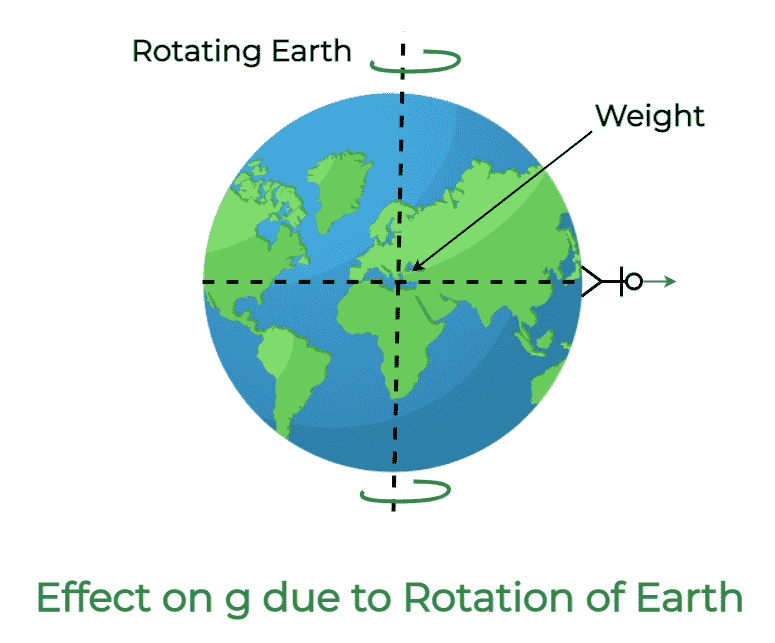
The variation in g is due to the centrifugal force acting on the rotation of the earth. When the earth is rotating, all the objects tend to experience a centrifugal force that won’t act in the direction of gravity.
Solved Problems
Question 1: Calculate the acceleration due to gravity on Earth if G = 6.67 × 10⁻¹¹ N m2/kg2, M = 6 × 1024 kg, and R = 6.4 × 10⁶ m.
Solution: Using the formula:
g =
\frac{GM}{R^2} Substituting values:
g = \frac{6.67 \times 10^{-11} \times 6 \times 10^{24}}{(6.4 \times 10^6)^2} On solving:
g ≈ 9.8 m/s2
Hence, the acceleration due to gravity is 9.8 m/s².
Question 2: Find the value of acceleration due to gravity at a height equal to the radius of the Earth (h = R).
Solution: Using the formula:
g_h = \frac{g}{\left(1+\frac{h}{R}\right)^2} Since h = R:
g_h = \frac{g}{(1+1)^2}
g_h = \frac{g}{4} If g = 9.8 m/s2
gh = 2.45 m/s2
Hence, the acceleration due to gravity becomes 2.45 m/s².
Question 3: Determine the acceleration due to gravity at a depth equal to half the radius of the Earth.
Solution: Using the formula:
g_D = g\left(1-\frac{D}{R}\right) Given:
D = \frac{R}{2} Substituting:
g_D = g\left(1-\frac{1}{2}\right)
g_D = \frac{g}{2} If g = 9.8 m/s2 :
gD = 4.9 m/s2
Hence, the acceleration due to gravity at half the Earth’s radius depth is 4.9 m/s².
Question 4: A body is taken from the equator to the poles. What happens to its weight?
Solution: The radius of the Earth is smaller at the poles and larger at the equator. Since acceleration due to gravity is inversely proportional to the square of Earth’s radius:
g \propto \frac{1}{R^2} Therefore, the value of g is greater at the poles.
Since weight is given by:
W = mg
the weight of the body increases when moved from the equator to the poles.
Unsolved Problems
Question 1: Calculate the acceleration due to gravity on a planet whose mass is 8×1024 kg and radius is 7 × 10⁶ m.
Question 2: Find the value of acceleration due to gravity at a height equal to twice the radius of the Earth.
Question 3: Determine the acceleration due to gravity at a depth equal to one-third of the Earth’s radius if g=9.8 m/s2.
Question 4: A body is taken to a place where the acceleration due to gravity becomes one-fourth of its value on Earth. Calculate the new weight of the body if its original weight is 200 N.
Question 5: Find the ratio of acceleration due to gravity at the poles to that at the equator if the radius of the Earth at the equator is greater than at the poles.
