

The meter bridge is an electrical instrument used to measure an unknown resistance accurately using the Wheatstone bridge principle. It works on a one-meter-long uniform wire, where resistance is proportional to length, allowing precise calculation of unknown resistance using balancing length.
Principle of Meter Bridge
The meter bridge works on the principle of the Wheatstone bridge. The Wheatstone bridge states that
- In a balanced network, the ratio of two resistances in one branch is equal to the ratio of two resistances in the other branch.
Mathematically,
At this condition:
- No current flows through the galvanometer
- Potential difference across the galvanometer becomes zero.
The meter bridge is essentially a practical form of Wheatstone bridge where two resistances are replaced by segments of a uniform wire.
Construction of Meter Bridge
A meter bridge is a practical application of the Wheatstone bridge used to measure an unknown resistance accurately. It consists of a uniform resistance wire stretched along a meter scale. By finding the balance point on the wire, the value of the unknown resistance can be determined using the Wheatstone bridge principle.
- It consists of a one-meter long uniform resistance wire mounted on a wooden board.
- The bridge wire is generally made of manganin, constantan, or nichrome due to their high resistivity and low temperature coefficient.
- Two gaps are provided to place the known resistance and unknown resistance.
- A galvanometer and a jockey are used to locate the balance point on the wire.
- A battery and connecting keys are used to supply current and complete the circuit.
Working of Meter Bridge
When current flows through the bridge wire, a potential difference is developed along its length. The jockey is moved on the wire until the galvanometer shows zero deflection. This position is called the balance point or null point. At this point, the potentials at the connected points are equal, and the Wheatstone bridge principle can be applied.
- Current flows through the bridge wire and resistance gaps.
- Potential difference varies uniformly along the wire.
- The jockey is moved to find the balance point.
- At the balance point, the galvanometer shows zero deflection.
- The Wheatstone bridge principle is applied to calculate the unknown resistance.
Resistance of a Uniform Wire
For a uniform wire:
where:
- 𝜌 = resistivity,
- l = length,
- A = cross-sectional area.
Since 𝜌 & A are constant
therefore:
Thus resistance of the bridge wire is directly proportional to its length.
This is the fundamental reason the meter bridge works.
Balance Condition of Meter Bridge
Suppose:
- unknown resistance = X ,
- known resistance = R ,
- balancing length = l ,
- remaining length = 100-l .
At balance point:
Therefore unknown resistance becomes:
This is the fundamental equation of the meter bridge.
Why the Balance Condition Works
At balance point:
- galvanometer current becomes zero,
- junction potentials become equal.
Hence, no potential difference exists across galvanometer.
The wire segments then behave exactly like Wheatstone bridge resistors. Because wire resistance is proportional to length, resistance ratio becomes equal to length ratio.
Thus, resistance measurement reduces to simple length measurement.
Null Deflection Principle
The meter bridge operates on the null-deflection principle.
At balance:
- galvanometer current is zero,
- no energy is consumed through galvanometer branch,
- measurement becomes independent of galvanometer resistance.
Null methods are generally superior because:
- the measuring device does not disturb the circuit,
- systematic errors are reduced,
- precise balancing becomes possible.
Sensitivity of Meter Bridge
Sensitivity refers to the ability of the bridge to detect small changes in resistance.
A meter bridge is most sensitive when:
- balancing length is close to 50 cm,
- resistances in both gaps are nearly equal.
This happens because:
- potential gradient becomes nearly symmetrical,
- small resistance changes produce noticeable galvanometer deflection.
End Error in Meter Bridge
Practically, copper strips and connecting wires possess small resistance.
Due to this:
- effective bridge wire length slightly changes,
- balance condition becomes inaccurate.
This error is called end error.
End error becomes significant when:
- balancing point lies near ends,
- contact resistances are large.
Reduction of End Error
End error can be minimized by:
- interchanging known and unknown resistances,
- taking mean value of obtained results.
Condition: If
- first balance length = l1,
- second balance length = l2,
then more accurate resistance value is obtained.
This correction method is frequently used in laboratory experiments.
Determination of Resistivity Using Meter Bridge
The meter bridge can also determine resistivity of a wire.
Suppose:
- resistance of wire is measured,
- length and radius are known.
Using:
resistivity becomes:
Since:
therefore:
Thus meter bridge indirectly helps determine material properties.
Temperature Effect in Meter Bridge
Resistance changes with temperature.
If wire temperature increases:
- resistivity changes,
- bridge balance may shift.
This is why manganin and constantan are preferred they have very low temperature coefficient.
Temperature stability improves measurement accuracy.
Effect of Non-Uniform Wire
The meter bridge assumes:
- wire thickness is uniform,
- resistivity remains constant throughout.
If wire is non-uniform:
- resistance is not proportional to length,
- balance equation becomes inaccurate.
Therefore bridge wire must be carefully manufactured.
Galvanometer in Meter Bridge
The galvanometer acts only as a null detector. It does not measure current directly. Its purpose is to indicate whether balancing condition has been reached.
At balance point : galvanometer current is zero.
A sensitive galvanometer helps:
- detect small deviations,
- improve precision.
Practical Procedure of Meter Bridge Experiment
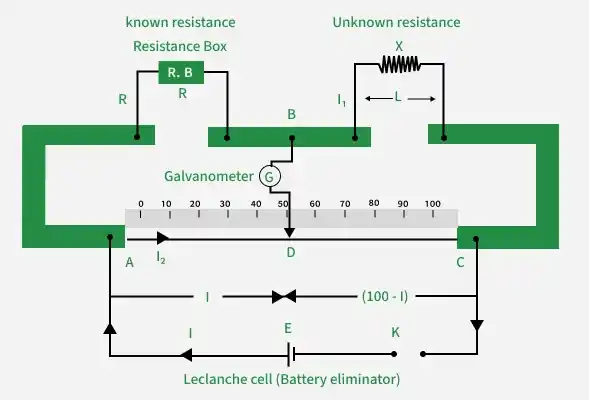
In a meter bridge experiment, the known and unknown resistances are placed in the two gaps, and current is passed through the circuit. The jockey is moved along the wire until the galvanometer shows zero deflection, indicating the balance point. The balancing length is then measured to calculate the unknown resistance.
Steps Involved:
- Place the known and unknown resistances in the two gaps.
- Pass current through the circuit.
- Move the jockey to locate the null point.
- Measure the balancing length and calculate the unknown resistance.
Advantages of Meter Bridge
- Simple construction
- High accuracy
- Null-deflection method
- Easy resistance comparison
- Inexpensive setup
- Reliable experimental results
Limitations of Meter Bridge
- Not suitable for very high resistances
- Not suitable for very low resistances
- End correction errors possible
- Wire heating may affect readings
- Requires uniform wire
Solved Problems
Question 1: In a meter bridge, there are two unknown resistance R and S. Find the ratio of R and S if the galvanometer shows a null deflection at 20cm from one end?
Solution: The null deflection in the galvanometer is obtained at 20cm from one end.
Let, L1 = 20cm
So, L2 = 100 – 20 = 80cm
Thus, the ratio of unknown resistance will be: R/S = L1 / L2
Thus, R / S = 1 / 4
Question 2: A 20Ω resistor is connected in the left gap, and an unknown resistance is joined in the right gap of the meter bridge. Also, the null deflection point is shifted by 40cm when the resistors are interchanged. Find the value of the unknown resistance?
Solution: In the first case, let the deflection point be taken as L. Let the balance point be shifted to l by 40cm when the resistors are interchanged.
Thus, L– l = 40 cm
Also, L+ l = 100 cm
Solving the above equations, we get:
l = 30 cm
L = 70 cm
Let R = 20 Ω
And unknown resistance be S, thus,
R / S = L / l
R / S = 70 / 30
20 / S = 7 / 3
∴S = 8.57 Ω
Question 3: In a meter bridge with a standard resistance of 15 Ω in the right gap, the ratio of balancing length is 3:2. Find the value of the other resistance.
Solution: Q=15 Ω , l1:l2 = 3:2
l1 / l2 = 3 / 2
P / Q = l1 / l2
P = Q x l1 / l2
P = 22.5 Ω
Question 4: In a meter bridge, the value of resistance in the resistance box is 10 Ω. The balancing length is l1 = 55 cm. Find the value of the unknown resistance.
Solution: Q= 10 Ω
P/Q =l1 / 100 - l1
P=Q x l1 /1 00 - l1
P = 10 x 55 / 100 - 55
P=12.2 Ω
Unsolved Problems
Question 1: In a meter bridge, a known resistance of 25 Ω is placed in the left gap and an unknown resistance in the right gap. The null point is obtained at 60 cm from the left end. Find the unknown resistance.
Question 2: A meter bridge has two resistances R and S. The balance point is found at 45 cm from one end. Find the ratio R: S.
Question 3: In a meter bridge experiment, a resistance of 12 Ω is placed in the right gap, and the balance length is found to be 40 cm. Calculate the resistance placed in the left gap.
Question 4: A 10 Ω resistance is connected in one gap of a meter bridge. The null point is obtained at 25 cm. When the resistances are interchanged, the new balance point is found at 75 cm. Find the unknown resistance.
Question 5: In a meter bridge, the balance point is obtained at 35 cm when a resistance of 18 Ω is placed in one gap. Find the value of the unknown resistance in the other gap.
