Announcements

  • journal logo

    Communications Earth & Environment has a 2-year Journal Impact Factor of 9.3 and a 5-year Journal Impact Factor of 10.4 (2025).

  • Median time from submission to the first editorial decision was 8 days in 2025; median submission-to-accept time: 184 days.
  • Articles published in Communications Earth & Environment in 2025 were downloaded 12,198,123 times.
  • portrait of outstanding reviewer

    We thank Kailiang Yu, of the Institute of Geographic Sciences and Natural Resources Research (IGSNRR), Chinese Academy of Sciences, for his excellent and helpful contributions to peer review at Communications Earth & Environment.

  • wastewater pipe

    We are welcoming submissions to our curated open collections, including:

  • * PFAS and forever chemicals in the environment
  • * Hazards in Mountain Regions
  • * Critical materials supply chain sustainability
  • * Ecosystems under marine heatwaves

Advertisement

  • Climate risk assessments used by the financial sector are often based on empirical data from recent decades that do not span the full range of possible futures. We argue that the financial sector needs to embrace risk analysis for all plausible scenarios, not just for median outcomes.

    • Ajay Gambhir
    • Erica Thompson
    • Jesse F. Abrams
    CommentOpen Access
  • Energy supply crises matter because their economic impacts extend beyond energy markets. This Comment argues that energy security should be understood by how energy systems transmit price shocks to the wider economy. Low-carbon technologies matter because, unlike fossil fuels, they dampen this transmission through the economy.

    • Jose A. Ordonez
    • Matthias Weitzel
    • Rafael Garaffa
    CommentOpen Access
  • Plastic particles below a diameter of 5 mm are often grouped together under the label ‘microplastics’ in current Environmental Impact Assessment protocols, regardless of their environmental half-life. This Comment argues that microplastics should be regulated according to degradability, with separate categories for transient and persistent particles.

    • Mirko Cucina
    CommentOpen Access
  • Beneath the deep ocean floor may not seem like a natural place for a prospering ecosystem, yet microbial life can thrive in subsurface sediments. The International Ocean Discovery Program Expedition 385 led by Drs. A. Teske and D. Lizarralde set out to drill and sample the deep biosphere, at eight sites of the Guaymas Basin in the Gulf of California. Dr Edgcomb and colleagues analysed these data and found active microbial life across a range of sediment and temperature conditions, especially around hydrothermal structures. Their work demonstrates that subsurface microbial life can flourish, even in the most challenging of conditions.

    • Alice Drinkwater
    Research HighlightOpen Access
  • Heat stress risk is increasingly assessed using composite indices that were derived for narrowly defined applications and then extrapolated far beyond those use cases. This Comment argues that users must understand each index’s origins and be transparent about the sometimes-significant limitations these impose on its application.

    • Ollie Jay
    • Farjana Jahan
    CommentOpen Access
  • Urban decarbonisation depends on materials such as aluminium, graphite and lithium. This Comment argues that disruptions to their supply pose a neglected climate risk and calls for a strategic reserve system to protect cities’ energy transitions.

    • Zaheer Allam
    • Rushaa Badaloo
    • Ali Cheshmehzangi
    CommentOpen Access
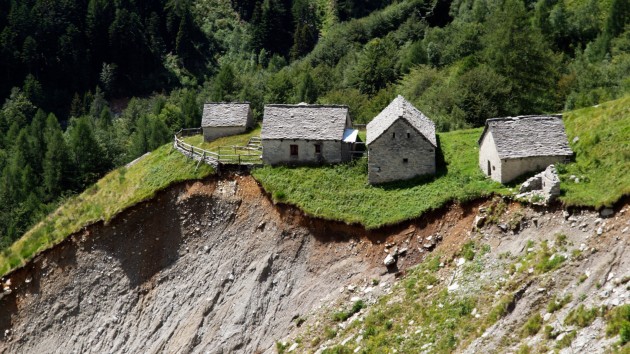
Mountain landslide and erosion

Hazards in Mountain Regions

This cross-journal collection from Communications Earth & Environment brings together research that explores the physical mechanisms and societal impacts of mountain hazards under changing climatic and cryospheric conditions.
Collection

Advertisement