¥È¥Ã¥×¥Ú¡¼¥¸(top page)¡ä ÃæÀ¸ÂåÇò°¡µª¸å´ü¤ÎÀ¤³¦(The world of Late Cretaceous)
|
ÃæÀ¸Â塦Çò°¡µª¸å´ü¤ÎÀ¤³¦¡¡
( Late Cretaceous) 9900Ëü¡Á6500ËüǯÁ°¡¡(99 million years¡Á65 million years ago) |

|
(The former age) Á°¤Î»þÂå¤Ø¢«¢£ ¢ª¼¡¤Î»þÂå¤Ø (The next age) |
| ¡¡
À¤³¦¤ÎÍÍ»Ò Environment |
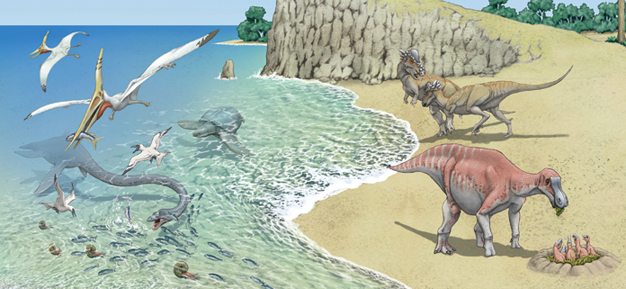
The Late Cretaceous was a period with warm climate and high eustatic sea level.
And oxygen became abundant through the Mesozoic Era.
A single supercontinent separated into seven continents and
a wide variety of plants and animals appeared on each continents.
| ¡¡
À¸Êª Life |
Íñ¤ÎÕÛ²½¤ò½õ¤±¤ë¹â¤¤µ¤²¹¤¬à¨ÃîÎà¤òÈ˱ɤµ¤»¡¢¶²Îµ¤Ï»ÙÇÛŪÃϰ̤òÀê¤á¤Æ¤¤¤¿¡£
The reptiles flourished in the high temperature to help hatching eggs
ºÇ½é¤ÎÄ»Îब¸½¤ì¤¿¤Î¤â¤³¤Îº¢¡£
Ó®ÆýÎà¤â±Æ¤Ê¤¬¤éÈ˱ɤ·¤Æ¤ª¤ê¡¢ºÇ½é¤ÎÍÂÛÈ×Îà¤âÅо줹¤ë¡£
Èï»Ò¿¢Êª¤Ï²Ö¤ò¤Ä¤±¤ë¤è¤¦¤Ë¤Ê¤ê¡¢º«Ãî¤È¤È¤â¤Ë±É¤¨¤ë¡£
³¤¤Ç¤Ïµû夬ÀäÌǤ·¡¢
£¶£µ£°£°ËüǯÁ°¤ÎÇò°¡µª¤ÎÂçÀäÌǤǤϼóĹε¤â¶²Îµ¤È¤È¤â¤Ë»Ñ¤ò¾Ã¤·¤¿¡£
and the dinosaurs dominated.
Birds (Aves) first appeared during this period.
During this time, Mammals also flourished and
Placental mammals first appeared during this period.
Angiosperms that came to flower flourished with insects.
Ichthyosaurs became extinct in the sea and Plesiosauria also died out with
dinosaurs at the K-T extinction event, 65 million years ago.
| ¡¡
Çò°¡µª¡Ê K-T¶³¦¡Ë¤ÎÂçÎÌÀäÌÇ Cretaceous–Tertiary (K–T boundary) extinction event |

£¶£µ£°£°ËüǯÁ°¡¢¥á¥¥·¥³²¤ËµðÂçð¨ÀФòÍî¤Á¡¢µÞ·ã¤Êµ¤¸õÊÑÆ°¤Ç
It's generally understood that a large meteorite fell on the coast of Mexico
¡¡¡¡´ØÏ¢¥Ö¥í¥°µ»ö¡ä¡ä¡ä
¡Öε¤òÌǤܤ·Ç˲õ¿À¥·¥ô¥¡¡×
ÂçÎÌÀäÌǤ·¤¿¤³¤È¤¬ÍÎÏ¡£
¶²Îµ¤ä¥¢¥ó¥â¥Ê¥¤¥È¤Ê¤ÉÀ¸Êª¼ï¤Î£·£°¡ó¤¬ÀäÌǤ·¤¿¤È¤¤¤ï¤ì¤Æ¤¤¤ë¡£
¶²Îµ¤¬ÀäÌǤ·¤¿¤³¤È¤Ç¤è¤¯ÃΤé¤ì¤ëÂçÎÌÀäÌÇ»ö·ï¤Ç¤¢¤ë¤¬
²áµî£µ²¯Ç¯¤Î£µÅÙ¤ÎÂçÎÌÀäÌǡʥӥ寥ե¡¥¤¥Ö¡Ë¤Î¤Ê¤«¤Ç¤â¤Ã¤È¤â·Ú¾É¤Ç¤¢¤ë¡£
and rapid climate change caused mass extinction 65 million years ago.
It is said that 70% of all species, such as the dinosaurs and ammonites, wiped out in this extinction.
The K-T extinction is best known as the dinosaur extinction
but it was the smallest extinction in the five major mass
extinctions over the last 500 million years, called the Big Five.
| ¸ÅÀ¸Âå | ¥¨¥Ç¥£¥¢¥«¥éµª | ¥«¥ó¥Ö¥ê¥¢µª | ¥ª¥ë¥É¥Ó¥¹µª | ¥·¥ë¥ëµª | ¥Ç¥Ü¥óµª | ÀÐúµª | ¥Ú¥ë¥àµª |
|---|---|---|---|---|---|---|---|
| ÃæÀ¸Âå | »°¾öµªÁ°´ü | »°¾öµª¸å´ü | ¥¸¥å¥éµªÁ°´ü | ¥¸¥å¥éµª¸å´ü | Çò°¡µªÁ°´ü | Çò°¡µª¸å´ü | |
| ¿·À¸Âå | ¸ÅÂè»°µª | ¿·Âè»°µª | Âè»Íµª | ||||
| ¸½ºß | ¸½ºß | ||||||
| ̤Íè | £µ£°£°Ëüǯ¸å | £µ£°£°£°Ëüǯ¸å | £±²¯Ç¯¸å | £²²¯Ç¯¸å |
¥È¥Ã¥×¥Ú¡¼¥¸(top page)¡ä ÃæÀ¸Â塦Çò°¡µª¸å´ü¤ÎÀ¤³¦(The world of Late Cretaceous)
