




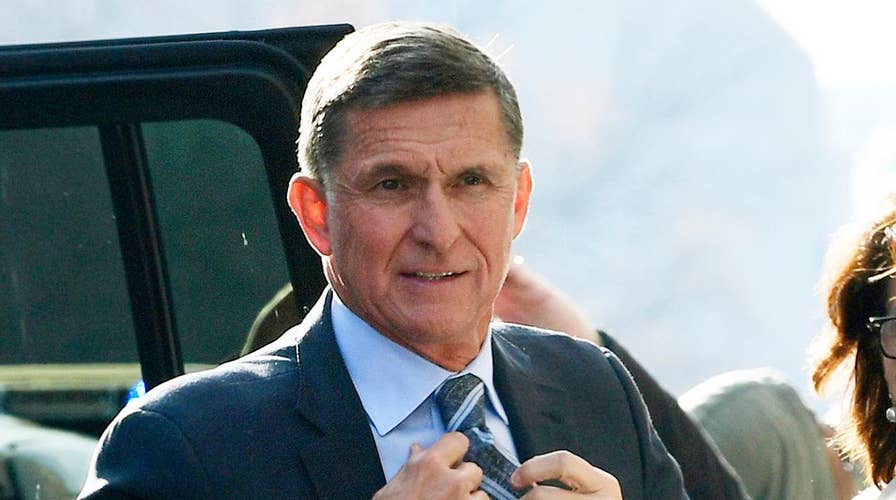
Michael Flynn moves to withdraw his guilty plea
Former National Security Adviser Michael Flynn seeks to formally withdraw his guilty plea, saying federal prosecutors breached their deal with him; insight from Michael Flynn's attorney Sidney Powell.
The Justice Department moved to drop its case against Michael Flynn -- more than three years after the former national security adviser's initial interview with federal prosecutors that ignited the federal case against him.
A bombshell dropped in the case on April 29 when internal documents from the FBI were unsealed revealing that top bureau officials discussed their motivations for interviewing Flynn in the White House in January 2017--and openly questioned if their "goal" was "to get him to lie, so we can prosecute him or get him fired."
President Trump has previously floated a “full pardon” of Flynn, who pleaded guilty as part of former Special Counsel Robert Mueller's Russia probe to making false statements to FBI agents during his Jan. 24, 2017, interview about his conversations with former Russian Ambassador Sergey Kislyak, after the Justice Department said in a court filing that they had lost the initial FBI 302 from that interview.
Here’s a look back at everything that’s happened in the case so far:
Jan. 24, 2017
Flynn, who at the time was national security adviser to Trump, was approached by a pair of FBI agents for an interview at the White House. They wanted to discuss his communications with then-Russian ambassador Sergey Kislyak regarding sanctions in December 2016, which unbeknownst to Flynn had been picked up in wiretapped discussions. This interview would later form the basis for a false-statement charge and guilty plea.
Feb. 13, 2017
Flynn resigned from his White House post. The resignation came as he was accused of misleading Vice President Pence and other senior White House officials about those same communications with Kislyak. Pence, after being briefed by Flynn, had said in television interviews that Flynn did not discuss sanctions with the ambassador.
May 17, 2017
Special Counsel Robert Mueller was appointed by Deputy Attorney General Rod Rosenstein to take over the investigation of Russian meddling and possible collusion with Trump associates in the 2016 election.
Dec. 1, 2017
As part of the Mueller investigation, Flynn pleaded guilty to making false statements in his FBI interview regarding his talks with Kislyak. Flynn was charged with lying to federal investigators about whether he had talked to Kislyak about limiting the Russian government’s response to former President Barack Obama’s sanctions for election meddling.
His plea deal involved his full cooperation with investigators in the special counsel’s office.
According to the charging document, the false statements were that:
“On or about Dec. 29, 2016, FLYNN did not ask the Government of Russia’s Ambassador to the United States…to refrain from escalating the situation in response to sanctions that the United States had imposed against Russia that same day; and FLYNN did not recall the Russian Ambassador subsequently telling him that Russia had chosen to moderate its response to those sanctions as a result of his request.”
“On or about Dec. 22, 2016, FLYNN did not ask the Russian Ambassador to delay the vote on or defeat a pending United Nations Security Council resolution; and that the Russia Ambassador subsequently never described to FLYNN Russia’s response to his request.”
Flynn agreed to “cooperate fully, truthfully, completely and forthrightly” with the investigation, with sentencing delayed until those efforts “have been completed.”
Flynn was told he could be sentenced to federal prison for up to five years.
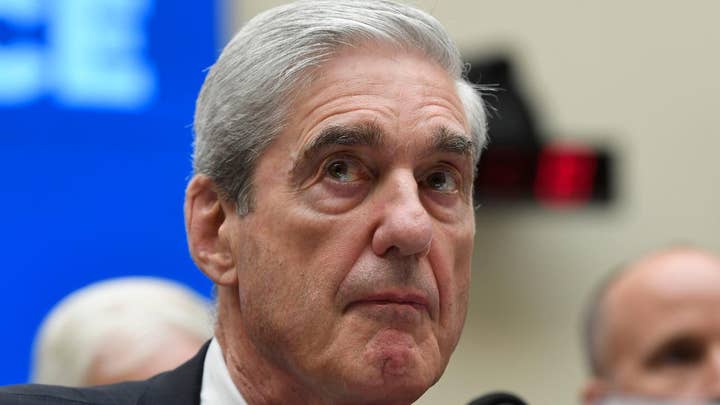
Flynn gave his guilty plea to Judge Rudolph Contreras of the U.S. District Court for the District of Columbia, but days later, Contreras recused himself from the case. Contreras is also a judge on the U.S. Foreign Intelligence Surveillance Court.
Feb. 1, 2018
Two months after Flynn initially pleaded guilty, Mueller and Flynn’s attorneys filed a “joint status report” to Judge Emmet G. Sullivan requesting more time.
“Due to the status of the special counsel’s investigation, the parties do not believe that this matter is ready to be scheduled for a sentencing hearing at this time,” the filing from Mueller and Flynn attorneys Robert Kelner and Stephen Anthony read. “The parties shall file a joint status report by no later than May, 2018, stating whether the matter should be scheduled for sentencing or whether a deadline should be set for filing another joint status report.”
April-May 2018
A Republican-authored House Intelligence Committee report on the Russia probe was released. The eventually unredacted report said FBI agents did not believe that Flynn intentionally lied about talks with Russia’s ambassador.
“Director [James] Comey testified to the Committee that ‘the agents…discerned no physical indications of deception," the report said. "They saw nothing that indicated to them that he knew he was lying to them.’”
Comey, though, disputed the claims, saying “someone misunderstood something I said. I didn’t believe that and didn’t say that.”
May 1, 2018
The special counsel and Flynn’s attorneys filed another joint status report, requesting yet another 90-day delay for Flynn’s sentencing.
June 29, 2018
The special counsel and Flynn’s attorneys filed yet another joint status report.
Sullivan demanded information about why both sides had repeatedly asked for Flynn’s sentencing to be delayed.
Aug. 21, 2018
Another joint status report was filed by Mueller and Flynn’s attorneys, signaling that the former national security adviser was continuing to cooperate with the special counsel.
In July, Flynn’s attorneys said their client was “eager” to wrap up and proceed to sentencing.
September 2018
The special counsel and attorneys for Flynn said in a joint filing that the “matter is now ready to be scheduled for sentencing.”
Both sides asked the judge to set a date for sentencing.
Dec. 4, 2018
Mueller filed a memorandum recommending a lenient sentence, with the possibility of no prison time, for Flynn, stating that he has offered “substantial” help to investigators about “several ongoing investigations.”
“Given the defendant’s substantial assistance and other considerations set forth below, a sentence at the low end of the guideline range, including a sentence that does not impose a term of incarceration—is appropriate and warranted,” the memo said.
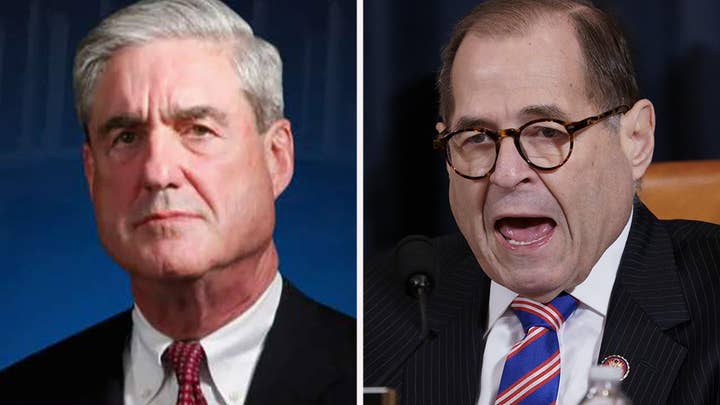
Flynn sat for 19 interviews with Mueller’s team and other Justice Department attorneys, according to the memo, and a heavily redacted supplemental filing attached. The documents did not provide specifics about what exactly Mueller had learned from Flynn but indicated that he provided “documents and communications” about his time working with the Trump administration during the transition period.
Dec. 9, 2018
In a panel appearance with MSNBC’s Nicolle Wallace, former FBI Director Comey was asked how FBI agents ended up at the White House on Jan. 24, 2017, to interview Flynn. Comey's response provided new details about the circumstances that fueled criticism of the bureau's conduct:
“I sent them,” Comey said, adding that it was “something I probably wouldn’t have done or maybe gotten away with in a more … organized administration.”
The interview was arranged directly with Flynn, which was not typical protocol.
“If the FBI wanted to send agents into the White House itself to interview a senior official, you would work through the White House counsel, and there would be discussions and approvals of who would be there,” Comey said, describing how things normally would work.
Regarding his decision to bypass those steps, he said: “I thought: 'It’s early enough, let’s just send a couple guys over.’”
Dec. 12, 2018
Flynn’s attorneys said in a court filing that former FBI Deputy Director Andrew McCabe nudged Flynn not to have an attorney present during the questioning that led to his guilty plea.
The document revealed that the FBI took a significantly more aggressive tack in handling the Flynn interview than it did during other similar matters, including the agency’s sit-downs with Hillary Clinton and ex-Trump adviser George Papadopoulos, who was also charged with making false statements to federal investigators.
Flynn’s attorneys alleged that the FBI agents in his case did not instruct Flynn that any false statements he made could constitute a crime, and decided not to “confront” him directly about anything he said that contradicted their knowledge of his wiretapped communications with Kislyak.
If “Flynn said he did not remember something they knew he said, they would use the exact words Flynn used . . . to try to refresh his recollection," FBI agents wrote in the so-called "302" witness interview report cited by the filing. "If Flynn still would not confirm what he said . . . they would not confront him or talk him through it.”
Dec. 14, 2018
Mueller faces an afternoon deadline to produce the sensitive FBI documents related to Flynn’s interviews.
Sullivan’s brief order stated that Mueller can choose to file the materials under seal if necessary.
Sullivan also ordered the Flynn team to turn over the documents backing up their assertions.
Sullivan has the authority to toss Flynn’s guilty plea and the charge against him if he concludes that the FBI interfered with Flynn’s constitutional right to counsel, although he has given no indications that he intends to do so.
March 2019
By early March 2019, Flynn sought another delay in his sentencing, saying that he could potentially cooperate further with the Justice Department.
March 24, 2019
Attorney General Bill Barr released the “principle conclusions” of Special Counsel Robert Mueller’s completed Russia probe. Barr revealed that Mueller “did not find that the Trump campaign, or anyone associated with it, conspired or coordinated” with Russians who worked on hacking efforts in the 2016 presidential election, “despite multiple offers from Russian-affiliated individuals to assist the Trump campaign.”
April 18, 2019
After two years of suspense, Mueller’s report was released into Washington’s partisan scrum Thursday showing investigators did not find evidence of collusion between the 2016 Trump campaign and Russia – as Barr declared in March– but revealing an array of controversial actions by the president that were examined as part of the investigation’s obstruction inquiry.
May 29, 2019
Mueller announced the investigation was complete, and that the special counsel's office had been closed.
June 6, 2019
Michael Flynn fired his legal team as he awaited sentencing, ending his relationship with Covington & Burling lawyers Robert Kelner and Stephen Anthony.
June 12, 2019
Flynn, after firing his legal team, hired a vocal-Mueller critic to represent him: his current attorney, Sidney Powell.
FLYNN HIRES VOCAL MUELLER CRITIC AS DEFENSE ATTORNEY AFTER FIRING COUNSEL
Powell, a former federal prosecutor, upon joining Flynn’s defense said he would continue to cooperate with the government.
August 2019
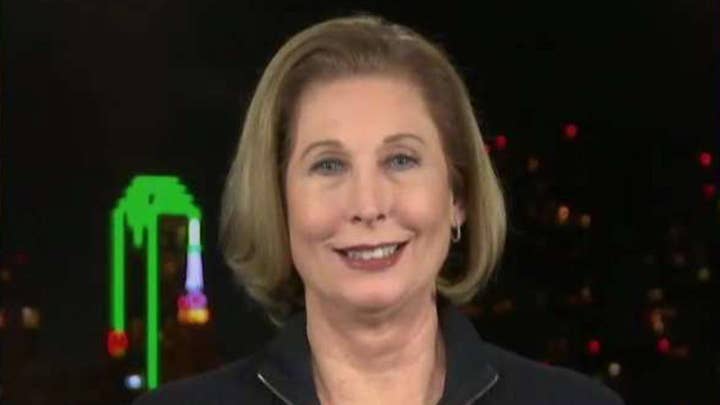
Powell filed a motion saying Flynn’s case was still “not ready for sentencing,” citing her position as “new counsel” and the timeline of receiving necessary files and documents that would be critical to the defense of her client.
Powell also claimed in the filing that the government was denying her request for security clearances needed to review classified material pertaining to Flynn, including transcripts and recordings of phone calls that “supposedly underpin the charges against” him.
DOJ SEEKS UP TO SIX-MONTH PRISON SENTENCE FOR FLYNN
October 2019
Justice Department attorneys Brandon Van Grack, Jocelyn Ballantine and U.S. Attorney for the District of Columbia Jessie Liu fired back against Powell and Flynn’s defense, saying that their various information requests from the government were “either irrelevant or seek information that has already been provided to them.”
The DOJ attorneys said Powell’s filing in August was “in fact an effort by the defendant to have his case dismissed.”
“Since the beginning of their involvement, the defendant’s new counsel, have sought to get the charges dropped, professed their client’s actual innocence, and perpetuated conspiracy theories, all while stating that the defendant does not intend to withdraw his guilty plea,” they wrote.
Oct. 25, 2019
Powell filed a motion urging the court to “dismiss the entire prosecution for outrageous government misconduct.”
Powell, at the time, alleged that FBI officials manipulated Flynn’s FBI 302 from his initial January 2017 interview with federal prosecutors. 302s are forms used by agents to report or summarize interviews.
Oct. 29, 2019
Days later, U.S. District Judge Emmet Sullivan canceled a hearing, citing Powell’s motion demanding that the government produce all evidence related to Flynn and dismiss the prosecution altogether.
November 2019
Sullivan agreed to postpone Flynn’s sentencing—again—until the release of Justice Department Inspector General Michael Horowitz’s report on the Russia probe.
December 2019
Sullivan set a Jan. 28 sentencing date for Flynn but rejected his legal team’s requests for exculpatory information that may have been withheld by the FBI. Sullivan also said that Flynn waived his fundamental constitutional rights by pleading guilty to making false statements in the first place.
Flynn's guilty pleas, Sullivan wrote, "effectively bar him from raising claims based on any evidence obtained in violation of the Fourth Amendment." Even if Flynn had not waived his Fourth Amendment rights, Sullivan argued that Flynn still needed to "establish that the requested information is favorable" to his defense in order to obtain it -- something he has "failed" to do, the judge said.

Jan. 7, 2020
The Justice Department recommended up to six months of prison time for Flynn, claiming he has refused to “accept responsibility” for his actions.
“Given the serious nature of the defendant’s offense, his apparent failure to accept responsibility, his failure to complete his cooperation in—and his affirmative efforts to undermine—the prosecution of [ex-Flynn associate] Bijan Rafiekian ... the government recommends that the court sentence the defendant within the applicable Guidelines range of 0 to 6 months of incarceration,” federal prosecutors wrote in a sentencing memo on Tuesday.
The filing represents a stark change from a prior Justice Department recommendation, which suggested that Flynn “receive a sentence at the low end of the Guidelines range.” Federal prosecutors, in earlier suggesting that Flynn not serve any prison time, had cited his cooperation with other federal cases, including Special Counsel Robert Mueller’s Russia probe.
BARR TAPS NETWORK OF PROSECUTORS TO REVIEW RUSSIA-UKRAINE CASES
Jan. 14, 2020
Flynn moved to withdraw his guilty plea for lying to the FBI, citing “bad faith, vindictiveness, and a breach of the plea agreement” by the government.
“The prosecution has shown abject bad faith in pure retaliation against Mr. Flynn since he retained new counsel,” Powell wrote in the filing. “This can only be because with new, unconflicted counsel, Mr. Flynn refused to lie for the prosecution.
FEDERAL JUDGE INDEFINITELY POSTPONES FLYNN SENTENCING
Jan. 16, 2020
Sullivan pushed back Flynn’s sentencing again, bumping the date to Feb. 27, after Flynn motioned to withdraw his guilty plea.
Feb. 9, 2020
Federal prosecutors proposed delaying approaching deadlines in the Flynn case. Prosecutors argued that Flynn’s former attorneys should testify after he claimed to receive ineffective assistance from them.
“The government requests that the Court suspend the current briefing schedule concerning the defendant’s [motion] until such time as the government has been able to confer with Covington regarding the information it seeks,” prosecutors wrote.
Feb. 10, 2020
Sullivan indefinitely postponed Flynn’s sentencing date after federal prosecutors filed their motion to delay the deadlines.
Feb. 14, 2020
Barr tapped U.S. attorney for the Eastern District of Missouri, Jeff Jensen, to review Flynn’s case.
Jensen was assigned to work hand-in-hand with the lead prosecutor of Flynn case, Brandon Van Grack.
March 15, 2020
President Trump said he was “strongly considering” a pardon for Flynn after reports that the Justice Department misplaced the records from Flynn’s January 2017 initial interview with federal prosecutors.
"So now it is reported that, after destroying his life & the life of his wonderful family (and many others also), the FBI, working in conjunction with the Justice Department, has 'lost' the records of General Michael Flynn," Trump tweeted. "How convenient. I am strongly considering a Full Pardon!”
April 29, 2020
New internal FBI documents were unsealed in late April, revealing that top bureau officials discussed their motivations for interviewing then-national security adviser Flynn in the White House in January 2017—and openly questioned if their “goal” was “to get him to lie, so we can prosecute him or get him fired."
The handwritten notes—written by the FBI’s former head of counterintelligence Bill Priestap after a meeting with then-FBI Director James Comey and then-FBI Deputy Director Andrew McCabe, Fox News is told—further suggested that agents planned in the alternative to get Flynn “to admit to breaking the Logan Act” when he spoke to then-Russian Ambassador Sergey Kislyak during the presidential transition period.
The Logan Act is an obscure statute that has never been used in a criminal prosecution; enacted in 1799 in an era before telephones, it was intended to prevent individuals from falsely claiming to represent the United States government abroad.
"What is our goal?" one of the notes read. "Truth/Admission or to get him to lie, so we can prosecute him or get him fired?”
"If we get him to admit to breaking the Logan Act, give facts to DOJ + have them decide," another note read. Constitutional law professor Jonathan Turley called the document's implications “chilling."
The memo appears to weigh the pros and cons of pursuing those different paths. "I don't see how getting someone to admit their wrongdoing is going easy on him," one note reads. Flynn did not ultimately admit to wrongdoing in the interview.
The document indicates that the agents at least discussed the merits of a by-the-book approach: "If we’re seen as playing games, WH [White House] will be furious.”
Flynn’s attorney, Sidney Powell, told Fox News after the document release that “this persecution will have to be thrown out entirely.”
May 7, 2020
The Justice Department moved to drop its case against Flynn.
“The Government has determined, pursuant to the Principles of Federal Prosecution and based on an extensive review and careful consideration of the circumstances, that continued prosecution of this case would not serve the interests of justice,” the filing said.
May 12, 2020
Sullivan moved to let outside groups submit their opinions in the case, indicating he would not immediately rule on the DOJ decision to dismiss the case.
Fox News' Gregg Re contributed to this report.

