


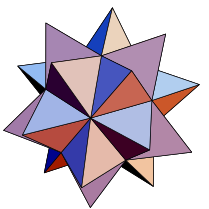
"Spikey" is the logo of Wolfram Research, makers of Mathematica and the Wolfram Language. In its original
(Version 1) form, it is an augmented icosahedron
with an augmentation height of  ,
not to be confused with the great stellated
dodecahedron, which is a distinct solid. This gives it 60 equilateral
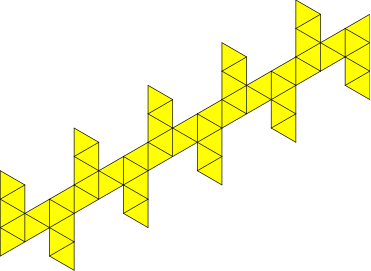
triangular faces, making it a deltahedron. More
elaborate forms of Spikey have been used for subsequent versions of Mathematica.
In particular, Spikeys for Version 2 and up are based on a hyperbolic
dodecahedron with embellishments rather than an augmented icosahedron (Trott 2007a, Weisstein 2009).
Trott's cover constructions use the full symmetry group of the dodecahedron, the icosahedral
group  of group
order 120. Each of the 12 equivalent regular
pentagon faces can be divided into 10 equivalent triangular pieces, so the construction
of one piece determines the others by symmetry (Trott 2007a). The earlier cover constructions
are described by Trott (2004, pp. 841-861).
The surface pattern of the Version 6 Spikey uses a rep-tile construction. An L-shaped triomino is recursively divided into four similar copies, each with half the linear dimensions. The resulting pattern is mapped onto the faces of a dodecahedron (Trott 2007b).
|
|
The "classic" (Version 1) Spikey illustrated above is implemented in the Wolfram Language as PolyhedronData["MathematicaPolyhedron"].
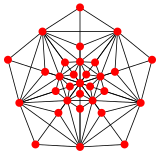
The skeleton of the classic Spikey is the graph of the triakis icosahedron.

A glyph corresponding to the classic Spikey, illustrated above, is available as the character \[MathematicaIcon] in the Wolfram Language.
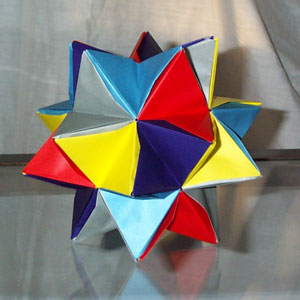
The above image shows an origami Spikey consisting of 30 double-pocket equilateral modules (Fusè 1990, pp. 126-128).

The cross-stitched Spikey shown above was created by Jennifer Peterson (pers. comm., Dec. 5, 2006).

|

|

|
In August 2004, R. Bell has constructed a 300-400-pound gigantic Spikey sculpture out of plywood, illustrated above (photos courtesy of Merritt Pelkey). Bell's plywood Spikey has an internal pentagonal floor, external metal strapping to hold the equilateral triangles together into the constituent tetrahedra, and internal metal strapping to hold the tetrahedra together into the final structure. Metal struts line the bottom five edges to strengthen the base and prevent the bottom tips from crushing. Assembly requires about 6 hours.
The volume of the Spikey constructed from an icosahedron with unit edge lengths is
 |
(1)
|
and the surface area is
 |
(2)
|
The inertia tensor is given by the diagonal matrix with diagonal elements
 |
(3)
|


 Trott, M. "The Cover Image: Making the Mathematica 6 Surface-Textured
Hyperbolic Dodecahedron." Wolfram Library Archive. May 22, 2007b.
