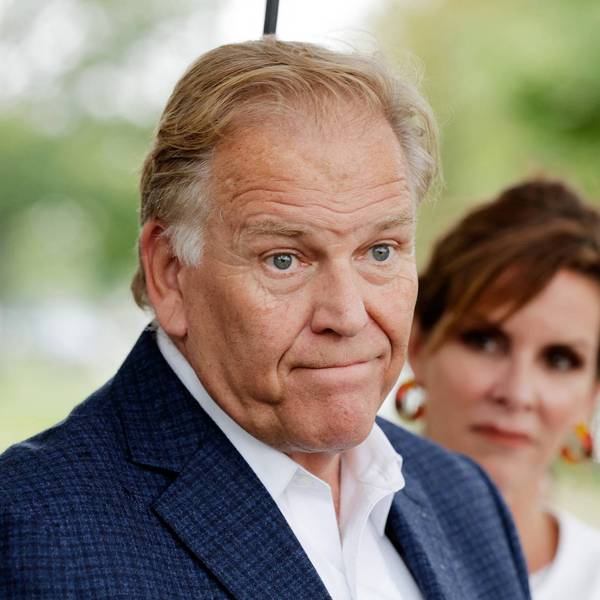

U.S. Speaker of House Mike Johnson (R-La.) talks to reporters at the Capitol in Washington, D.C. on February 6, 2024.
Privacy Advocates Alarmed as House Resumes Spying Powers Fight
Rights groups are particularly concerned about reporting that parts of the debate could be held in "secret session."
Privacy rights advocates and experts are sounding the alarm this week as members of the U.S. House of Representatives dive back into a contentious battle over reforming warrantless government surveillance powers that historically have been abused and consider closed-door debate.
House Republicans on Monday unveiled the Reforming Intelligence and Securing America Act and announced that the Committee on Rules will meet Wednesday to discuss the bill, which combines two previously competing proposals focused on Section 702 of the Foreign Intelligence Surveillance Act (FISA).
Section 702—which Congress temporarily extended with an annual defense package in December—only allows warrantless surveillance targeting foreigners located outside the United States, but Americans' data is also collected, and several agencies including the Federal Bureau of Investigation (FBI) have been widely lambasted for misusing it.
"Rushing to pass an anti-reform bill, subject only to very limited (and partially secret) debate, is a flagrant attempt to sidestep the strong, bipartisan movement for surveillance reform."
The new bill "more closely aligns with the original proposal from the House Intelligence Committee over that of its Judiciary competitor, focusing on more reforms at the FBI to address misuse of the powerful spy tool," according to The Hill. "But it does not include Judiciary's hope for a warrant requirement—something deemed a red line for the intelligence community but nonetheless a top priority for privacy advocates in Congress."
The outlet also noted that "the process of bringing the bill to the floor will push the House to return to a previously floated idea from Speaker Mike Johnson (R-La.) to do a queen-of-the-hill-style debate format that would allow for consideration of amendments—including a potential amendment on a warrant requirement."
Also stressing the divisiveness of the warrant policy, Wired detailed Monday:
Several aides attributed the drawn-out nature of the fight, at least in part, to the relative naivete of the House speaker on national security matters, saying that, with little experience in the area, Johnson had not previously had the opportunity to be captured by the intelligence community—powerful interests accused by congressional staffers of routinely deploying "fear tactics" to defend surveillance operations plagued by regular error and abuse.
Johnson's lack of any intelligence background, staffers say, would have likely increased his dependence on House intelligence staffers, who, while cultivating a sense of awe due to their access to national secrets, routinely behave as ambassadors between the spy agencies and regular congressional staff.
Privacy advocates inside and outside the House continue to emphasize the need for a warrant requirement. They are also concerned about reporting from Politico's Jordain Carney late Sunday that some debate may occur in "secret session."
"Most lawmakers want major reform of Section 702. The Judiciary Committee's reform bill passed out of committee on a 35-2 vote," said Elizabeth Goitein, senior director of the Brennan Center for Justice's Liberty & National Security Program. "Intelligence Committee leaders know they can't win on an even playing field, so they're trying to use secrecy to avoid reform."
"Secret law is anathema to democracies, and making law in secret is the next worst thing. Open debate is a core feature of our democratic system," she continued, noting how uncommon secret sessions are. "House members should unite in opposition to this ploy and demand open debate on surveillance reform."
Responding to Goitein on social media, exiled American whistleblower Edward Snowden declared: "Secrecy and deceit must have no place in the making of American law. This effort to revive disgraced Bush-era practices in order to thwart a *reform bill* is a scandal. A genuine scandal."
Jeramie Scott, senior counsel and director of EPIC's Project on Surveillance Oversight was similarly critical, saying: "Rushing to pass an anti-reform bill, subject only to very limited (and partially secret) debate, is a flagrant attempt to sidestep the strong, bipartisan movement for surveillance reform. The American people deserve better."
Jake Laperruque of the Center for Democracy & Technology's Security and Surveillance Project—who backed the previous House Judiciary Committee bill—cast doubt on the new legislation's prospects given opposition from not only that panel but also the far-right Freedom Caucus, which has scheduled a Tuesday afternoon press conference.
Laperruque said Monday that "I don't think you can say with any certainty" that the bill would get support from a majority of Republicans, who narrowly control the House.
We are at a crossroads
This country and this world are at a monumental crossroads. In a few short weeks, US voters will have an opportunity to beat back the forces of fascism and confront the billionaires who are rigging the economy, our media system, and our democracy, making it increasingly impossible for ordinary people to get by. We’re not just talking about the election. We’re talking about what must be done once these fascist elements are vanquished from power. We need a bolder set of solutions than what either major party has so far been willing to offer and a working-class movement ready to fight like hell for it. Trump didn't emerge from nowhere. The conditions that fueled MAGA authoritarianism were created by decades of radical neoliberal economic policies and a corrupt political system dominated by corporate interests. They slashed taxes on the super-rich, promising that the benefits would trickle down. They said giveaways to the corporate titans would make life more affordable for the rest of us. It was all bullshit. And when a bitter, betrayed populace searches for someone to blame, right-wing demagogues have little trouble finding scapegoats. People know when they're being lied to, but you won't hear any of this from the corporate media. Only independent journalism—powered and funded by people who believe in building a better world—can deliver truly trustworthy daily news. Our Fall Campaign is underway, and we need your help. To power our newsroom through the rest of the year, we need to raise $125,000 by midnight on October 31. So if you share our vision, please contribute whatever you can to sustain our work. |
Privacy rights advocates and experts are sounding the alarm this week as members of the U.S. House of Representatives dive back into a contentious battle over reforming warrantless government surveillance powers that historically have been abused and consider closed-door debate.
House Republicans on Monday unveiled the Reforming Intelligence and Securing America Act and announced that the Committee on Rules will meet Wednesday to discuss the bill, which combines two previously competing proposals focused on Section 702 of the Foreign Intelligence Surveillance Act (FISA).
Section 702—which Congress temporarily extended with an annual defense package in December—only allows warrantless surveillance targeting foreigners located outside the United States, but Americans' data is also collected, and several agencies including the Federal Bureau of Investigation (FBI) have been widely lambasted for misusing it.
"Rushing to pass an anti-reform bill, subject only to very limited (and partially secret) debate, is a flagrant attempt to sidestep the strong, bipartisan movement for surveillance reform."
The new bill "more closely aligns with the original proposal from the House Intelligence Committee over that of its Judiciary competitor, focusing on more reforms at the FBI to address misuse of the powerful spy tool," according to The Hill. "But it does not include Judiciary's hope for a warrant requirement—something deemed a red line for the intelligence community but nonetheless a top priority for privacy advocates in Congress."
The outlet also noted that "the process of bringing the bill to the floor will push the House to return to a previously floated idea from Speaker Mike Johnson (R-La.) to do a queen-of-the-hill-style debate format that would allow for consideration of amendments—including a potential amendment on a warrant requirement."
Also stressing the divisiveness of the warrant policy, Wired detailed Monday:
Several aides attributed the drawn-out nature of the fight, at least in part, to the relative naivete of the House speaker on national security matters, saying that, with little experience in the area, Johnson had not previously had the opportunity to be captured by the intelligence community—powerful interests accused by congressional staffers of routinely deploying "fear tactics" to defend surveillance operations plagued by regular error and abuse.
Johnson's lack of any intelligence background, staffers say, would have likely increased his dependence on House intelligence staffers, who, while cultivating a sense of awe due to their access to national secrets, routinely behave as ambassadors between the spy agencies and regular congressional staff.
Privacy advocates inside and outside the House continue to emphasize the need for a warrant requirement. They are also concerned about reporting from Politico's Jordain Carney late Sunday that some debate may occur in "secret session."
"Most lawmakers want major reform of Section 702. The Judiciary Committee's reform bill passed out of committee on a 35-2 vote," said Elizabeth Goitein, senior director of the Brennan Center for Justice's Liberty & National Security Program. "Intelligence Committee leaders know they can't win on an even playing field, so they're trying to use secrecy to avoid reform."
"Secret law is anathema to democracies, and making law in secret is the next worst thing. Open debate is a core feature of our democratic system," she continued, noting how uncommon secret sessions are. "House members should unite in opposition to this ploy and demand open debate on surveillance reform."
Responding to Goitein on social media, exiled American whistleblower Edward Snowden declared: "Secrecy and deceit must have no place in the making of American law. This effort to revive disgraced Bush-era practices in order to thwart a *reform bill* is a scandal. A genuine scandal."
Jeramie Scott, senior counsel and director of EPIC's Project on Surveillance Oversight was similarly critical, saying: "Rushing to pass an anti-reform bill, subject only to very limited (and partially secret) debate, is a flagrant attempt to sidestep the strong, bipartisan movement for surveillance reform. The American people deserve better."
Jake Laperruque of the Center for Democracy & Technology's Security and Surveillance Project—who backed the previous House Judiciary Committee bill—cast doubt on the new legislation's prospects given opposition from not only that panel but also the far-right Freedom Caucus, which has scheduled a Tuesday afternoon press conference.
Laperruque said Monday that "I don't think you can say with any certainty" that the bill would get support from a majority of Republicans, who narrowly control the House.
- ACLU Slams Congress for NDAA Vote Extending Mass Surveillance Program with No Reforms ›
- 'This Is Wrong': Congress Trying to Ram Through Spying Powers Extension ›
- Senate Passes $886 Billion Military Bill That Includes Mass Spying Extension ›
- Supporters of Government Surveillance Reform Act Aim to End 'Litany of Abuse' ›
- 'Chilling': Rights Advocates Blast FBI for Abusing Surveillance Tool 278,000+ Times ›
- Privacy Defenders Decry 'Spy Draft' in Section 702 Renewal Advanced by Senate | Common Dreams ›
