

Accountancy is a systematic practice that involves recording, classifying, and summarizing business transactions to ensure the efficient and effective functioning of an organization.
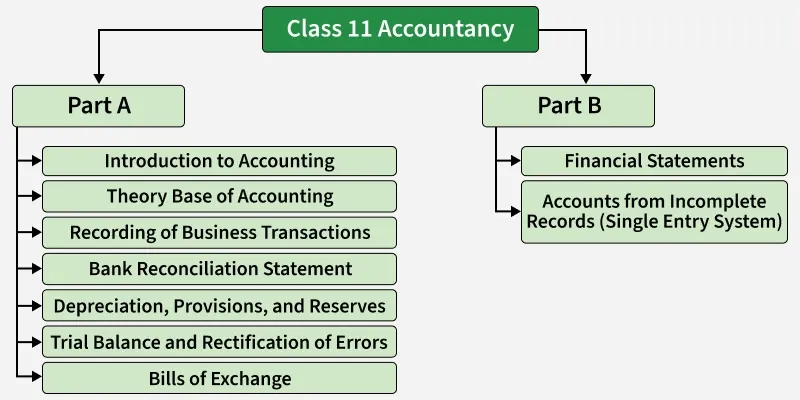
These Class 11 Accountancy notes are prepared in accordance with the CBSE syllabus and are designed to support thorough revision.
PART A
Chapter 1: Introduction to Accounting
Accounting means identifying, recording, measuring, and communicating the accounting information with its different users. Chapter 1: Introduction of Accounting of Class 11th Accountancy describes the basic concept of accounting, accounting information, and different users of accounting information in detail for a better understanding of the subject. The notes of this chapter also contain basic accounting terms like "capital," "profit," "loss," "drawings," "purchase," "sale," etc., to build a strong base of the subject so that the learners can easily understand further chapters.
- Introduction to Accounting
- Types and Users of Accounting Information
- Bookkeeping vs. Accounting
- Objectives, Characteristics, Advantages, Disadvantages, and Role
- Basic Accounting Terms
- Accounting vs. Accountancy
Chapter 2: Theory Base of Accounting
The second chapter of Class 11th Accountancy Part A consists of the basis of accounting and accounting standards. The notes also cover the basic and important accounting concepts in detail, like the business entity concept, going concern concept, cost concept, matching concept, and many more. The below-mentioned quick links also describe the International Financial Reporting Standards and Generally Accepted Accounting Principles for accounting. Another major topic to understand the concept of accounting, single and double entry systems of accounting, is also mentioned in the notes.
- Accounting Standards: Need, Benefits, Limitations, and Applicability
- International Financial Reporting Standards and Generally Accepted Accounting Principles
- Difference between Cash Basis and Accrual Basis of Accounting
- Basic Accounting Concepts
- Systems and Basis of Accounting | Single and Double Entry System
Chapter 3: Recording of Business Transactions
As we know from the definition of accountancy, the business transactions of an organization are recorded for further reference and preparation of financial statements. The third chapter of Class 11th Accountancy Part A contains all the required information on how to record a transaction, where to record a transaction, and how to transfer the recorded transactions from journal to ledger. It is the most important chapter of accountancy, as it will help in solving the full-fledged questions of accountancy. The notes of this chapter include detailed knowledge of the important topics like the accounting equation, journal entry, cash book, sales book, ledger, and many more with meaning, format, and examples. The below-mentioned quick links are sufficient to understand the Recording of Business Transactions.
- What is an accounting voucher? Explain the Types of Vouchers.
- Introduction to Accounting Equation
- Accounting Equation | Increase in Assets and Capitals both and Increase in Assets and Liability both
- Accounting Equation | Decrease in Assets and Capital both and Decrease in Asset and Liability both
- Accounting Equation: Decrease in Capital and Increase in the Liability, Decrease in Liability and Increase in the Capital, and Increase and Decrease in Assets
- Accounting Equation | Sale of Goods and Calculation of Net Worth (Owner’s Equity) or Capital
- Journal Entries
- Rules of Journal Entry
- Journal Entry (Capital, Drawings, Expenses, Income & Goods)
- Journal Entry for Capital
- Journal Entry for Drawings
- Journal Entry for Paid Expenses
- Journal Entry for Income
- Journal Entry for Sales and Purchase of Goods
- Journal Entry for Cash and Credit Transactions
- Journal Entries | Banking Transactions (Part-1)
- Journal Entries | Banking Transactions (Part-2)
- Journal Entry for Assets
- Journal Entry for Depreciation
- Journal Entry for Discount Allowed and Received
- Journal Entry for Full/Final Settlement
- What is a compound journal entry?
- Opening Journal Entry
- Journal Entry for Bad Debts and Bad Debts Recovered
- Journal Entry for Loss of Insured Goods/Assets
- Journal Entry for Loan Taken
- Journal Entry for Loan Given
- Journal Entry for Outstanding Expenses
- Journal Entry for Prepaid or Unexpired or Advance Expenses
- Journal Entry for Accrued Income or Income Due
- Journal Entry for Income Received in Advance or Unearned Income
- Journal Entry for Income Tax
- Journal Entry for Life Insurance Premium & Employee’s Life Insurance Premium
- Journal Entry for Interest on Capital
- Journal Entry for Interest on Drawings
- Journal Entry for Use of Goods in Business
- Journal Entry for Expenditure on Assets (Erection or Installation)
- Journal Entry for Expenses on Purchase of Goods
- Journal Entries under GST (Goods and Services Tax)
- Cash Book: Meaning and Types. and Example
- Purchases Book: Meaning, Format, and Example
- Sales Book: Meaning, Format, and Example
- Purchase Return Book: Meaning, Format, and Example
- Sales Return Book: Meaning, Format, and Example
- Journal Proper: Meaning, Format, and Examples
- Ledger | Meaning, Format, Example, and Balancing of Accounts
Chapter 4: Bank Reconciliation Statement
The fourth chapter of Class 11th Accountancy, Bank Reconciliation Statement, is one of the important chapters of Accountancy. The notes of this chapter cover the meaning, format, and example of the bank reconciliation statement. It also describes how to prepare a statement reconciling the balances of an organization's Cash Book and Pass Book.
- Bank Reconciliation Statement
- Difference between Bank Statement and Bank Reconciliation Statement
- Preparation of BRS without correcting the cash book
- Bank Reconciliation Statement (BRS): Without Correcting Cash Book
- Preparation of Bank Reconciliation Statement with Amended Cash Book
- Bank Reconciliation Statement (BRS): When extracts from the cash book and pass book are given
Chapter 5: Depreciation, Provisions, and Reserves
The fifth chapter of Class 11th Accountancy Part A is Depreciation, Provisions, and Reserves. The important topics covered in the notes of this chapter are depreciation, methods of calculating depreciation (SLM and WDV methods), accounting treatment of depreciation, reserves, provisions, different types of reserves, and many more. The notes provide detailed information on these topics with formulas to calculate and examples for a better understanding of the topic.
- Depreciation: Features, Causes, Factors, and Need
- Methods of charging depreciation
- Straight Line Method of Charging Depreciation
- Written Down Value Method
- Difference between the Straight Line and Written Down Value Methods of Calculating Depreciation
- Difference between Depreciation and Amortization
- Provisions in Accounting—Meaning, Accounting Treatment, and Example
- Reserves in Accounting: Meaning, Accounting Treatment, Importance, and Example
- Reserves and Their Types
- Difference between Capital Reserve and Revenue Reserve
Chapter 6: Trial Balance and Rectification of Errors
Although a trial balance is not a part of the accounting process of an organization, it is essential to ascertain the accuracy of the ledger accounts and determine any mistake or error in the accounts. Chapter 6 of Class 11th Accountancy Part-A, Trial Balance and Rectification of Errors, covers the detailed information on how to prepare a trial balance, its format, objectives, etc. The notes also consist of important topics like detection of errors in trial balance, rectification of errors, and suspense account.
- Trial Balance: Meaning, Objectives, Preparation, Format, and Example
- Types of Errors in Trial Balance
- Detection and Rectification of Errors in Trial Balance
- What is a Suspense Account?
Chapter 7: Bills of Exchange
The last chapter of Class 11th Accountancy Part A is Bills of Exchange. The important topics covered in the notes of this chapter are bills of exchange, promissory notes, how these two (bills of exchange and promissory note) are different from each other, their accounting treatment, and important terms such as term of bill, accommodation bill, discounting of bill, maturity of bill, etc.
- Bills of Exchange: Meaning, Features, Parties, and Advantages
- Promissory Note: Features and Parties
- Difference between Bills of Exchange and Promissory Note
- Important Terms in Bills of Exchange
- Accounting Treatment of Bills of Exchange
PART B
Chapter 1: Financial Statements
Financial statements are statements depicting the financial position, profit and loss, and cash flow position of an organization. The first chapter of Accountancy Part B contains detailed information about the financial statements and their adjustments. The notes also describe the purpose and importance of preparing the financial statements for an organization and its different users. Other important topics of this chapter are stakeholders, capital, revenue, operating profit, and many more.
- Introduction to Financial Statements
- Financial Statements with Adjustments
- Financial Statements with Adjustments (Journal Entries)
- Financial Statement with Adjustment with with Examples—I
- Adjustment of Closing Stock in Final Accounts (Financial Statements)
- Adjustment of Outstanding Expenses in Final Accounts (Financial Statements)
- Adjustment of Prepaid Expenses in Final Accounts (Financial Statements)
- Adjustment of Accrued Income in Final Accounts (Financial Statements)
- Adjustment of Unearned Income in Final Accounts (Financial Statements)
- Financial Statement with Adjustment with Examples-II
- Adjustment of Interest on Capital in Final Accounts (Financial Statements)
- Adjustment of Interest on Drawings in Final Accounts (Financial Statements)
- Adjustment of Interest on Loan in Final Accounts (Financial Statements)
- Adjustment of Proprietor’s Salary in Final Accounts (Financial Statements)
- Adjustment of Interest on Deposits in Final Accounts (Financial Statements)
- Financial Statement with Adjustment with Examples-III
- Adjustment of Depreciation in Final Accounts (Financial Statements)
- Adjustment of Appreciation in Final Accounts (Financial Statements)
- Adjustment of Bad Debts in Final Accounts (Financial Statements)
- Adjustment of Provision for Bad and Doubtful Debts in Final Accounts (Financial Statements)
- Adjustment of Bad Debts Recovered in Final Accounts (Financial Statements)
- Financial Statement with Adjustment with Examples – IV
- Adjustment of Provision for Discount on Debtors in Final Accounts (Financial Statements)
- Adjustment of Provision for Discount on Creditors in Final Accounts (Financial Statements)
- Financial Statement with Adjustment of Loss of Insured Goods & Assets (all three cases)
- Adjustment of Goods Given as Charity or Free Sample in Final Accounts (Financial Statements)
- Adjustment of Goods Used for Personal Purpose in Final Accounts (Financial Statements)
- Financial Statement with Adjustment with Examples-V
- Adjustment of Use of Goods in Business in Final Accounts (Financial Statements)
- Adjustment of Manager’s Commission in Final Accounts (Financial Statements)
- Adjustment of Deferred Revenue Expenditure in Final Accounts (Financial Statements)
- Financial Statement with Adjustment of Loss of Insured Goods & Assets (all three cases)
- Stakeholders and their Information Requirements
- Capital Expenditure | Meaning, Example, and Accounting Treatment
- Revenue Expenditure | Meaning, Types, Example, and Accounting Treatment
- Capital Receipts | Meaning, Types, Components, and Accounting Treatment
- Revenue Receipts | Meaning, Features, Example, and Accounting Treatment
- Difference between Capital Expenditure and Revenue Expenditure in Accountancy
- Difference between Capital Receipts and Revenue Receipts in Accountancy
- Trading and Profit and Loss Account: Opening Journal Entries
- Operating Profit (EBIT): Meaning, Formula, and Example
- Balance Sheet: Meaning, Format, Need, and Objectives
- Balance Sheet formats
Chapter 2: Accounts from Incomplete Records (Single Entry System)
Accounts from Incomplete Records, also known as the Single Entry System, deals with situations where complete accounting records are not maintained by a business. This chapter explains the meaning, features, advantages, and limitations of incomplete records. It also describes the methods used to ascertain profit or loss when full double-entry records are not available, namely the Statement of Affairs Method and the Conversion Method. The chapter highlights the suitability of the single-entry system for small businesses and emphasizes the importance of maintaining complete records for accurate financial reporting and decision-making.
