

Software development requires a solid foundation of technical skills that help you write efficient, reliable, and maintainable code. Whether you are a student, beginner, or experienced programmer, mastering these core skills improves problem-solving ability and career readiness. The skills below remain highly relevant for developers working in modern software environments.
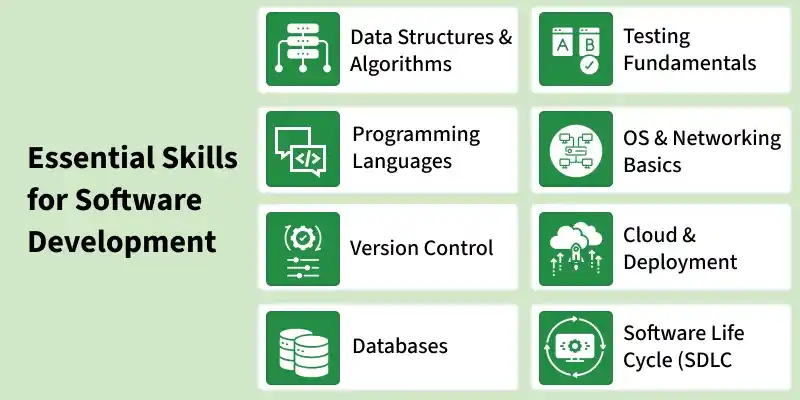
1. Data Structures and Algorithms
Understanding how to organize and process data efficiently is fundamental to good software development. Strong knowledge of data structures and common algorithms helps you write faster and more memory-efficient code. This skill is frequently tested in interviews and used daily in real projects.
- Improves problem-solving and coding efficiency
- Helps optimize time and space complexity
- Forms the foundation for technical interviews
2. Programming Languages
Developers should gain deep proficiency in at least one programming language. Popular choices include Python, JavaScript/TypeScript, Java, C++, and Go, depending on the domain. Depth in one language is more valuable than surface knowledge of many.
- Enables effective problem-solving and application development
- Supports backend, frontend, scripting, or systems work
- Builds a strong base for learning additional languages
3. Version Control
Version control systems help developers track changes, collaborate, and manage code history. Git is the industry standard used by most teams and open-source projects. Comfort with branching, commits, pull requests, and code review is essential.
- Enables safe collaboration on shared codebases
- Supports rollback and change tracking
- Is expected in nearly every professional development role
4. Databases
Most applications rely on databases to store and retrieve data. Developers should understand SQL for relational databases and have familiarity with NoSQL options such as MongoDB or Redis. Skills include writing queries, designing schemas, and handling basic performance considerations.
- Supports data storage, retrieval, and management
- Helps build reliable and scalable applications
- Is required for nearly all backend and full-stack roles
5. Testing Fundamentals
Testing ensures software works correctly and remains stable over time. Developers should understand unit testing, integration testing, and basic system testing approaches. Writing automated tests improves code quality and reduces bugs.
- Helps catch issues early in development
- Supports reliable software releases
- Builds confidence in code changes
6. Operating Systems and Networking Basics
Understanding how operating systems manage memory, processes, and resources is useful for debugging and performance tuning. Basic networking knowledge (HTTP, TCP/IP, client-server models) helps when building or troubleshooting web and distributed applications. These fundamentals support better system-level thinking.
- Improves debugging and performance awareness
- Supports development of networked applications
- Helps diagnose environment-related issues
7. Cloud and Deployment Basics
Modern software is frequently deployed on cloud platforms. Developers benefit from understanding containers, basic cloud services, and how code moves from development to production. Familiarity with tools such as Docker and one major cloud provider is increasingly expected.
- Supports scalable and reliable application deployment
- Helps understand production environments
- Aligns with current industry practices
8. Software Development Life Cycle
The Software Development Life Cycle provides a structured approach to building software. Understanding stages such as requirements, design, development, testing, deployment, and maintenance helps teams deliver quality products. This knowledge improves planning and collaboration.
- Guides organized and predictable development
- Supports quality and risk management
- Helps developers work effectively within teams
9. Security Fundamentals
Security is a shared responsibility in modern software development. Developers should understand basic concepts such as encryption, authentication, secure coding practices, and common vulnerabilities(Cryptography). Building secure software from the start reduces risk.
- Protects user data and system integrity
- Supports secure application design
- Reduces exposure to common attacks
10. Integrated Development Environments and Tools
IDEs and modern development tools speed up writing, debugging, and testing code. Familiarity with popular environments and editors improves productivity. Developers should also be comfortable with the command line and basic automation.
- Speeds up coding, debugging, and testing
- Supports efficient daily workflows
- Helps maintain consistent development practices
Must Read
