

Denormalization is a database optimization technique in which some redundant or derived data is intentionally introduced into a normalized design to improve read performance. It is commonly used when frequent joins, aggregations, or repeated calculations become expensive.
- Normalization reduces redundancy and improves data integrity.
- Denormalization selectively adds redundancy to optimize specific access patterns.
- It is mainly useful in read-heavy systems where query performance is more important than minimizing duplicate data.
Example: A reporting system may store customer name, region, and order summary data together so reports can be generated without repeatedly joining multiple tables.
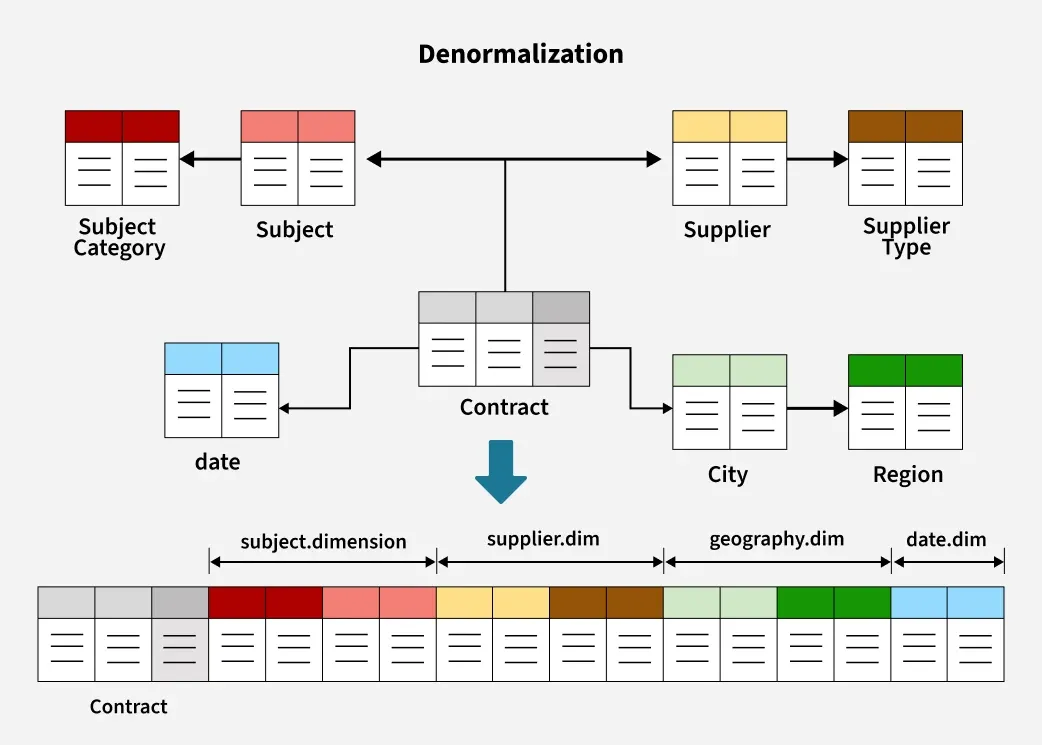
The above image illustrates database denormalization, where data from related tables such as Subject, Supplier, City, Region, and Date is combined into a single flattened Contract table. This reduces the need for complex joins and improves query performance, but increases data redundancy and storage requirements.
How Denormalization Works
Denormalization is generally applied to an existing normalized database by selectively combining or duplicating data to optimize frequently executed queries.
Step 1: Unnormalized Structure
An unnormalized structure may combine multiple types of information in one table, leading to unnecessary duplication and maintenance challenges.
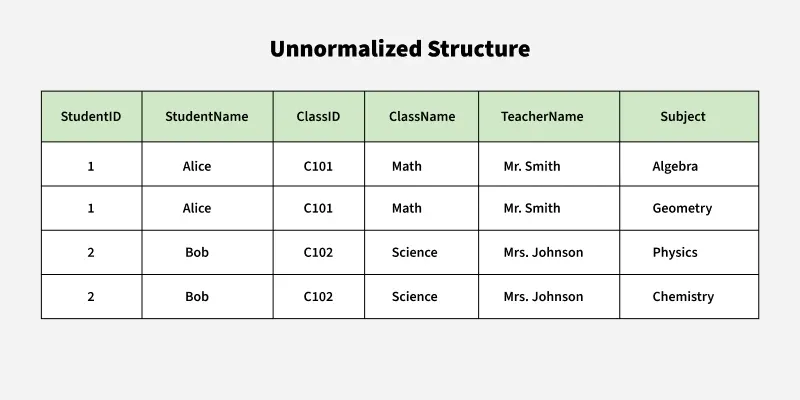
- Data Redundancy: The same information may appear in multiple records.
- Update Anomalies: Modifying one value may require updating several records.
- Data Inconsistency: Missing updates can produce conflicting values.
- Storage Overhead: Duplicate information increases storage requirements.
Step 2: Normalized Structure
Normalization divides data into related tables to reduce redundancy and improve data integrity.
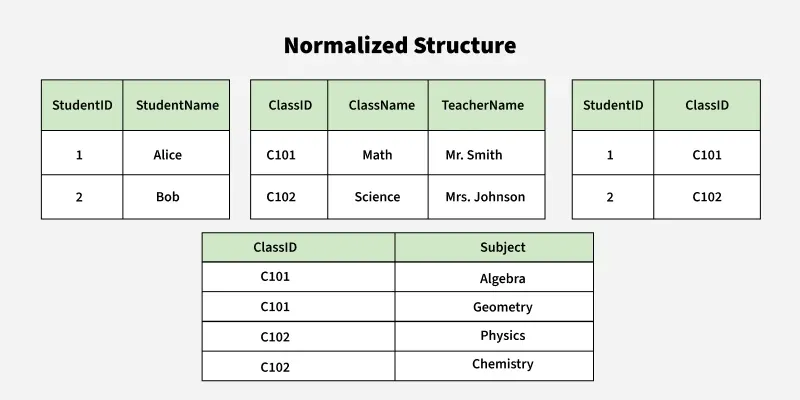
- Reduced Redundancy: Stores repeated information in fewer locations.
- Improved Integrity: Uses relationships and constraints to maintain consistent data.
- Simplified Updates: Changes can often be made in one authoritative record.
- Efficient Storage: Reduces unnecessary data duplication.
Step 3: Denormalized Structure
Denormalization selectively combines or duplicates related data to reduce expensive joins and improve frequently executed read queries.

- Faster Retrieval: Stores frequently accessed information together to reduce joins.
- Simplified Queries: Makes common data retrieval operations less complex.
- Controlled Redundancy: Introduces selected duplicate or derived values for performance.
- Synchronization Requirements: Requires mechanisms to keep redundant data consistent.
Note: Denormalization differs from an unnormalized design because it deliberately introduces selected redundancy into an otherwise structured database to optimize specific workloads.
Common Denormalization Techniques
Denormalization uses several techniques to reduce query complexity and improve frequently accessed data retrieval.
- Duplicating Fields: Copies frequently accessed values into related tables to avoid repeated joins.
- Precomputed Values: Stores calculated results, such as order totals, instead of recalculating them for every query.
- Summary Tables: Maintains aggregated data, such as daily sales totals, for faster reporting.
- Combining Tables: Merges frequently joined data into a single structure when justified by workload requirements.
- Materialized Views: Stores query results physically for faster retrieval, with refresh requirements depending on the database.
When to Use and Avoid Denormalization
| When to Use Denormalization | When to Avoid Denormalization |
|---|---|
| Read-heavy workloads where applications perform significantly more reads than writes. | Data changes frequently, increasing synchronization overhead. |
| Queries require multiple expensive joins across large tables. | Strict consistency between duplicated values is difficult to maintain. |
| Reporting and analytics require repeated joins or aggregations. | Storage is limited and redundant data would increase storage usage. |
| Frequently accessed data needs lower-latency retrieval. | Normalized queries already meet performance requirements. |
| Query analysis confirms that joins or repeated calculations are actual bottlenecks. | Additional write, synchronization, and maintenance complexity outweighs the performance benefit. |
Advantages of Denormalization
Denormalization can improve database efficiency for workloads dominated by repeated reads and aggregations.
- Faster Read Queries: Reduces expensive joins for frequently accessed information.
- Simpler Data Retrieval: Makes related data accessible through fewer tables.
- Reduced Computation: Stores precomputed values to avoid repeated calculations.
- Improved Reporting: Summary tables and materialized views accelerate analytical queries.
- Higher Read Throughput: Reducing query work can help support larger read workloads.
Limitations of Denormalization
Denormalization introduces trade-offs involving consistency, storage, and maintenance complexity.
- Data Redundancy: Duplicates information across tables or records.
- Consistency Risks: Values may become inconsistent when updates are not synchronized.
- Storage Overhead: Requires additional space for duplicate and derived data.
- Complex Write Operations: Updates may need to modify multiple records.
- Maintenance Complexity: Schema changes and synchronization become harder to manage.
- Stale Data: Precomputed or replicated values may temporarily become outdated.
