

Ascending order means arranging numbers or objects from smallest to largest. It is also called increasing order.
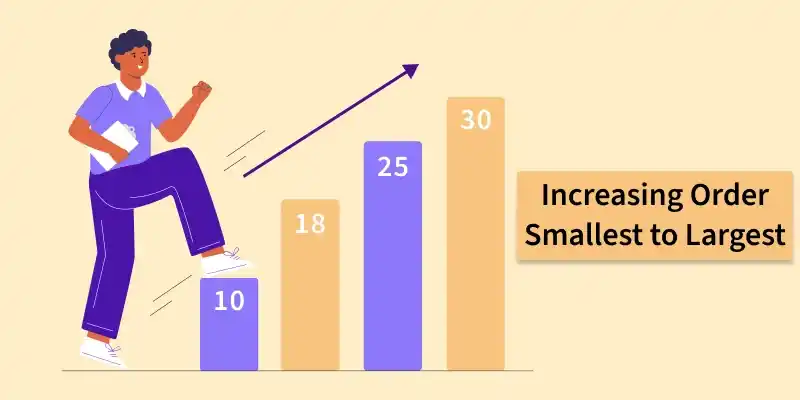
We use the “less than” symbol (<) to write numbers in ascending order.
The symbol “<” means is smaller than.
Example: 1 < 3 < 5 < 8 < 9
Ascending Order on Number Line
A number line is the easiest way to understand ascending order. On a number line, numbers increase from left to right.
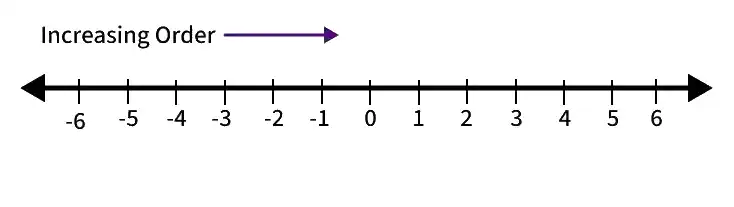
Example: The numbers 1, 3, -2, 0, 4 arranged in ascending order are:
The smallest number is placed on the left, and the numbers become bigger as we move to the right.
So, -2 < 0 < 1 < 3 < 4
How to Arrange Numbers in Increasing Order
In order to arrange the numbers in ascending order, we must first compare the values before doing so.
1. Integers in Ascending Order
Integers are numbers like … -3, -2, -1, 0, 1, 2, 3 …so on. They include negative numbers, zero, and positive numbers.
- In ascending order, numbers are arranged from smallest to largest (left to right on the number line).
- For negative numbers, the one with the bigger number (without sign) is actually smaller.
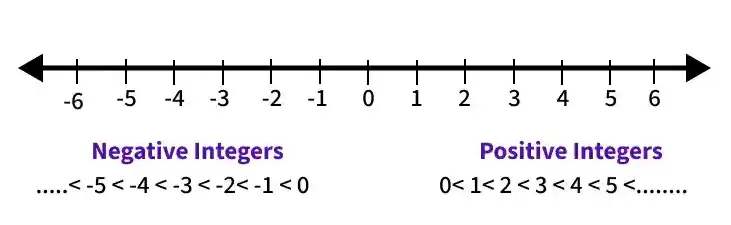
We know 8 > 5 > 3 > 1 So for negative numbers, the order becomes:
–8 < –5 < –3 < –1
In ascending order of integers:
–8, –5, –3, –1, 0, 1, 3, 5, 8
(Smallest to largest — left to right on the number line.)
Fractions in Ascending Order
Fractions are easily arranged in increasing order by making all the fractions as like fractions and then arranging them in ascending order in the order of their numerator.
Example: Let us arrange 1/6, 2/3, 5/12, 7/4 in ascending order.
For changing the given fraction into like fractions we must make the denominators of the fractions equal.
LCM of 6, 3, 12, 4 = 12
- 1/6 = 2/12
- 2/3 = 8/12
- 5/12 = 5/12
- 7/4 = 21/12
Arranging them in the increasing order we get :
2/12 < 5/12 < 8/12 < 21/12
3. Decimals in Ascending Order
Decimals in ascending order are arranged by following the steps discussed below,
Step 1 : In comparing 7.8 and 8.1 we only compare the whole number part, as 7 < 8, so
7.8 < 8.1
Step 2 : If the whole number part is equal then we compare the decimal part one by one as,
7.890 and 7.891 here,
7.890 < 7.891.
Ascending Order vs Descending Order
Descending order is the opposite of ascending order.
Increasing Order | Decreasing Order |
|---|---|
| In ascending order, the number are arranged in order from smaller to larger. | In descending order, the numbers are arranged in order from larger to smaller. |
| The two consecutive numbers are in ascending order. The second number is always greater than the first number. | The two consecutive numbers are in descending order. The second number is always less than the first number. |
It is represented using "<" the symbol. | It is represented using ">" the symbol. |
For example, in ascending order, the numbers are arranged as 2 < 4 < 6 < 8 | For example, in descending order, the numbers are arranged as 8 > 6 > 4 > 2 |
