

Trigonometric equations are mathematical expressions that involve trigonometric functions (such as sine, cosine, tangent, etc.) and are set equal to a value.
Example, a simple trigonometric equation might be: sin(x) = 0.5
Solving this equation involves finding the values of x that make the sine of x equal to 0.5. The solutions could be periodic due to the nature of trigonometric functions.
Note: To solve trigonometric equations, we will use the fact that the periods of sin x and cos x are 2π, and that of tan x is π.
We usually solve trigonometric equations to find the value(s) of the angle (like x or θ) that make the equation true.
Example: sin x = 1/2
Solutions: x = 30° + 360°n OR x = 150° + 360°n (where n is any integer)
Steps to Solve
The following steps define how to solve trigonometric equations:
- Step 1: Transform the supplied trigonometric equation into a single trigonometric ratio equation (sin, cos, tan).
- Step 2: Convert the equation with many angles or submultiple angles into a simple angle using the trigonometric equation.
- Step 3: Now, write the equation as a polynomial, quadratic, or linear equation.
- Step 4: Solve the trigonometric problem in the same way you would any other equation, then calculate the trigonometric ratio.
- Step 5: The solution of a trigonometric equation is given by the angle(s) (in degrees or radians) that satisfy the equation.
General Solutions to Trigonometric Equations
The table below lists the general solutions to the trigonometric equations.
Trigonometric Equations | General Solutions |
|---|---|
| sin θ = 0 | θ = nπ |
| cos θ = 0 | θ = (nπ + π/2) |
| tan θ = 0 | θ = nπ |
| sin θ = 1 | θ = (2nπ + π/2) = (4n+1)π/2 |
| cos θ = 1 | θ = 2nπ |
| sin θ = sin α | θ = nπ + (-1)nα, Where α ∈ [-π/2, π/2] |
| cos θ = cos α | θ = 2nπ ± α, Where α ∈ (0, π] |
| tan θ = tan α | θ = nπ + α, Where α ∈ (-π/2 , π/2] |
| sin 2θ = sin 2α | θ = nπ ± α |
| cos 2θ = cos 2α | θ = nπ ± α |
| tan 2θ = tan 2α | θ = nπ ± α |
If α is supposed to be the least positive number that satisfies two specified trigonometrical equations, then the general value of θ will be 2nπ + α.
Principle Solution
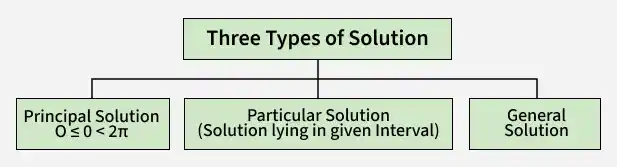
The principal solution of a trigonometric equation refers to the solution that falls within a specific interval, typically between 0° and 360° or 0 and 2π radians. This solution represents the primary or fundamental solution of the equation, and it is often used as a reference point when finding other solutions.
Particular Solution
A particular solution is a specific value of the variable that satisfies a trigonometric equation. It represents one valid solution selected from the possible solutions of the equation and may be given under a particular condition or restriction.
General Solution
A general solution represents all possible values of the variable that satisfy a trigonometric equation. It is expressed using an integer parameter to account for the periodic nature of trigonometric functions, allowing infinitely many solutions to be represented in a single expression or a set of expressions.
Proof of Solutions
Let us now use theorems to demonstrate these solutions i.e.,
- sin x = sin y implies x = nπ + (–1)ny, where n ∈ Z
- cos x = cos y, which implies x = 2nπ ± y, where n ∈ Z
- tan x = tan y implies x = nπ + y, where n ∈ Z
Theorem 1: If x and y are real numbers, sin x = sin y implies x = nπ + (–1)ny, where n ∈ Z
Proof:
Consider the following equation: sin x = sin y. Let's try to solve this trigonometric equation in general.
sin x = sin y
⇒ sin x - sin y = 0
⇒ sin x - sin y = 0
⇒ 2cos (x + y)/2 sin (x - y)/2 = 0
⇒ cos (x + y)/2 = 0 or sin (x - y)/2 = 0Taking the common answer from both requirements, we obtain:
x = nπ + (-1)ny, where n ∈ Z
Theorem 2: For any two real integers x and y, cos x = cos y, which implies x = 2nπ ± y, where n ∈ Z.
Proof:
Likewise, the generic solution of cos x = cos y is:
cos x - cos y = 0.
⇒ 2sin (x + y)/2 sin (y - x)/2 = 0
⇒ sin (x + y)/2 = 0 or sin (x - y)/2 = 0
⇒ (x + y)/2 = nπ or (x – y)/2 = nπTaking the common answer from both criteria yields:
x = 2nπ± y, where n ∈ Z
Theorem 3: Show that tan x = tan y implies x = nπ + y, where n ∈ Z if x and y are not odd multiples of π/2.
Proof:
Similarly, we may utilise the conversion of trigonometric equations to obtain the solution to equations involving tan x or other functions.
In other words, if tan x = tan y,
Then, sin x cos x = sin y cos y
⇒ sin x cos y - sin y cos x
⇒ sin x cos y - sin y cos x = 0
⇒ sin (x - y) = 0As a result, x - y = nπ or x = nπ + y, where n ∈ Z.
Formulas
For solving other trigonometric equations, we use some of the conclusions and general solutions of the fundamental trigonometric equations. The following are the outcomes:
- For any two real integers, x and y, sin x = sin y means that x = nπ + (-1)n y, where n ∈ Z.
- For any two real integers, x and y, Cos x = cos y implies x = 2nπ ± y, where n ∈ Z.
- If x and y are not odd multiples of π/2, then tan x = tan y implies that x = nπ + y, where n ∈ Z.
