

Composite numbers are numbers with more than two factors. These are also known as composites. Composite numbers are the opposite of prime numbers, with only two factors: 1 and the number itself.
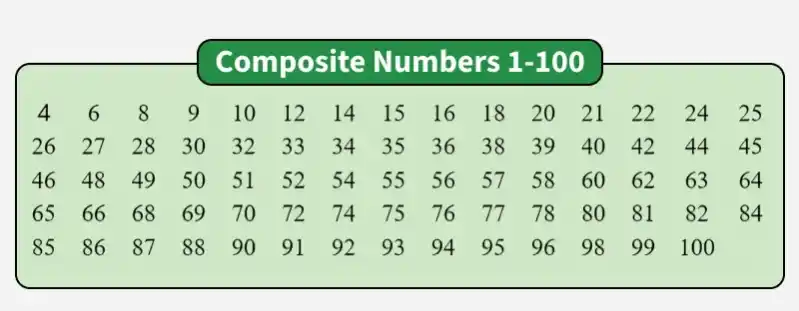
The following chart lists all composite numbers between 1 and 100
Steps to Calculate
Below are the steps for checking if the number is composite:
- Step 1: Find all the factors of the given number.
- Step 2: Count the total numbers of factors for the given number
- Step 3: If the given number has more than two factors then the number is a composite
Types of Composite Numbers
In mathematics, composite numbers come in two primary varieties:
- Even Composite Numbers: Composite numbers are divisible by 2 (except 2, which is prime).
Examples: 4, 6, 8, 10, 12, …
- Odd Composite Numbers: Composite numbers not divisible by 2.
Examples: 9, 15, 21, 25, 27, …
Prime Factorization of Composite Numbers
Prime factorization is a process of breaking down a composite number into its prime factors, which are the prime numbers that, when multiplied together, result in the original composite number.
Some examples of prime factorization of composite numbers are:
- Prime factorization of 24: 24 = 2 × 2 × 2 × 3
- Prime factorization of 56: 56 = 2 × 2 × 2 × 7
- Prime factorization of 90: 90 = 2 × 3 × 3 × 5
- Prime factorization of 120: 120 = 2 × 2 × 2 × 3 × 5
- Prime factorization of 210: 210 = 2 × 3 × 5 × 7
- Prime factorization of 360: 360 = 2 × 2 × 2 × 3 × 3 × 5
Properties
Various properties of composite numbers that are very useful for students are,
- Composite numbers consist of more than two factors.
- Of all composite numbers, 4 is the smallest.
- Composite numbers can be divided evenly by smaller numbers, either prime or composite.
- If n is a composite number, then 2n - 1 is always composite. However, if n is prime, then 2n - 1 may or may not be prime.
- Perfect Squares are the only numbers that have an odd number of distinct divisors. For example, 9 has divisors as 1, 3, and 9. 4 has divisors as 1, 2, and 4. For all other numbers, divisors appear in pairs, so the total number of divisors is always even for other numbers.
- Every Composite number has at least 3 distinct divisors.
