

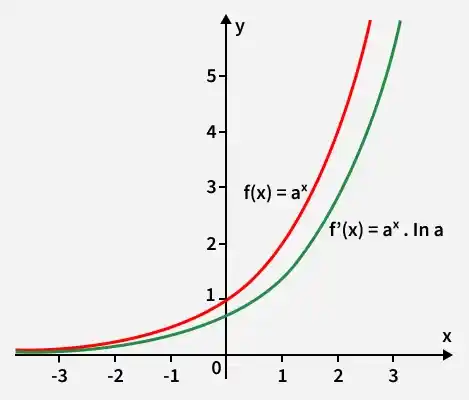
The derivative of an exponential function like ax (a > 0) is the same function multiplied by a constant (the natural log of a). For example, ax becomes ax ln a when differentiated.
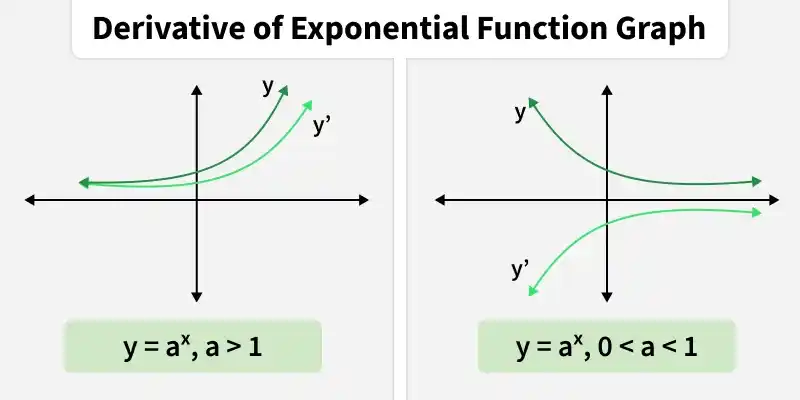
It can be obtained through the first principles of differentiation, utilizing limit formulas, and its graph increases when a > 1 and decreases when 0 < a < 1.
The formula for the differentiation or derivative of the exponential function is:
- If f(x) = ax then f'(x) = ax ln a
- If f(x) = eˣ, then f'(x) = eˣ
Proof
It can be proved by using the first principle, where we find the derivative of a function using the definition of limits. From the definition of limits, we know that
f'(x) = \lim_{h \to 0} \frac{f(x + h) - f(x)}{h} For the function f(x) = ax, using the First Principle,
\frac{d(a^x)}{dx} = \lim_{h \to 0} \frac{a^{x+h} - a^x}{h} =
\lim_{h \to 0} \frac{a^x \cdot a^h - a^x}{h} =
\lim_{h \to 0} \frac{a^x \left(a^h - 1\right)}{h}
= a^x \lim_{h \to 0} \frac{a^h - 1}{h} = ax ln a {Since,
\lim_{h \to 0} \frac{a^h - 1}{h} = ln(a) }Hence, the derivative of the Exponential Function ax is the product of ax and the natural logarithm of a.
Derivative of e to the Power x (ex)
Taking a = e in ax , our function will be f(x) = ex
So, f'(x) = ex ln e
ex ln(e) = ex logee (ln is a natural logarithm with base e)
ex logee = ex (from logarithm formulas, logaa = 1 )
Hence, f'(x) = ex
Exponential Function Derivative Graph
The nature of the graph of exponential function changes when the value of 'a' increases or decreases with respect to 1.
- Graph is increasing if a > 1
- Graph is decreasing if 0 < a < 1
Since exponential function ax is only defined when a > 0 and derivative of a function is tangent to the graph or curve of that function. Hence, the graph of exponential function derivative is increasing for a > 0.
➢Practice: https://write.geeksforgeeks.org/post/6084929
