

Dividing polynomials is the process of dividing one polynomial by another to find a quotient and, sometimes, a remainder. It is similar to dividing ordinary numbers.
Solved Examples
Problem 1. Using synthetic division, find the quotient and remainder of
Solution:
Dividend = x2 + 3 or, x2 + 0x + 3
Divisor = x - 4
Applying synthetic division, we have:
\begin{array}{c|rrr}&1&0&3\\4&&4&16\\\hline\\&1&4&19\\\end{array} The first two numbers of the last row represent the coefficients of the quotient and the third value is the remainder.
Thus, the quotient is x + 4 and the remainder is 19.
Problem 2. Solve
Solution:
Dividend = 4x3 + 5x2 + 5x + 8
Divisor = 4x + 1
Using long division method, we have:
\begin{array}{r} x^2+x+1\phantom{)} \\ 4x+1{\overline{\smash{\big)}\,4x^3+5x^2+5x+8\phantom{)}}}\\ \underline{4x^3~\phantom{}+x^2~~~~~~~~~~~\phantom{-b)}}\\ 4x^2+5x~~~~~~~\phantom{)}\\ \underline{~\phantom{()}4x^2+1x~~~~~~~~~}\\ 4x+8\phantom{)}\\ \underline{-~\phantom{()}(4x+1)}\\ 7\phantom{)}\\ \end{array} Thus, the quotient and remainder are x2 + x + 1 and 7 respectively.
Problem 3. Solve
Solution:
Dividend = 4x3 - 3x2 + 3x - 1
Divisor = x - 1
Applying synthetic division, we have:
\begin{array}{c|rrr}&4&-3&3&-1\\1&&4&1&4\\\hline\\&4&1&4&3\\\end{array} The first three numbers of the last row represent the coefficients of the quotient and the fourth value is the remainder.
The quotient is 4x2 + x + 4 and the remainder is 3.
Problem 4. Solve
Solution:
Dividend = 5x3 - 6x2 + 3x + 11
Divisor = x - 2
Applying synthetic division, we have:
\begin{array}{c|rrr}&5&-6&3&11\\2&&10&8&22\\\hline\\&5&4&11&33\\\end{array} The first three numbers of the last row represent the coefficients of the quotient and the fourth value is the remainder.
The quotient is 5x2 + 4x + 11 and the remainder is 33.
Problem 5. Solve
Solution:
Dividend = 18x4 + 9x3 + 3x2 + 0x + 0
Divisor = 3x2 + 1
Using long division method, we have:
\begin{array}{r} 6x^2+3x-1\phantom{)} \\ 3x^2+1{\overline{\smash{\big)}\,18x^4+9x^3+3x^2+0x+0\phantom{)}}}\\ \underline{18x^4~\phantom{}+0x^3+6x^2~~~~~~~~~\phantom{-b)}}\\ 9x^3-3x^2+0x+0\phantom{)}\\ \underline{~\phantom{()}9x^3+0x^2+3x~~~~~~~~~}\\ -3x^2-3x+0\phantom{)}\\ \underline{~\phantom{()}-3x^2+0x-1}\\ -3x+1\phantom{)}\\ \end{array} Thus, the quotient and remainder are 6x2 + 3x - 1 and -3x + 1 respectively.
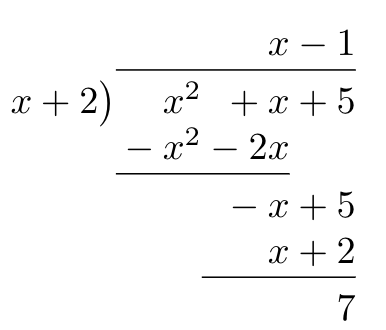
Problem 6. Given the polynomial p(x) = x2 + x +5 and g(x) = x +2. Find the value of q(x) and r(x).
Solution:
Using the steps mentioned above. On dividing p(x) with g(x) we get,
q(x) = x - 1 and r(x) = 7.
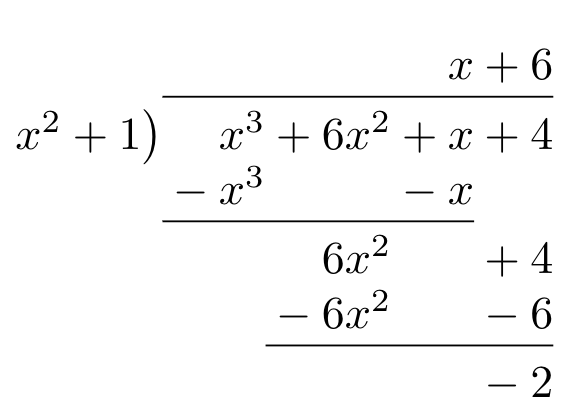
Problem 7. Given the polynomial p(x) = x3 + x + 6x2 + 4 and g(x) = x2 + 1. Find the value of q(x) and r(x).
Solution:
Using the steps mentioned above. On dividing p(x) with g(x) we get,
So, here q(x) = x + 6, and r(x) = -2.
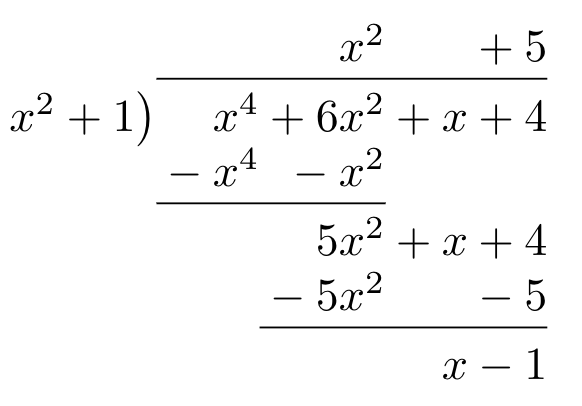
Problem 8. Given the polynomial p(x) = x4 + x + 6x2 + 4 and g(x) = x2 + 1. Find the value of q(x) and r(x).
Solution:
Using the steps mentioned above. On dividing p(x) with g(x) we get,
So, here q(x) = x2 + 5, and r(x) = x -1.
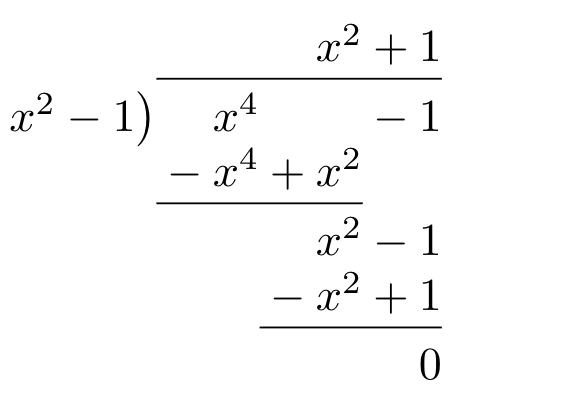
Problem 9. Given the polynomial x4 - 1. We know two of the roots are -1, 1. Find the other two roots if they exist.
Solution:
We know that the two roots are -1 and 1.
So, x -1 and x + 1 are the factors of the given polynomial. Then, (x - 1)(x +1) is also a factor of the polynomial.
(x - 1) (x + 1) = x2 - 1
We see that quotient is x2 + 1. The roots of this polynomial will be the roots of the equation.
x2 + 1 = 0
⇒ x2 = -1
This equation cannot have real roots, thus roots don't exist for this polynomial.
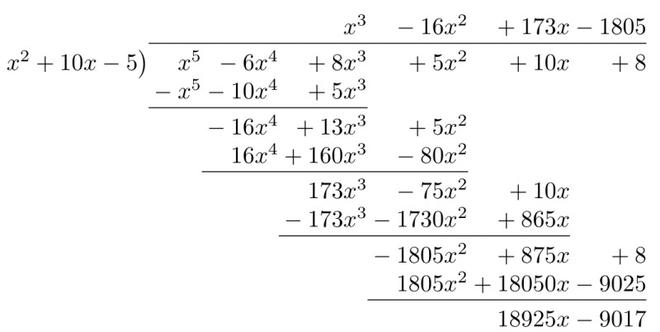
Problem 10. Given the polynomial p(x) = x5 + 8x3 - 6x4 + 5x2 + 10x + 8 and g(x) = x2 + 10x -5. Find q(x) and r(x).
Solution:
Using the same steps as done in previous questions,
q(x) = x3 - 16x2 + 173x - 1805
r(x) = 18295x - 9017
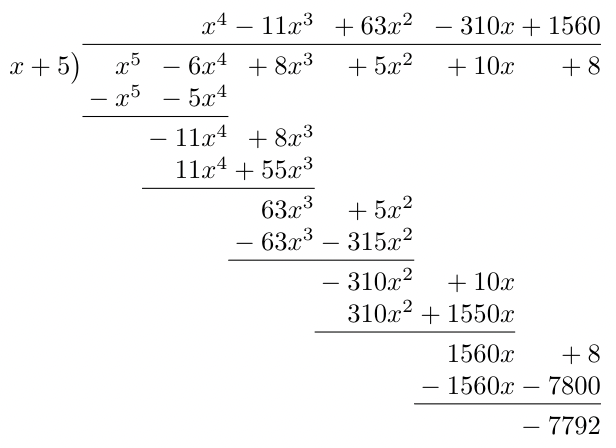
Problem 11. For the same given the polynomial p(x) = x5 + 8x3 - 6x4 + 5x2 + 10x + 8 and g(x) = x + 5. Find q(x) and r(x).
Solution:
Here, q(x) = x4 - 11x3 + 63x2 - 310x + 1560
r(x) = -7792
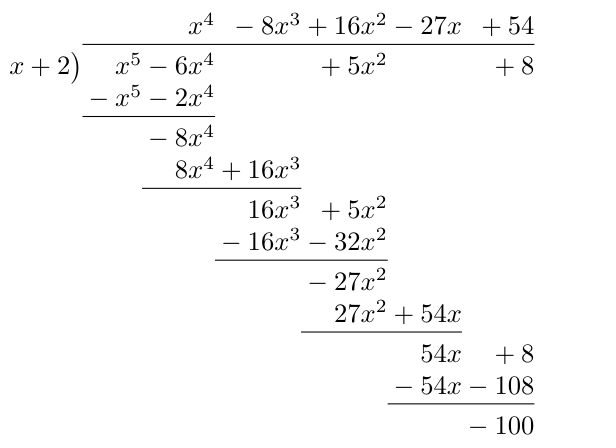
Problem 12. For the same given the polynomial p(x) = x5 - 6x4 + 5x2 + 8 and g(x) = x + 2. Find q(x) and r(x).
Solution:
q(x) = x4 - 8x3 + 16x2 -27x + 54
g(x) = -100
Practice Problems
Problem 1: Find the quotient and remainder when 12345 is divided by 97.
Problem 2: Given that when 3456 is divided by 89 the remainder is 56. Find the quotient.
Problem 3: Divide 6789 by 123 and express the result in terms of quotient and remainder.
Problem 4: If a divided by 25 gives a quotient of 37 and a remainder of 8 find the value of a.
Problem 5: Determine the quotient and remainder when 98765 is divided by 543.
Problem 6: Find the remainder when 1001 is divided by 7 and 11. Use the results to find the quotient for each case.
Problem 7: When 2024 is divided by 40 the remainder is r. Find r and express 2024 in terms of the quotient and remainder.
Problem 8: If 5678 is divided by 54 what is the remainder? Also, find the quotient.
Problem 9: Find the quotient and remainder when 4321 is divided by 89.
Problem 10: Given that the quotient of 8765 divided by 89 is 98 find the remainder.
