

Polynomials are algebraic expressions made using numbers and variables, combined through addition, subtraction, and multiplication, where the variables have only non-negative whole number powers.
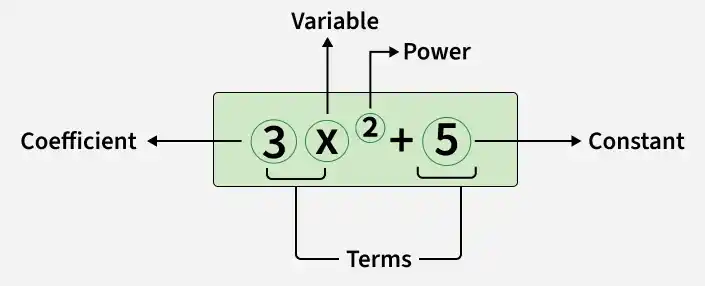
The above image shows the parts of a polynomial (3x² + 5), including the coefficient, variable, exponent (power), constant, and terms.
Degree of a Polynomial
The degree of a polynomial is the highest power of the variable in it. For polynomials with more than one variable, the degree is the highest sum of powers in any term.
Example: In 3x⁴ + 7, the highest power of x is 4, so the degree is 4.
Types
Polynomials can be categorised into several types based on the number of terms they contain or their degree.
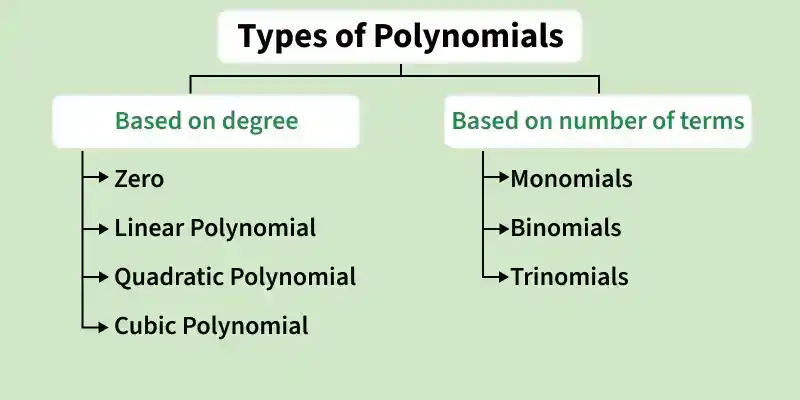
Based on the Number of Terms:
- Monomial: A polynomial with just one term. For example, 7x3 or −4.
- Binomial: A polynomial with two terms. For example, x2 − 5x.
- Trinomial: A polynomial with three terms. For example, 2x2 − 3x + 4.
- Multinomial: A polynomial with more than three terms. For example, x4 − 2x3 + 3x2 − x + 1.
Based on Degree:
- Constant Polynomial: A polynomial of degree 0. It has no variable terms, just a constant. For example, 5 or −3.
- Linear Polynomial: A polynomial of degree 1. It forms a straight line when graphed. For example, 3x + 2.
- Quadratic Polynomial: A polynomial of degree 2. It forms a parabolic shape when graphed. For example, x2 − 4x + 4.
- Cubic Polynomial: A polynomial of degree 3. It can have points of inflexion and typically has the shape of an S-curve when graphed. For example, x3 − 6x2 + 11x − 6.
Properties and Theorems
Polynomials follow some important rules and theorems that make them easier to understand and solve:
- Degree Rule: The degree of the sum or difference of two polynomials is at most the highest degree among them, while the degree of their product is the sum of their degrees.
- deg(A ± B) ≤ max(deg A, deg B)
- deg(A × B) = deg A + deg B
- Division Algorithm: For any polynomials A and B (where B ≠ 0), we can write:
A = BQ + R, where the degree of R is less than the degree of B.
- Factor Theorem: A polynomial P(x) is divisible by (x − a) if and only if P(a) = 0.
- Remainder Theorem: When a polynomial f(x) is divided by (x − a), the remainder is f(a).
- Number of Zeros: A polynomial of degree n can have at most n zeros.
- Zeros Property: If a polynomial P is divisible by another polynomial Q, then every zero of Q is also a zero of P.
Polynomial Function
A polynomial function is a function expressed as a sum of terms in which each variable has a non-negative integer exponent, and each term has a constant coefficient.
The general form of a polynomial function is:
f(x) = an x n + an - 1 x n -1 + ⋯ + a1 x + a0
where:
- a0 , a1 ,…, an are constant coefficients.
- x is the variable.
- n is a non-negative integer representing the degree of the polynomial, provided an ≠ 0.
Operations on Polynomial Functions
Operations on polynomial functions involve adding, subtracting, multiplying, and dividing polynomial expressions to form new functions.
- Addition of Polynomial Functions : To add two polynomial functions, combine their like terms.
- Subtraction of Polynomial Functions: To subtract two polynomial functions, subtract the corresponding terms and change the signs of the terms inside the subtracted polynomial.
- Multiplication of Polynomial Functions : To multiply two polynomial functions, multiply each term of one polynomial by every term of the other polynomial and combine like terms.
- Division of Polynomial Functions: To divide two polynomial functions, divide one polynomial by the other, provided the denominator is not zero.
Operation | Formula |
|---|---|
Addition | (f + g) (x) = f(x) + g(x) |
Subtraction | (f − g) (x) = f(x) − g(x) |
Multiplication | (fg) (x) = f(x) g(x) |
Division |
