

Probability refers to the extent of the occurrence of events. When an event occurs, like throwing a ball, picking a card from the deck, etc., then there must be some probability associated with that event. In terms of mathematics, probability refers to the ratio of wanted outcomes to the total number of possible outcomes.
The probability of simultaneous occurrence of two events A and B is equal to the product of the probability of the other, given that the first one has occurred. This is called the Multiplication Theorem of probability.
Theorem 1: If A and B are two events associated with a random experiment, then
P(A ∩ B) = P(A)P(\frac{B}{A})\ if P(A) ≠ 0\\ or, P(A ∩ B) = P(B)P(\frac{A}{B})\ if P(B) ≠ 0 or, P(A ∩ B) = P(B)P(A/B) if P(B) ≠ 0
Proof:
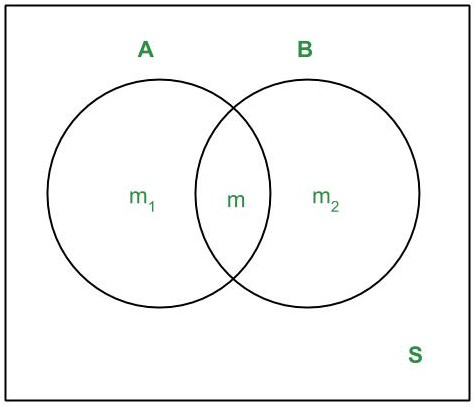
Let S be the sample space associated with the given random experiment. Suppose S contains n elementary events. Let m1,m2 and m be the number of elementary events favorable to A,B and A ∩ B respectively, Then,
P(A) = m1/n, P(B) = m2/n and P(A∩B) = m/n
Since m1 elementary events are favorable to A out of which m are favorable to B. Therefore, P(B/A) = m/m1. Similarly, we have P(A/B) = m/m2.
Now, P(A ∩ B) = m/n
or, P(A ∩ B) = m/m1 × m1/n = P(B/A) × P(A) ... (i)
Again, P(A ∩ B) = m/n
or, P(A ∩ B) = m/m2 × m2/n = P(A/B) × P(B) ...(ii)
From (i) and (ii) in the above theorem, we obtain that
P(B/A) = P(A ∩ B)/P(A) and P(A/B) = P(A ∩ B)/P(B)
Prove That: For P(B) > 0, P(A/B) ≤ P(A)
Proof:
n( A ∩ B) ≤ n(A) and n(B) ≤ n(S)
Dividing, we get n( A ∩ B) / n(B) ≤ n(A)/ n(S)
=> P(A/B) ≤ P(A)
Note 2:
(i) The conditional probability P(A/B) is not defined if P(B) = 0.
(ii) P(B / B) = 1
Remark: If A and B are independent events, then
P(A/B) = P(A) and P(B/A) = P(B)
∴ P(A ∩ B) = P(A) P(B)
Theorem 2: (Extension of multiplication theorem.) If A1, A2, ..., An are n events associated with a random experiment, then
P(A1 ∩ A2 ∩ … ∩ An) = P(A1) P(A2 / A1) P(A3 / A1 ∩ A2) … × P(An / A1 ∩ A2 ∩ … ∩ An-1)
where P(Ai / A1 ∩ A2 ∩ … ∩ Ai-1) represents the conditional probability of the occurrence of event Ai, given that the events A1, A2, ..., Ai-1 have already occurred.
Particular Case: If A, B, C are three events associated with a random experiment, then
P(A ∩ B ∩ C) = P(A) P(B/A) P(C/A ∩ B)
Theorem 3: (Multiplication Theorem of Probability for Independent events) If A and B are two events with positive probabilities ( P(A) ≠ 0, P(B) ≠ 0), then A and B are independent if and only if
P(A ∩ B) = P(A) . P(B)
Proof:
We have: P(A ∩ B) = P(A) P(B/A) = P(B) P(A/B); P(A) ≠ 0 . . . (i)
If A and B are independent, i.e A is independent of B and B is independent of A, then, we have
P(A/B) = P(A) and P(B/A) = P(B) . . . (ii)
From (i) and (ii), we get: P(A ∩ B) = P(A) P(B), as required.
Properties
1. Multiplication Rule for Two Events P(A∩B) = P(A) × P(B∣A)
2. Multiplication Rule for Dependent Events P(A∩B) = P(A) × P(B∣A)
3. Multiplication Rule for Three Events P(A ∩ B ∩ C) = P(A) × P(B∣A) × P(C∣A∩B)
4. Multiplication Rule for Mutually Independent Events P(A ∩ B ∩ C) = P(A) × P(B) × P(C)
