

A pentagon is a two-dimensional polygon with five straight sides, five vertices, and five interior angles. The sum of its interior angles is 540°. A pentagon can be regular, where all sides and angles are equal, or irregular, where the sides and angles are of different lengths and measures.
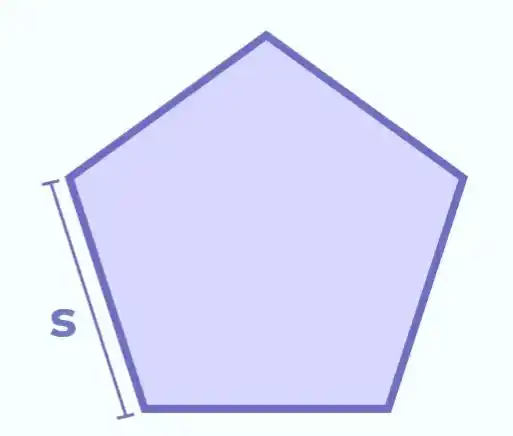
Parts of the Pentagon
The parts of a pentagon are shown in the image below:

| Term | Definition |
|---|---|
| Side | One of the five line segments that together form the boundary of a pentagon. |
| Vertex | A point where two sides of the shape meet. It's also referred to as a corner. |
| Diagonal | A line segment connecting two non-adjacent vertices of the polygon. |
| Exterior Angle | The angle between one side of the polygon and the extension of an adjacent side. |
| Interior Angle | The angle formed inside the polygon between two adjacent sides. |
| Apothem | A line from the centre of the polygon perpendicular to one of its sides. It also represents the shortest distance from the center to the side. |
Properties of a Pentagon
- A pentagon is a polygon with 5 sides, 5 vertices, and 5 angles.
- It has 5 diagonals joining non-adjacent vertices.
- The sum of its interior angles is 540°.
- The sum of its exterior angles is 360°.
- In a regular pentagon, all sides are equal and each interior angle measures 108°, while each exterior angle measures 72°.
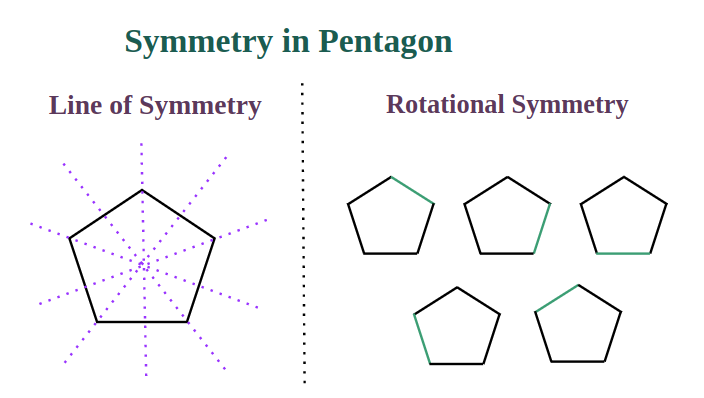
- A regular pentagon has 5 lines of symmetry and rotational symmetry of order 5.
Pentagons Around Us
Pentagons can be found in many everyday objects and structures. Identifying these real-life examples helps us understand how the pentagon shape is used in our surroundings.

Types of Pentagons
A pentagon can be classified into different types based on the lengths of its sides, the measures of its angles, and its overall shape.
1. Regular Pentagon: A regular pentagon has five equal sides and five equal interior angles.
2. Irregular Pentagon: An irregular pentagon has sides or angles that are not all equal.
3. Convex Pentagon: A convex pentagon has all interior angles less than 180°, and all its diagonals lie inside the shape.
4. Concave Pentagon: A concave pentagon has at least one interior angle greater than 180°, causing part of the shape to curve inward.
Angles in a Pentagon
A pentagon has five interior angles and five exterior angles. In a regular pentagon, all interior angles are equal, and all exterior angles are equal.
1. Interior Angles: An interior angle is the angle formed inside a pentagon where two adjacent sides meet. In a regular pentagon, each interior angle measures 108°.
2. Exterior Angles: An exterior angle is the angle formed outside a pentagon when one side is extended. In a regular pentagon, each exterior angle measures 72°, and the sum of all exterior angles is 360°.
Line of Symmetry
The number of lines of symmetry in a regular polygon is equivalent to the number of its sides. These symmetrical lines extend from a vertex to the midpoint of the opposite side, creating a total of 5 lines that divide the pentagon into congruent halves. A regular pentagon has five lines of symmetry: one horizontal, one vertical, and three diagonals.
Formulas Related to the Pentagon
The following table shows the list of all the formulas necessary to calculate the various pentagon properties:
| Property | Formula |
|---|---|
| Perimeter (Regular Pentagon) | P = 5a |
| Perimeter (Irregular Pentagon) | Sum of the lengths of all five sides |
| Area (Regular Pentagon) | A = ¼ × √[5(5 + 2√5)] × a² |
| Area (Using Apothem) | A = ½ × P × Apothem |
| Area (Using Circumradius) | A = (5/2) × r² × sin 72° |
| Area (Using Side Length) | A = (5 × s²) / (4 × tan 36°) |
| Area (Irregular Pentagon) | Divide the pentagon into smaller polygons, find the area of each, and add them together. |
| Number of Diagonals | n(n − 3) / 2 |
| Diagonal Length (Regular Pentagon) | d = [(1 + √5) / 2] × a |
| Side Length (Regular Pentagon) | a = P / 5 |
Where,
- P = Perimeter
- A = Area
- a = Side length of a regular pentagon
- s = Side length
- r = Circumradius (distance from the center to a vertex)
- d = Diagonal length
- n = Number of sides (for a pentagon, n = 5).
Read More
