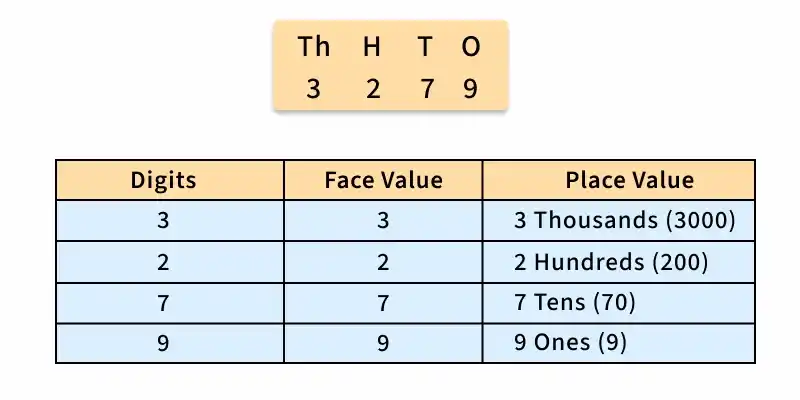
Place value is the value of a digit based on its position in a number.
In every number, digits have different places, such as ones, tens, hundreds, and thousands. The value of a digit changes according to its position and is counted from the right side, starting with the ones place.
Example: Place Value in the number 3846
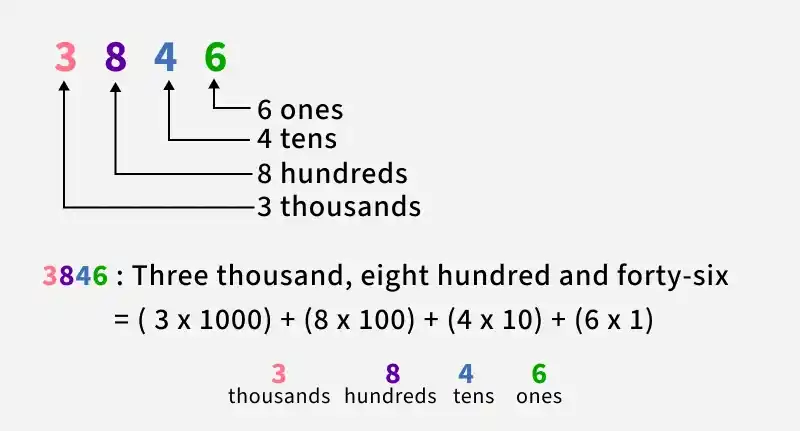
Place Value Chart
A Place Value Chart is a table that shows the position and value of each digit in a number, such as ones, tens, hundreds, and thousands. We find a digit’s value by checking the column in which it is placed, and large numbers are separated by commas to make them easier to read.
There are two commonly used place value systems:
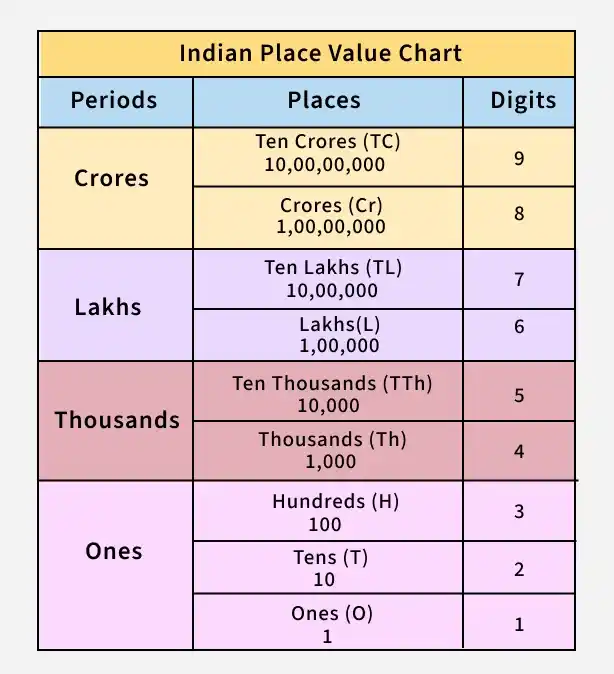
1. Indian Place Value System
The Indian Place Value Chart is a table that shows the value of each digit according to its position in the Indian numeral system. Large numbers are grouped using commas (like 1,23,456) to make them easy to read and write correctly.
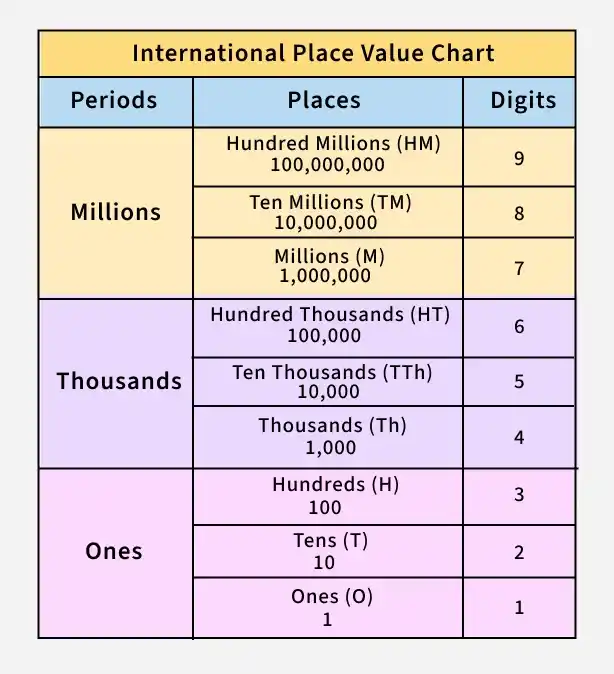
2. International Place Value Chart
The International Numeral System is used worldwide and follows the order of ones, tens, hundreds, thousands, millions, and so on. In this system, commas are placed after every three digits from the right (for example, 135,912,332) to make large numbers easy to read and write.
Place Value Chart with Decimals
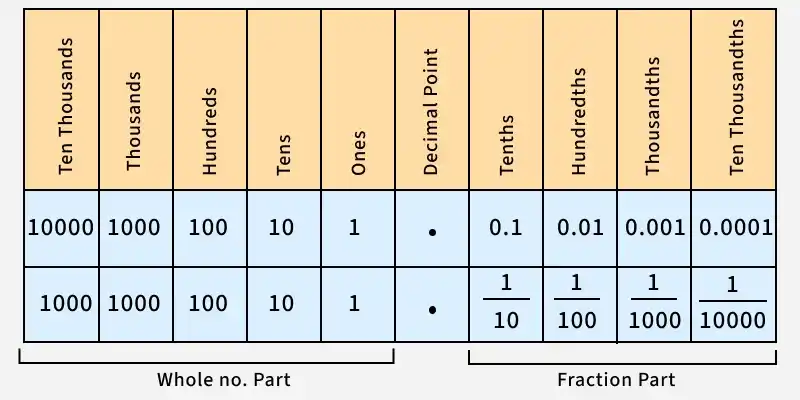
The Decimal Place Value Chart shows the value of each digit in a decimal number. A decimal number includes both whole numbers and fractions, separated by a decimal point. The decimal point divides the whole number part (on the left) and the fractional part (on the right).
On the left side, the place values are ones, tens, hundreds, and so on. On the right side, the place values begin from tenths (1/10), then hundredths (1/100), thousandths (1/1000), and so on.
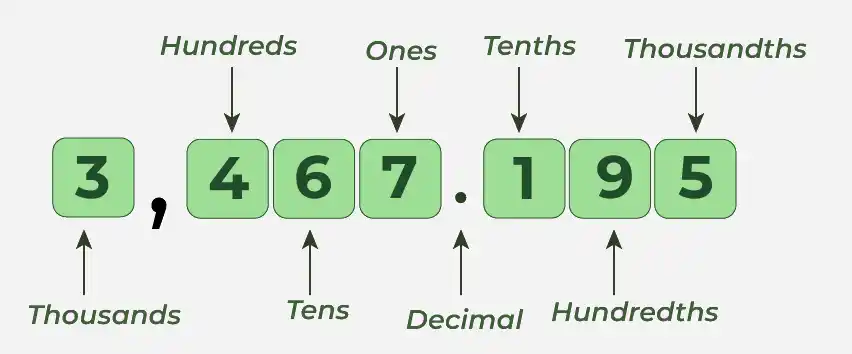
Example: Consider the number 3,467.195
Place Value vs Face Value
The key differences between Place Value and Face Value in mathematicsares listed below:
| Place Value | Face Value |
|---|---|
| Place value is the value of a digit based on its position in a number. | Face value is the actual value of the digit itself. |
| It depends on where the digit is placed in the number. | It does not depend on the digit’s position. |
| It is found by multiplying the digit by its place (ones, tens, hundreds, etc.). | It is simply the digit as it is. |
| Example: In 3279, the place value of 7 is 70 (7 × 10). | Example: In 3279, the face value of 7 is 7. |