

Polar representation expresses a complex number in terms of its magnitude (distance from the origin) and argument (angle from the positive real axis).
It is written as:
z = r(cos θ + i sin θ)
where, r is the magnitude and θ is the angle.
Geometrical or Algebraic Form of a Complex Number
The complex number z = (x + i y) is represented by a point P (x, y) on the Argand plane, and every point on the Argand/complex plane represents a unique complex number. If a complex number is purely real then it's imaginary part Im(z) = 0 and it lies exactly on the real axis (X-axis), whereas a purely imaginary complex number has its real part Re(z) =0 and it lies exactly on the imaginary axis (Y-axis).
Note: If a point P (x, y) represents a complex number z on the Argand plane then the complex number Z = (x + i y) is known as the affix of the point P.
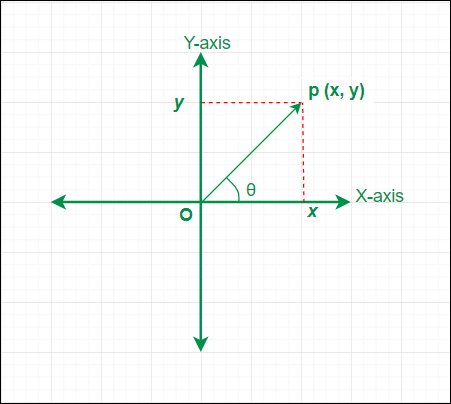
In the above representation of the complex number length of the line segment, OP is equal to the modulus of the complex number and the angle θ is the angle formed by OP in the anticlockwise direction with the positive direction of the X-axis known as the amplitude or argument of the complex number denoted by amp(z) or arg(z).
From the above figure, θ can be calculated as follows
tan(θ) = y / x
⇒ tan(θ) = |Im(z) / Re(z)|
⇒ θ = tan-1{|Im(z) / Re(z)|}
Note: The angle θ can have infinite values in the multiple of 2π. But the unique value of θ that lies in the range (-π ≤ θ ≤ π) is called the principal argument or principal value of the amplitude. The point to be remembered is the value of the principal argument of a complex number (z) depends on the position of the complex number (z) i.e the quadrant in which the point P representing the complex number (z) lies.
Let's discuss the different cases to find out the value of the principal argument. Let α be the acute angle subtended by OP with the X-axis and θ is the principal argument of the complex number (z).
Case 1. When the complex number z = (x + i y) lies in the first quadrant i.e. x > 0 & y > 0 then the value of the principal argument (θ = α).

Case 2. When the complex number z = (x + i y) lies in the second quadrant i.e. x < 0 & y > 0 then the value of the principal argument (θ = π - α).

Case 3. When the complex number z = (x + i y) lies in the third quadrant i.e. x < 0 & y < 0 then the value of the principal argument (θ = α - π).

Case 4. When the complex number z = (x + i y) lies in the fourth quadrant i.e. x > 0 & y < 0 then the value of the principal argument (θ = -α).

Polar or Trigonometrical Form of a Complex Number
We have seen the geometrical form of a complex number (z) in which it is represented by (x, y) on the Argand plane, OP = |z| and arg(z) = θ. Now we will use the geometrical form of a complex number to obtain its polar form. In the polar or trigonometrical form, the complex number (z) is represented by (r, θ). where r = |z| & θ = arg(z).
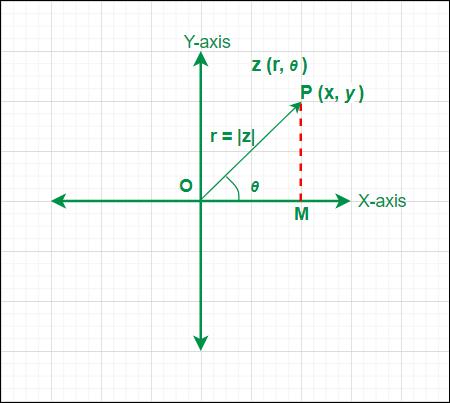
From the above figure, we can find OM = x = |z| cos θ and MP = y = |z| sin θ ;
Now put the values of x & y in z = (x + i y) and we get z = |z| cos θ + i |z| sin θ
Taking |z| common, z = |z| (cos θ + i sin θ)
And putting |z| = r ;
The polar form of a complex number (z) is given by
z = r (cos θ + i sin θ) ;
If we take the general value of the argument arg(z) = 2n π + θ, then the polar form of z is given by
z = r [cos (2n π + θ) + i sin (2n π + θ)] ; where n is an integer.
As we have θ in the expression of the polar form of z then again there will be four different cases depending upon the principal argument values θ in the four quadrants. Let's discuss them using the results obtained above for the principal argument θ.
- Case 1. When the complex number z lies in the first quadrant then the value of the principal argument (θ = α). So, the polar form of z = r (cos α + i sin α).
- Case 2. When the complex number z lies in the second quadrant then the value of the principal argument (θ = π - α). So, the polar form of z = r [cos (π - α) + i sin (π - α)] or z = r (-cos α + i sin α)
- Case 3. When the complex number z lies in the third quadrant then the value of the principal argument (θ = α - π). So, the polar form of z = r [cos (α - π) + i sin (α - π)] or z = r (-cos α - i sin α)
- Case 4. When the complex number z lies in the fourth quadrant then the value of the principal argument (θ = -α). So, the polar form of z = r [cos (-α) + i sin (-α)] or z = r (cos α - i sin α).
Practice Questions on Polar Representation of Complex Numbers
