

The Section Formula is a useful tool in coordinate geometry that helps us find the coordinates of a point that divides a line segment in a known ratio. If a point divides a line segment into two parts equal or unequal, the section formula allows us to determine the coordinates of that dividing point.
The section formula can be applied in two ways:

- Internal Division : The point lies between the endpoints of the line segment and divides it internally.
- External Section Formula: The point lies outside the line segment, on its extension, and divides the line externally.
Because these two situations are different, we use two corresponding formulas:
- Internal Section Formula
- External Section Formula
Internal Section Formula
When the point divides the line segment in the ratio m: n internally at point C then that point lies on the line segment i.e., C divides AB internally, then we can use the Internal Section formula to calculate coordinates of C with the help of ratio and coordinates of the endpoints A and B. It is also called the Internal Division.
The term 'Sectional Formula' is generally used for Internal Sectional Formula. If the coordinates of A and B are (x1, y1) and (x2, y2) respectively then Internal Section Formula is given as:
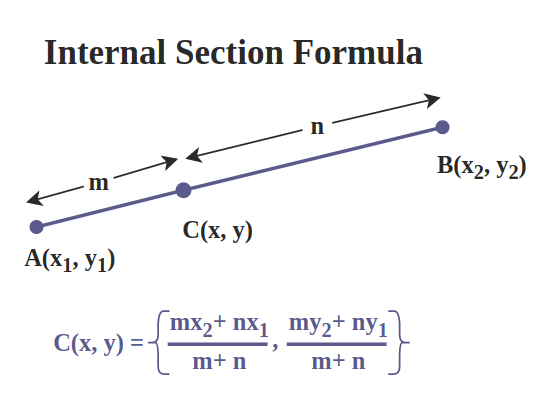
Derivation of Internal Section Formula
Let A(x1, y1) and B(x2, y2) be the endpoints of the given line segment AB and C(x, y) be the point that internally divides AB in the ratio m: n.
i.e., AC / CB = m / n
We want to find the coordinates of C (x, y). Take the given line segment and draw perpendiculars of A, C, and B parallel to Y coordinate joining at P, Q, and R on the X-axis as illustrated in the diagram below:

From above diagram,
AM = PQ = OQ - OP = (x - x1),
CN = QR = OR - OQ = (x2 - x),
CM = CQ - MQ = (y - y1),
and BN = BR - NR = (y2 - y)Clearly, ∆AMC ∼ ∆CNB (As all angles are equal for both triangles)
Therefore, ratio of sides are same for similar triangles.⇒ AC / CB = AM / CN = CM / BN
Now substituting the values in the above relation
⇒ m / n = [(x - x1)/(x2 -x)] = [(y - y1)/(y2 - y)]
⇒ m / n = [(x - x1)/(x2 -x)] and m / n = [(y - y1)/(y2 - y)]Solving the 1st condition,
⇒ m(x2 - x) = n(x - x1)
⇒ (m + n)x = (mx2 + nx1)
⇒ x = (mx2 + nx1) / (m + n)Solving the 2nd condition,
⇒ m(y2 - y) = n(y - y1)
⇒ (m + n)y = (my2 + ny1)
⇒ y = (my2 + ny1) / (m + n)Therefore,
\bold{C (x, y) = \left( \frac{m x_2+ n x_1}{m + n} , \frac{m y_2 + n y_1}{m + n }\right)}
External Section Formula
When the point which divides the line segment in the ratio m : n lies outside the line segment i.e., when we extend the line it coincides with the point, then we can use the External Section formula to calculate the coordinates of C. It is also called External Division.
If the coordinates of A and B are (x1, y1) and (x2, y2) respectively then the external Section Formula is given as follows:

Derivation of the External Section Formula
To derive the internal section we took a line segment and a point C(x, y) which lies on the line, but in the case of the external section formula, we have to take that point C(x, y) outside the line segment.
Let A(x1, y1) and B(x2, y2) be the endpoints of the given line segment AB and C(x, y) be the point that divides AB in the ratio m: n externally. To find the coordinates (x, y) of C, take the external divided line AB and draw perpendiculars from A, B, and C parallel to the y-axis joining at P, Q, and R on the x-axis.
Perpendicular from A and B parallel to the x-axis which meats the perpendicular drawn from C parallel to the y-axis at M and N. The following diagram shows the complete construction.

From the diagram,
AM = PR = OR - OP = (x - x1),
BN = QR = OR - OQ = (x - x2),
CM = RC - MR = (y - y1),
and CN = CR - NR = (y - y2)Clearly, ∆AMC ∼ ∆CNB (As all angles are equal for both triangles)
As, the ratio of all the sides are same for similar triangles.
⇒ AC / BC = AM / BN = CM / CNNow substituting the values in the above relation
⇒ m/n = [(x - x1)/(x - x2)] = [(y - y1)/(y - y2)]
⇒ m/n = [(x - x1)/(x - x2)] and m/n = [(y - y1)/(y - y2)]Solving the 1st condition,
⇒ m(x - x2) = n(x - x1)
⇒ (m - n)x = (mx2 - nx1)
⇒ x = (mx2 - nx1)/(m - n)Solving the 2nd condition,
⇒ m(y - y2) = n(y - y1)
⇒ (m - n)y = (my2 - ny1)
⇒ y = (my2 - ny1)/(m - n)Therefore,
\bold{C(x,y) = \left(\frac{mx_2 - n x_1}{ m - n} , \frac{m y_2 - ny_1}{m - n }\right)}
Section Formula for Midpoint
When the point dividing the line segment joining the two points A and B coincide with the midpoint of the line segment, then this special case emerges. The section formula for this case is also referred to as the midpoint formula.
Let two points A(x1, y1) and B(x2, y2), and a point C(x, y) be the midpoint of the line segment AB i.e., AC: CB = 1:1, then the section formula becomes as follows:
\bold{C(x, y) = \left(\frac{x_1+x_2}{2}, \frac{y_1+y_2}{2}\right)}
