

Autoregressive models are a class of statistical models that predict future values based on previous ones. In the context of NLP, these models generate sequences of words or tokens one step at a time, conditioned on the previously generated tokens. The key idea is that each word in a sentence depends on the words that came before it.
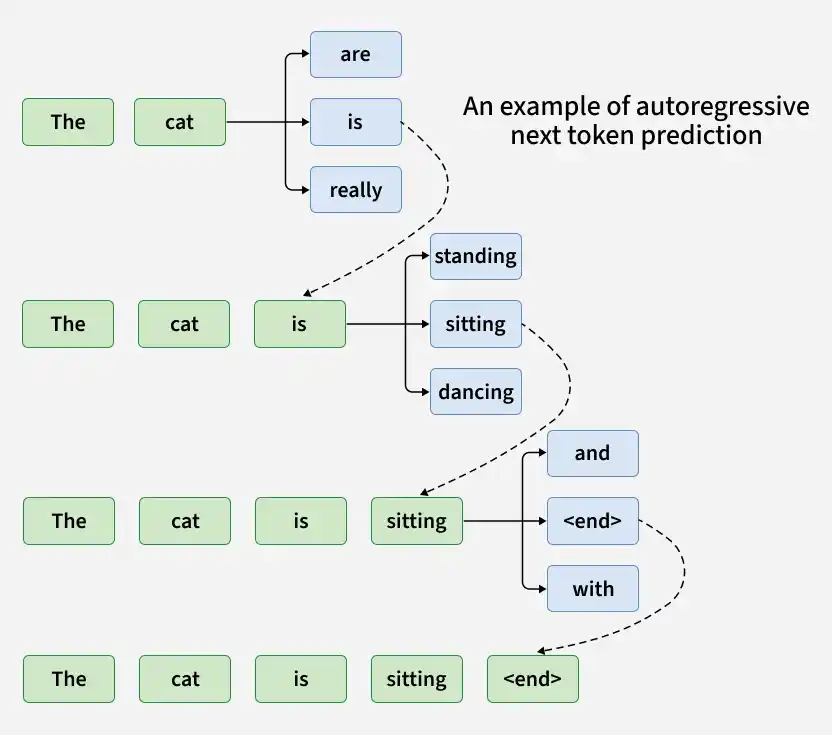
The generation process continues until the model produces a special end-of-sequence (EOS) token or reaches a predefined maximum sequence length. For example, the generated text could be: "The cat is sitting." followed by an EOS token.
Characteristics
- Sequential Generation: Words are generated one after another, left-to-right (or right-to-left in some cases).
- Conditional Probability: Each word is predicted using the conditional probability distribution given the prior context.
- Dependence on Previous Tokens: The probability of the current token is conditioned on the previously generated tokens in the sequence. In a standard autoregressive language model, this context can include all tokens generated before the current position.
Mathematically, an autoregressive model factorizes the joint probability of a sequence
P(x_1, x_2, x_3, . .., x_n) = \prod_{t=1}^{n}P(x_t|x_{<t})
Where
Working
Autoregressive language models generate text one token at a time. At each step, the model uses the previously generated tokens as context to predict a probability distribution for the next token.
For example:
Given the prompt "The cat is", the model may assign probabilities to possible next tokens such as "sleeping", "running" or "hungry". After selecting "sleeping", that token becomes part of the context for the next prediction.
- Input Context: The model receives the initial prompt or previously generated tokens.
- Next-Token Prediction: It calculates the probability distribution for the next token.
- Token Selection: A token is selected based on the predicted probabilities.
- Context Update: The selected token is added to the sequence.
- Repeat: Steps 2–4 continue until an EOS token is generated or the maximum sequence length is reached.
This makes autoregressive generation inherently sequential during inference, since each newly generated token depends on the tokens generated before it.
Popular Models
1. Recurrent Neural Networks (RNNs)
Recurrent Neural Networks were among the first neural network architectures used for autoregressive language modeling. They process input sequences sequentially, maintaining a hidden state that captures information from previous tokens. However, RNNs suffer from challenges like vanishing gradients, which limit their ability to capture long-range dependencies.
2. LSTM and GRUs
Long Short-Term Memory and Gated Recurrent Units are advanced variants of RNNs designed to address the vanishing gradient problem. These models use gating mechanisms to control the flow of information, enabling them to better capture long-term dependencies in text.
3. Transformer-Based Models
Transformers have become a dominant architecture in modern NLP. Although the Transformer architecture itself is not inherently autoregressive, decoder-only Transformers can perform autoregressive language modeling by using causal masking to prevent each position from attending to future tokens during training.
For example:
GPT (Generative Pre-trained Transformer): GPT models use decoder-only Transformers with causal masking to generate text autoregressively. They predict the next token based on the previously generated tokens and are widely used for text generation, completion, dialogue and code generation.
Applications
- Text Generation: They can generate essays, stories, dialogues, code and other forms of text based on a given prompt.
- Machine Translation: They can generate translations token by token while using previously generated target-language tokens as context.
- Speech Recognition: They can generate text sequences from speech representations by predicting tokens sequentially.
- Text Summarization: They can generate concise summaries of longer documents while conditioning each prediction on the previously generated summary tokens.
- Dialogue Systems: Chatbots and conversational agents can use autoregressive models to generate responses based on the conversation history.
Advantages
- Context-Aware Generation: Models can use previously generated tokens to maintain context and produce coherent sequences.
- Flexibility: The same autoregressive framework can support tasks such as text completion, generation, translation, summarization and dialogue.
- Scalability: Transformer-based autoregressive models can scale to large datasets and model sizes, improving their ability to learn complex language patterns.
Limitations
- Sequential Generation: During inference, tokens are generated one at a time because each prediction depends on previously generated tokens, limiting parallelism and increasing latency for long sequences.
- Error Propagation : Mistakes made early in the sequence can propagate and affect subsequent predictions, leading to compounding errors.
- Limited Future Context: Causal autoregressive models predict tokens using only the preceding context, so they cannot directly use future tokens when generating the current token.
- Bias and Fairness Issues : Like other AI models, autoregressive models may inadvertently perpetuate biases present in the training data.
