

- Courses
- Tutorials
- Practice
- Jobs
Transaction & Concurrency Control GATE CS PYQ Quiz
Question 1
Consider the following transactions with data items P and Q initialized to zero:
T1: read (P) ;
    read (Q) ;
    if P = 0 then Q : = Q + 1 ;
    write (Q) ;
T2: read (Q) ;
    read (P) ;
    if Q = 0 then P : = P + 1 ;
    write (P) ;
Any non-serial interleaving of T1 and T2 for concurrent execution leads to
- A
A serializable schedule
- B
A schedule that is not conflict serializable
- C
A conflict serializable schedule
- D
A schedule for which a precedence graph cannot be drawn
Question 2
Consider the following schedule for transactions T1, T2 and T3:

Which one of the schedules below is the correct serialization of the above?
- A
T1->>T3->>T2
- B
T2->>T1->>T3
- C
T2->>T3->>T1
- D
T3->>T1->>T2
Question 3
Consider two transactions T1 and T2, and four schedules S1, S2, S3, S4 of T1 and T2 as given below:
T1 = R1[X] W1[X] W1[Y]
T2 = R2[X] R2[Y] W2[Y]
S1 = R1[X] R2[X] R2[Y] W1[X] W1[Y] W2[Y]
S2 = R1[X] R2[X] R2[Y] W1[X] W2[Y] W1[Y]
S3 = R1[X] W1[X] R2[X] W1[Y] R2[Y] W2[Y]
S4 = R2[X] R2[Y] R1[X] W1[X] W1[Y] W2[Y]
Which of the above schedules are conflict-serializable?
- A
S1 and S2
- B
S2 and S3
- C
S3 only
- D
S4 only
Question 4
Which of the following scenarios may lead to an irrecoverable error in a database system ?
- A
A transaction writes a data item after it is read by an uncommitted transaction
- B
A transaction reads a data item after it is read by an uncommitted transaction
- C
A transaction reads a data item after it is written by a committed transaction
- D
A transaction reads a data item after it is written by an uncommitted transaction
Question 5
Consider the following schedule S of transactions T1, T2, T3, T4: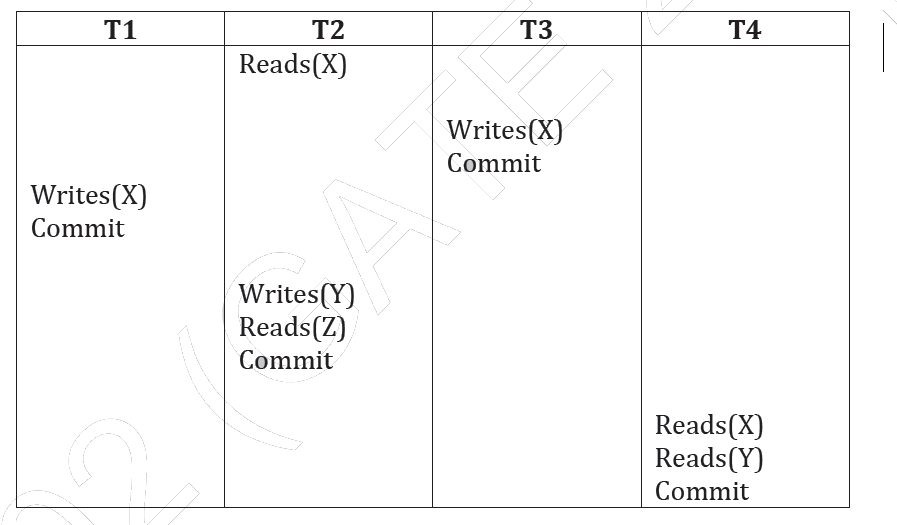
Which one of the following statements is CORRECT?
- A
S is conflict-serializable but not recoverable
- B
S is not conflict-serializable but is recoverable
- C
S is both conflict-serializable and recoverable
- D
S is neither conflict-serializable nor is it recoverable
Question 6
Consider the following partial Schedule S involving two transactions T1 and T2. Only the read and the write operations have been shown. The read operation on data item P is denoted by read(P) and the write operation on data item P is denoted by write(P).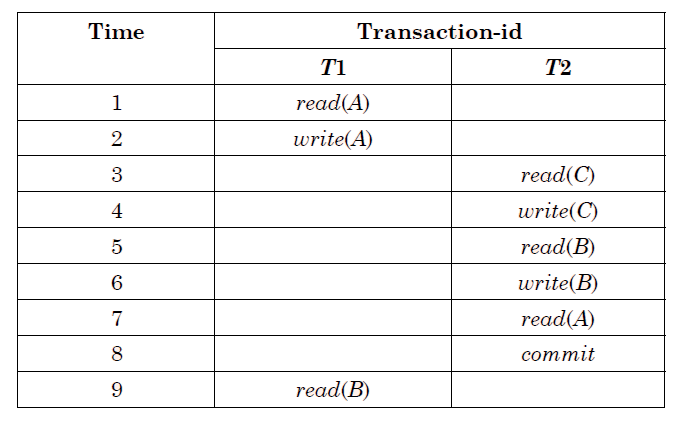
Suppose that the transaction T1 fails immediately after time instance 9. Which one of the following statements is correct?
- A
T2 must be aborted and then both T1 and T2 must be re-started to ensure transaction atomicity
- B
Schedule S is non-recoverable and cannot ensure transaction atomicity
- C
Only T2 must be aborted and then re-started to ensure transaction atomicity
- D
Schedule S is recoverable and can ensure atomicity and nothing else needs to be done
Question 7
Which of the following concurrency control protocols ensure both conflict serializability and freedom from deadlock? I. 2-phase locking II. Time-stamp ordering
- A
I only
- B
II only
- C
Both I and II
- D
Neither I nor II
Question 8
Consider the following four schedules due to three transactions (indicated by the subscript) using read and write on a data item x, denoted by r(x) and w(x) respectively. Which one of them is conflict serializable.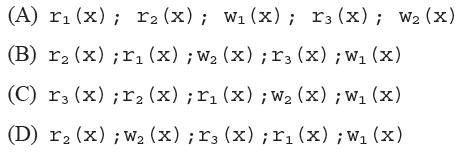
- A
A
- B
B
- C
C
- D
D
Question 9
Consider the transactions T1, T2, and T3 and the schedules S1 and S2 given below.
T1: r1(X); r1(Z); w1(X); w1(Z)
T2: r2(Y); r2(Z); w2(Z)
T3: r3(Y); r3(X); w3(Y)
S1: r1(X); r3(Y); r3(X); r2(Y); r2(Z);
    w3(Y); w2(Z); r1(Z); w1(X); w1(Z)
S2: r1(X); r3(Y); r2(Y); r3(X); r1(Z);
    r2(Z); w3(Y); w1(X); w2(Z); w1(Z)
Which one of the following statements about the schedules is TRUE?
- A
Only S1 is conflict-serializable.
- B
Only S2 is conflict-serializable.
- C
Both S1 and S2 are conflict-serializable.
- D
Neither S1 nor S2 is conflict-serializable.
Question 10
Consider the following log sequence of two transactions on a bank account, with initial balance 12000, that transfer 2000 to a mortgage payment and then apply a 5% interest.
  1. T1 start
  2. T1 B old=12000 new=10000
  3. T1 M old=0 new=2000
  4. T1 commit
  5. T2 start
  6. T2 B old=10000 new=10500
  7. T2 commit
Suppose the database system crashes just before log record 7 is written. When the system is restarted, which one statement is true of the recovery procedure?
- A
We must redo log record 6 to set B to 10500
- B
We must undo log record 6 to set B to 10000 and then redo log records 2 and 3.
- C
We need not redo log records 2 and 3 because transaction T1 has committed.
- D
We can apply redo and undo operations in arbitrary order because they are idempotent
There are 31 questions to complete.
