

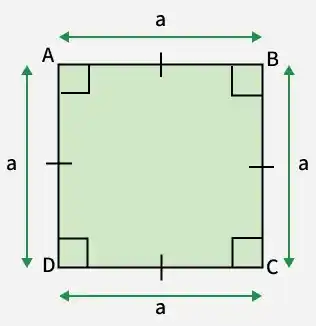
A square is a type of quadrilateral in which all four sides are equal and each interior angle measures 90°. It has two pairs of parallel sides, and its diagonals are equal in length and bisect each other at right angles.
The basic figure of a square is shown below, with each side represented by a single unit.
Properties of a Square
- A square has 4 equal sides and 4 vertices (corners).
- Opposite sides are parallel to each other.
- Each interior angle measures 90°.
- The sum of all interior angles is 360°.
- The diagonals are equal in length.
- The diagonals bisect each other at right angles (90°).
- The diagonals divide the square into two congruent triangles.
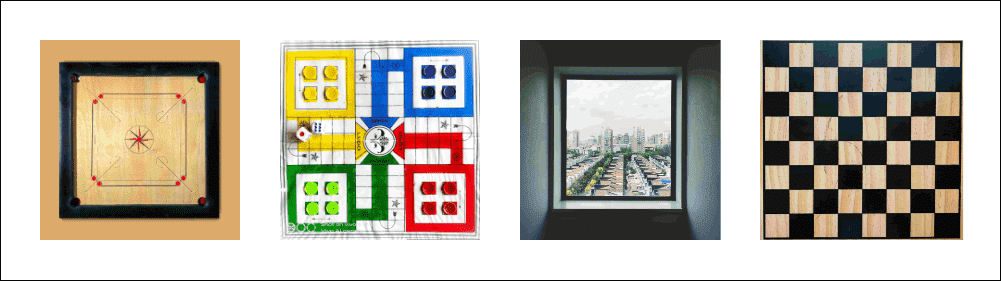
Squares in Real Life
Square Formulas
We know that a square is a four-sided figure with all sides equal. Three basic square formulas are commonly used in geometry for squares:
1. Area of Square
The area of a square is defined as the total space occupied inside its boundaries. The formula for calculating the area of a square with sides 'a' is given by the formula,
Area of Square = a2
2. Area of a Square (When Diagonal is Given)
If the diagonal of a square is given, then the area of the square is given by
Area = d2/2
3. Perimeter of Square
The perimeter of a square is defined as the length of all its boundaries. Suppose the length of the sides of a square is 'a', then its perimeter is given by
Perimeter of Square = Sum of all sides of square
= a + a + a + a
= 4a units
Diagonal of Square
The diagonal of a square is a line that joins two opposite (non-adjacent) vertices. In the square shown, AC and BD are the diagonals, and both are equal in length. Each diagonal divides the square into two equal right-angled triangles.
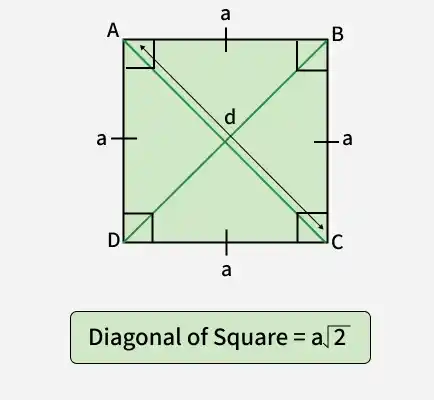
If the side of the square is a and the diagonal is d, then by Pythagoras theorem (H² = P² + B²):
d² = a² + a²
d² = 2a²
d = √(2a²)
d = a√2
