

Combinational circuits generate outputs based only on the current input values, while decoders are combinational logic circuits that convert an n-bit binary input into one of 2n output lines. By combining decoder outputs with OR gates, various combinational logic functions can be implemented efficiently.
- Combinational circuits produce outputs that depend only on the present inputs and are widely used in digital electronic systems.
- Decoders activate a unique output for each input combination and are commonly used in memory addressing, code conversion, and digital control circuits.
Combinational Logic Implementation using Decoder
A decoder generates 2n minterms from n input variables. Since any Boolean function in Sum of Products (SOP) form can be expressed as a combination of minterms, the required decoder outputs can be combined using OR gates to implement the desired logic function.
Example: Full Adder using 3-to-8 Decoder
A 3-to-8 decoder can be used to implement a full adder by applying the three input variables (x, y, z) to the decoder inputs. The required decoder outputs are then combined using OR gates to generate the Sum (S) and Carry (C) outputs.
Truth Table
x | y | z | S | C |
|---|---|---|---|---|
| 0 | 0 | 0 | 0 | 0 |
| 0 | 0 | 1 | 1 | 0 |
| 0 | 1 | 0 | 1 | 0 |
| 0 | 1 | 1 | 0 | 1 |
| 1 | 0 | 0 | 1 | 0 |
| 1 | 0 | 1 | 0 | 1 |
| 1 | 1 | 0 | 0 | 1 |
| 1 | 1 | 1 | 1 | 1 |
From the truth table:
- S = Σ(1,2,4,7)
- C = Σ(3,5,6,7)
The following circuit implements the full adder using a 3-to-8 decoder and OR gates.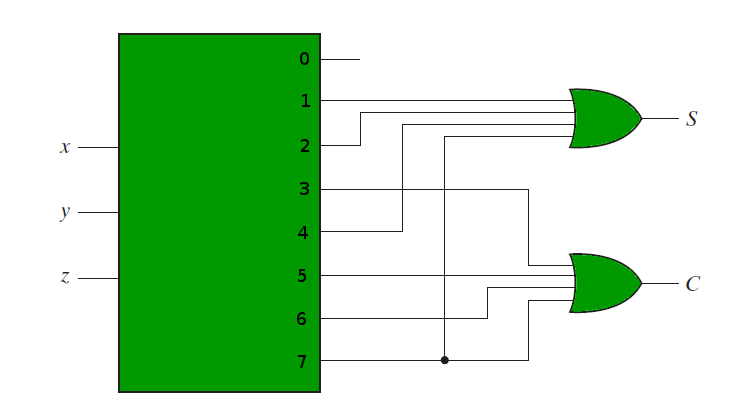
Advantages
- Simplifies Logic Design: Decoders reduce the number of logic gates required, making combinational circuits easier to design.
- Flexible: They can be used to implement various Boolean functions and control circuits such as multiplexers, demultiplexers, and memory devices.
- Modular Design: Decoder-based circuits can be easily expanded and integrated into larger digital systems.
- Reliable: Built using simple logic gates, decoder circuits are reliable and easy to implement.
Disadvantages
- Hardware Complexity: The number of outputs increases rapidly with the number of inputs, requiring more hardware.
- Propagation Delay: Signal propagation through the decoder may introduce delays in high-speed circuits.
- Higher Power Consumption: Larger decoder circuits consume more power due to the increased number of logic gates.
- Limited Scalability: Decoder-based implementation becomes less efficient for very complex logic functions.
Application
- Memory Address Decoding: Selects specific memory locations in RAM and ROM.
- Data Routing: Directs data to the required output or processing unit based on the input code.
- Display Systems: Drives seven-segment displays and similar digital display devices.
- Instruction Decoding: Generates control signals for executing instructions in microprocessors.
