

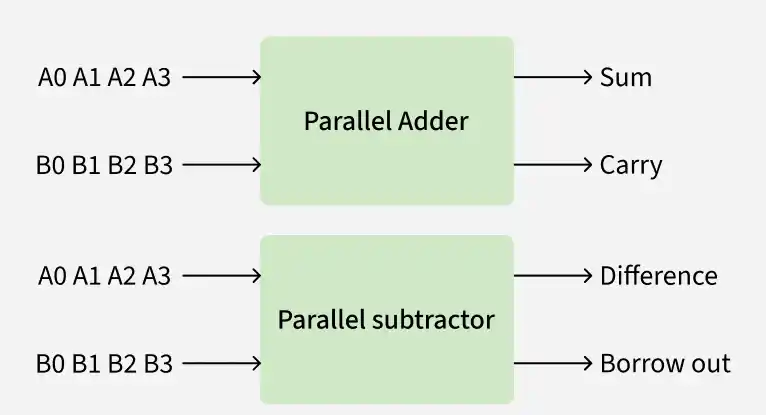
A Parallel Adder and Parallel Subtractor are combinational circuits used to perform multi-bit binary addition and subtraction. They process all bits simultaneously, making arithmetic operations faster and more efficient than serial arithmetic circuits.
- Produces the sum or difference along with the carry/borrow output.
- Forms the basic arithmetic unit used in digital logic design.
Binary Addition
Binary addition follows the same rules as decimal addition but uses only two digits: 0 and 1. These basic rules are used by parallel adders to add multi-bit binary numbers.
0 + 0 = 0
0 + 1 = 1
1 + 0 = 1
1 + 1 = 10 (0 with Carry = 1)
Example
Add 13 (1101) and 11 (1011):
1 1 0 1
+ 1 0 1 1
─────
1 1 0 0 0
Result: 110002 = 2410
Binary Subtraction
Binary subtraction is similar to decimal subtraction, but for multi-bit subtraction we commonly use the 2's complement method. This is the technique used in many digital circuits and processors.
0 − 0 = 0
1 − 0 = 1
1 − 1 = 0
0 − 1 = 1 (Borrow = 1)
Example
Subtract 11 ( 1 0 1 1 ) from 13 ( 1 1 01 ).
- 1’s complement of 1011 → 0100
- Add 1 → 0101 (2’s complement)
1 1 0 1
+ 0 1 0 1
─────
1 0 0 1 0
Result: 00102 = 210 (Ignore the leftmost carry)
Parallel Adder
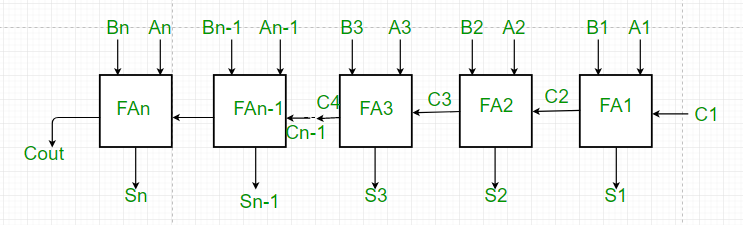
A Parallel Adder is formed by connecting multiple full adders to add multi-bit binary numbers. All corresponding bits are added simultaneously, while the carry generated by each Full Adder is passed to the next higher-order stage.
- Built by cascading multiple Full Adders.
- Each Full Adder adds one pair of input bits.
- The carry output of one stage becomes the carry input of the next stage.
- An n-bit Parallel Adder requires n Full Adders.
Working of Parallel Adder
- The first Full Adder adds the least significant bits (A1 and B1) along with the input carry (C1) to produce S1 and C2.
- The carry C2 is passed to the next Full Adder, which adds A2 and B2 to generate S2 and C3.
- This process continues through all the Full Adders until the most significant bits are added.
- The final stage produces the last sum bit along with the final carry-out (Cout).
Parallel Subtractor
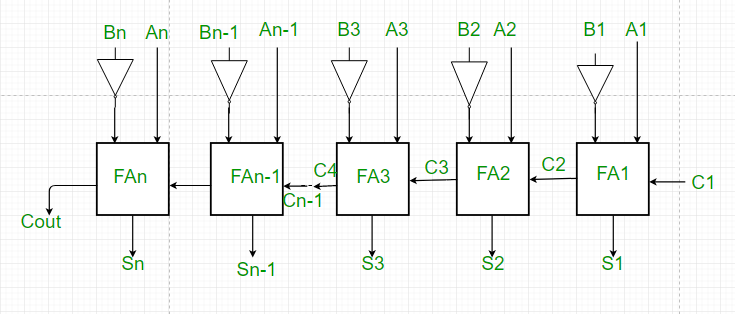
A Parallel Subtractor is formed by connecting multiple Full Adders along with NOT gates to subtract multi-bit binary numbers using the 2's complement method. All bits are processed simultaneously, making subtraction much faster than performing it bit by bit.
- Built using multiple Full Adders and NOT gates.
- Subtraction is performed using the 2's complement of the subtrahend.
- Each stage processes one pair of input bits.
- An n-bit Parallel Subtractor requires n full adders.
Working of Parallel Subtractor
- The subtrahend bits (B) are first complemented using NOT gates, and the initial carry (C1 = 1) is applied to obtain the 2's complement.
- The first Full Adder subtracts the least significant bits by adding A1 and the 2's complement of B1, producing the first difference bit and the carry.
- The carry is passed to the next full adder, which repeats the same operation for the next pair of bits.
- This process continues through all stages until the most significant bits are processed, producing the final difference and carry-out.
