

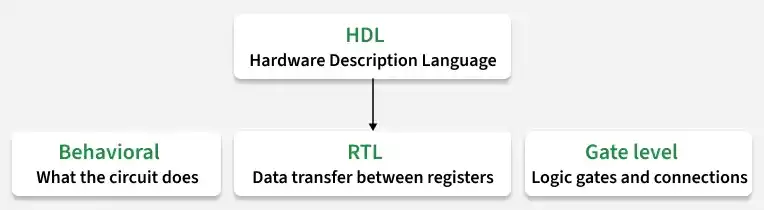
A Hardware Description Language (HDL) is a specialized language used to design, model, and simulate digital hardware. It enables designers to describe electronic circuits at different levels of abstraction before implementing them on hardware platforms such as ASICs and FPGAs.
- Supports concurrent hardware operations, making it suitable for modeling complex digital systems.
- Improves the accuracy of digital circuit design through simulation and hardware verification.
History
- The evolution of Hardware Description Languages (HDLs) began in the 1950s, when designers explored methods to describe digital circuits more efficiently.
- The first HDL, Description Language for Hardware (DLH), was developed by IBM in the late 1960s, but it saw limited adoption due to its complexity.
- During the 1980s, several new HDLs were introduced, including ABEL and PALASM, which improved digital circuit design.
- In the mid-1980s, VHDL was developed by the U.S. Department of Defense for designing complex digital systems, while Verilog, created by Phil Moorby at Gateway Design Automation, became widely adopted for digital design and verification.
Purpose of HDL
Hardware Description Languages (HDLs) are used to design, model, simulate, and implement digital circuits. They simplify the hardware development process by allowing designers to verify circuit behavior before physical implementation.
- Circuit Design: Describes the structure and behavior of digital circuits.
- Simulation: Tests circuit functionality before hardware implementation.
- Verification: Validates that the circuit performs according to the required specifications.
- Synthesis: Converts HDL code into a hardware implementation for FPGA or ASIC devices.
- Timing Analysis: Evaluates circuit timing to ensure reliable operation.
- Design Reusability: Enables reusable modules, reducing design time and development effort.
- Optimization: Improves circuit performance, area utilization, and power efficiency.
Popular HDL
Several Hardware Description Languages (HDLs) are available for digital circuit design. Among them, Verilog and VHDL are the most widely used because of their support for simulation, synthesis, and hardware implementation.
Verilog
- Verilog is a Hardware Description Language used to model, simulate, and implement digital circuits.
- It has a syntax similar to the C programming language, making it relatively easy to learn and widely adopted for FPGA and ASIC design.
VHDL
- VHDL (VHSIC Hardware Description Language) is a Hardware Description Language used to describe and implement digital systems.
- It features a strong type system and is commonly used for designing complex and safety-critical digital circuits.
