

Loop Testing is a white-box testing technique used to verify the correctness of loop structures in a program. It checks whether loops such as for, while, and do-while execute, iterate, and terminate correctly under different conditions.
- Tests loop behavior for zero, one, multiple, and boundary iterations.
- Helps identify issues such as incorrect iteration counts, boundary errors, and infinite loops.
- Ensures loops function correctly and terminate as expected.
Types of Loop Testing
Loop Testing consists of different types based on the structure of loops used in a program. Each type focuses on verifying the correct execution and termination of specific loop configurations.
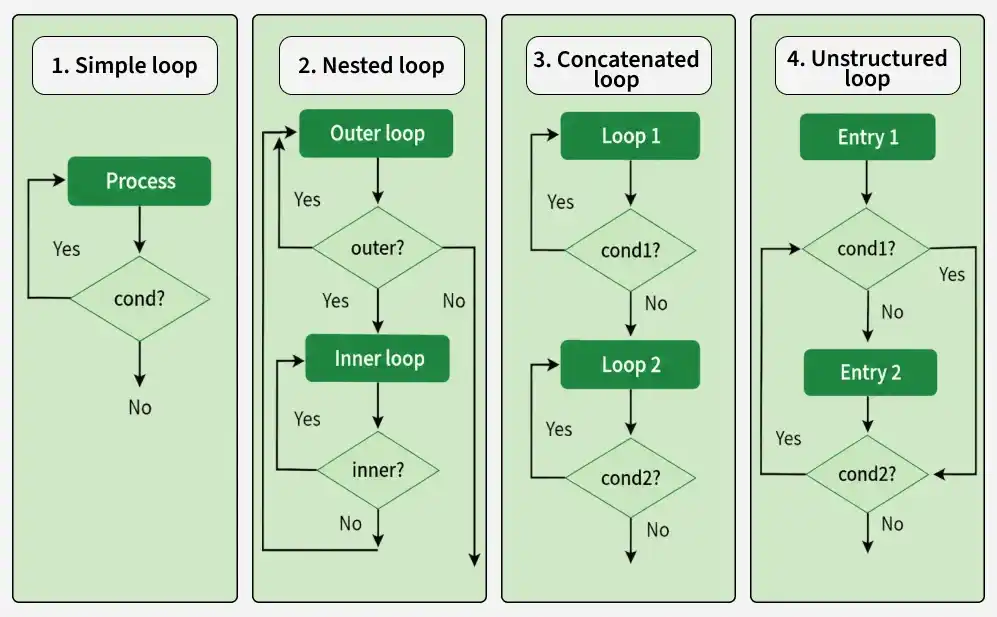
1. Simple Loop Testing
Testing performed on a single loop is known as Simple Loop Testing. A simple loop is a normal loop such as for, while, or do-while, where a condition controls the execution and termination of the loop.
This type of testing is mainly done to ensure that the loop condition is correct and that the loop terminates properly after a specific number of iterations.
Example:
while(condition)
{
statement(s);
}
2. Nested Loop Testing
Testing performed on a nested loop is known as Nested Loop Testing. A nested loop is a loop inside another loop. There can be multiple levels of nesting using for, while, or do-while loops.
This type of testing ensures that both inner and outer loops function correctly together.
Example:
while(condition 1)
{
while(condition 2)
{
statement(s);
}
}
3. Concatenated Loop Testing
Testing performed on concatenated loops is known as Concatenated Loop Testing. Concatenated loops are multiple loops written one after another (not inside each other).
Each loop is independent and executed separately.
Example:
while(condition 1)
{
statement(s);
}
while(condition 2)
{
statement(s);
}
4. Unstructured Loop Testing
Unstructured Loop Testing is used to test complex loop structures with irregular control flow. Such structures may involve multiple entry or exit points and control statements that make the execution path more difficult to analyze.
Example:
while (condition1)
{
for (initialization; condition2; update)
{
statement(s);
}while (condition3)
{
statement(s);
}
}
Loop Testing Strategy
Loop Testing Strategy is a white-box testing approach used to verify that loops execute correctly, handle different iteration conditions, and terminate properly. The strategy focuses on testing loop initialization, conditions, updates, boundaries, and control flow.
- Verify Loop Components: Check initialization, condition, and update expressions.
- Plan Iteration Coverage: Select appropriate cases for zero, single, typical, and boundary iterations.
- Check Termination Logic: Verify that every loop has a valid exit condition.
- Test Complex Loop Structures: Test nested and concatenated loops systematically.
- Verify Control Flow: Check the impact of statements such as
breakandcontinue. - Monitor for Infinite Execution: Ensure loop variables and conditions allow the loop to terminate.
Common Test Cases for Loop Testing
The following test cases help verify that loops execute correctly under different iteration conditions and terminate as expected.
- Zero Iteration Case: Verify that the loop does not execute when the condition is initially false.
- Single Iteration Case: Verify that the loop executes exactly once and terminates correctly.
- Multiple Iterations Case: Verify that the loop executes correctly for a typical number of iterations and produces the expected output.
- Boundary Value Case: Test the loop at minimum, maximum, and boundary values to ensure correct behavior at the limits.
- Loop Termination Case: Verify that the loop stops correctly when its termination condition is met.
- Infinite Loop Case: Verify that loop variables are updated correctly and that the loop does not continue indefinitely.
- Control Statements Case: Verify the behavior of break and continue statements to ensure correct control flow.
- Nested Loop Case: Verify that inner and outer loops execute correctly together and produce the expected results.
Advantages of Loop Testing
Loop Testing helps identify errors in loop structures and ensures that loops execute and terminate correctly under different conditions.
- Detects infinite loops before software deployment.
- Verifies the correct execution of loop conditions and iterations.
- Helps identify boundary value and iteration-related defects.
- Improves the reliability and stability of loop structures.
- Helps ensure predictable program behavior during repeated execution.
Limitations of Loop Testing
Loop Testing is useful for verifying loop structures, but it also has some limitations when applied to complex software systems.
- It is mainly focused on loop structures and ignores other parts of the program.
- Becomes complex and time-consuming for programs with deeply nested loops.
- It can be difficult to apply in large-scale systems with many loops.
- Cannot detect all types of logical or functional errors outside loops.
- Requires good understanding of program structure, making it less suitable for beginners.
