

Integration testing tools are software applications and frameworks used to verify whether different modules, components, or services work correctly when combined. They help identify communication failures, data inconsistencies, and interface-related defects.
- These tools support automated test execution, reducing manual effort and improving testing efficiency.
- They provide features such as test assertions, dependency simulation, and reporting to simplify testing.
- Popular tools include Postman, JUnit, TestNG, REST Assured, SoapUI, and Testcontainers.0
What Do Integration Testing Tools Test?
Integration testing tools check whether connected application components exchange data correctly and complete operations as expected. Unlike unit testing, which focuses on individual functions or classes in isolation, integration testing examines their interactions.
Example: Consider an e-commerce application with the following components:
- Order Service: Creates and manages customer orders.
- Payment Service: Processes payments.
- Inventory Service: Updates available stock.
- Database: Stores order and transaction records.
An integration test can verify that a successful payment updates the order status, adjusts inventory, and stores the transaction correctly.
How Integration Testing Tools Work
Integration testing tools execute test cases against connected components and verify whether the interaction produces the expected results.
/image
The process generally involves the following steps:
- Identify integrated components: Determine the modules or services whose interactions need testing.
- Prepare the test environment: Configure application services, databases, test data, and dependencies.
- Create test cases: Define expected communication, data exchange, and outcomes.
- Execute integration tests: Use the selected tool to trigger interactions between components.
- Validate results: Compare actual responses and system state with expected behavior.
- Analyze failures: Review logs, assertions, and test reports to identify integration defects.
Popular Integration Testing Tools
Different tools are available for testing APIs, application components, databases, and user workflows.
1. Postman
Postman is an API development and testing platform used to verify communication between services through HTTP APIs. Testers can create requests, validate responses, and execute API test collections.
- Supports common HTTP methods such as GET, POST, PUT, PATCH, and DELETE.
- Provides JavaScript-based assertions for response validation.
- Supports automated execution through Collection Runner and CI/CD tools.
Example: Verify that an Order API successfully creates an order and that a subsequent GET request returns the newly created record.
REST API integration testing, API workflows, and service communication validation.
2. JUnit
JUnit is a Java testing framework used to write and execute automated tests. It can perform integration testing when combined with application frameworks such as Spring Boot and appropriate test configurations.
- Provides annotations to define and manage test execution.
- Supports assertions for validating expected results.
- Integrates with Maven, Gradle, and CI/CD pipelines.
- Works with Spring Boot Test for application-context and database integration testing.
Example: Test whether a Spring Boot service correctly retrieves product records from a real test database.
Java applications and Spring Boot integration testing.
3. TestNG
TestNG is a Java testing framework that supports automated tests, including integration tests. It offers flexible configuration for organizing and executing test suites.
- Supports test grouping, prioritization, and dependencies.
- Provides data-driven testing through data providers.
- Supports parallel execution of suitable test cases.
Example: Verify that a user registration module correctly communicates with an authentication service and persists user information.
Java-based applications requiring configurable test suites and execution control.
4. REST Assured
REST Assured is a Java library designed to test REST APIs. It allows developers to send HTTP requests and validate responses using readable Java code.
- Supports common HTTP methods.
- Validates HTTP status codes, headers, and response bodies.
- Supports JSON and XML response assertions.
- Integrates with JUnit and TestNG.
Example: Send a POST request to an authentication API and verify that valid credentials return a successful response and an access token.
Automated REST API integration testing in Java projects.
5. SoapUI
SoapUI is an API testing tool used to validate SOAP and REST web services. It allows testers to create API requests, organize test suites, and check responses using assertions.
- Supports SOAP and REST service testing.
- Provides response assertions and test case management.
- Supports parameterization and transferring data between test steps.
- Allows testing of service interactions and API workflows.
Example: Verify that a SOAP-based payment service returns the expected transaction status after processing a request.
SOAP web services, REST APIs, and enterprise service integration testing.
6. Testcontainers
Testcontainers is a testing library that helps developers run integration tests using temporary containerized dependencies such as databases, message brokers, and other supporting services.
- Starts containerized dependencies during test execution.
- Supports databases such as PostgreSQL and MySQL.
- Helps create reproducible test environments.
- Integrates with testing frameworks such as JUnit.
Example: Start a temporary MySQL container and verify that a Spring Boot repository correctly saves and retrieves product records.
Database integration testing and applications that depend on containerized infrastructure.
7. Ranorex Studio
Ranorex Studio is a commercial test automation tool used to test desktop, web, and mobile applications. It supports integration testing by automating workflows that involve multiple interconnected application components.
- Provides record-and-playback functionality for creating automated tests with minimal coding.
- Supports automated testing across desktop, web, and mobile applications.
- Uses object recognition to identify and interact with UI elements.
- Supports C# and VB.NET for developing customized test scripts.
Example: In an e-commerce application, Ranorex can automate placing an order, completing payment, and verifying that the order confirmation appears correctly. This helps test the interaction between the user interface and integrated backend services.
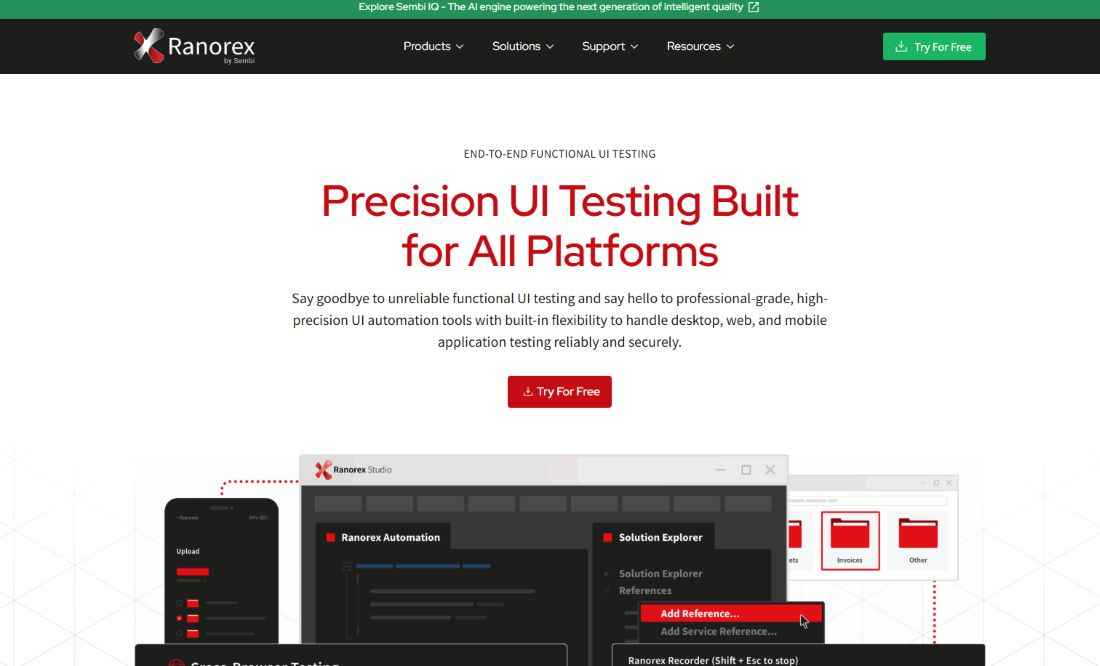
UI-based integration testing, end-to-end workflow testing, and cross-platform test automation.
Choose the Right Integration Testing Tool
Choosing the right integration testing tool depends on the application's technology stack, testing requirements, and automation needs. The selected tool should support the components being tested and integrate easily with the existing development workflow.
- Application Technology: Choose tools compatible with the programming language and framework, such as JUnit for Java applications.
- Type of Integration: Use Postman or REST Assured for REST APIs, SoapUI for SOAP services, and Testcontainers for testing with real infrastructure dependencies.
- Automation Requirements: Select tools that support automated test execution and integration with CI/CD pipelines.
- Ease of Use: Consider the team's technical expertise. Postman provides a graphical interface, while REST Assured requires Java programming.
- Cost and Licensing: Evaluate open-source tools against commercial solutions based on project requirements and budget.
