

Stress Testing is a type of performance testing used to determine how a system behaves when subjected to workloads beyond its expected operating capacity. It helps evaluate application stability, identify performance limitations, and observe system behavior under extreme conditions.
- Identifies the workload limits, performance bottlenecks, and resource constraints that cause significant system degradation or failure.
- Evaluates system stability, behavior, and recovery capabilities under extreme workloads and stressful operating conditions.
Example: If an e-commerce website is expected to handle 20,000 concurrent users, a stress test may increase the load to 30,000, 40,000, or 50,000 users to evaluate degradation and failure behavior beyond the expected capacity.
Characteristics
These characteristics define how stress testing evaluates system behavior under extreme and unpredictable conditions.
- Helps detect system weaknesses and potential failure points under extreme conditions.
- Evaluates response time, throughput, and resource utilization during stress.
- Tests the system by increasing workload, user traffic, or resource pressure beyond expected operating conditions.
- Analyzes how the system behaves when resources become exhausted or failures occur.
- Performs testing in a controlled environment to safely observe degradation, failure behavior, and recovery.
Stress Testing Process
The stress testing process helps identify system limitations and improve application performance through controlled testing.

The following steps outline the typical process for performing stress testing effectively.
- Define testing objectives, identify expected workloads, prepare the testing environment, and establish success criteria.
- Develop realistic test scenarios and automation scripts that simulate actual user activities using stress testing tools.
- Gradually increase the workload beyond normal capacity while monitoring application behavior and system resources.
- Review logs, response times, throughput, resource utilization, and failures to identify bottlenecks.
- Resolve identified issues, optimize the application and infrastructure, then repeat testing to verify improvements.
Common Stress Testing Scenarios
Different types of stress testing focus on evaluating specific components or scenarios under extreme workloads.
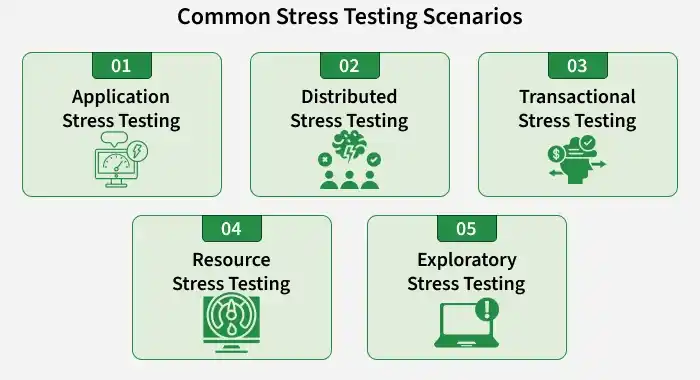
1. Application Stress Testing
Application stress testing evaluates how an application behaves when the workload exceeds its normal operating capacity.
- Helps identify performance degradation, resource exhaustion, and application failures under heavy load.
- Reveals the point at which the application becomes unstable or unable to handle additional requests.
Example: An e-commerce application is tested with a sudden increase in concurrent users to observe how the checkout system behaves beyond normal traffic levels.
2. Distributed Stress Testing
Distributed stress testing evaluates how multiple services or nodes behave when the overall distributed system is exposed to heavy workloads.
- Helps identify bottlenecks, service coordination problems, and overloaded components across multiple nodes.
- Can reveal cascading failures when one slow or unavailable service affects other dependent services.
Example: A microservices-based application is tested with high traffic across order, payment, inventory, and notification services to identify overloaded dependencies.
3. Transactional Stress Testing
Transactional stress testing focuses on how the system handles a very high number of transactions within a short period.
- Helps detect database contention, locking problems, connection exhaustion, and processing delays.
- Evaluates whether transaction-heavy operations remain stable when demand exceeds expected levels.
Example: A banking application processes a large number of simultaneous fund-transfer requests to test database and transaction-processing limits.
4. Resource Stress Testing
Resource stress testing evaluates system behavior when specific computing resources become highly utilized or constrained.
- Stresses resources such as CPU, memory, disk, network bandwidth, database connections, or worker threads.
- Helps determine how the application responds when one or more critical resources approach their limits.
Example: A web application is tested while available memory is heavily constrained to observe whether performance degrades or failures occur.
5. Exploratory Stress Testing
Exploratory stress testing evaluates system behavior under unusual, unexpected, or extreme operating conditions.
- Helps uncover failures that may not appear during predefined or normal workload scenarios.
- Allows testers to experiment with combinations of load, failures, delays, and resource limitations.
Example: A system is tested with sudden traffic spikes while one dependent service is slow to identify unexpected failure behavior.
Stress Testing Tools
Several tools are available to simulate heavy workloads, measure system performance, and identify bottlenecks during stress testing.
| Tool | Description |
|---|---|
| Apache JMeter | Open-source Java-based tool for load and stress testing websites, APIs, and services. |
| LoadNinja | Browser-based tool that supports performance and load testing of web applications. |
| WebLOAD | Tests the performance, stability, and reliability of web and mobile applications. |
| NeoLoad | Simulates large numbers of users for web, mobile, and API performance testing with CI/CD integration. |
| SmartMeter | Provides graphical test creation, load testing, and performance reporting capabilities. |
Metrics of Stress Testing
Stress testing metrics measure application performance and resource utilization during extreme workloads.
| Metric | Description |
|---|---|
| Response Time | Measures how long the system takes to complete a request or transaction under stress. |
| Throughput | Measures the number of requests or transactions processed per unit of time. |
| CPU and Memory Utilization | Shows how heavily system resources are consumed during stress conditions. |
| Error Rate | Measures the number or percentage of failed requests, errors, and timeouts. |
| Breaking Point | Indicates the workload level at which performance becomes unacceptable or major failures begin. |
Advantages of Stress Testing
- Identifies system breaking points and performance bottlenecks under extreme workloads.
- Detects resource exhaustion, application crashes, and unexpected failures during heavy traffic.
- Evaluates how effectively the system recovers after excessive load is removed.
- Helps identify stability, reliability, and availability issues under abnormal conditions.
- Supports performance optimization, capacity planning, and better preparation for unexpected traffic spikes.
Limitations of Stress Testing
- Requires a realistic testing environment to produce accurate and meaningful results.
- Can be expensive and resource-intensive when testing large-scale applications.
- May require specialized testing tools, infrastructure, and technical expertise.
- Results depend on realistic workload simulation and can be misleading if test conditions are inaccurate.
- Identifying the root cause of failures can be difficult, especially in distributed systems with multiple dependencies.
