

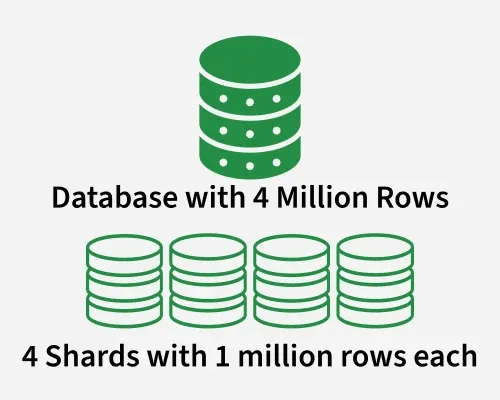
Database sharding is a technique used to distribute a large dataset across multiple database nodes. It helps increase storage capacity and distribute query or write workloads when a single database instance is no longer sufficient.
- Data is divided into smaller partitions called shards.
- Each shard stores a subset of the overall data.
Example: An e-commerce platform may distribute users across multiple database servers using user_id as the shard key.
Methods of Database Sharding
1. Hash-Based Sharding
Hash-based sharding applies a hash function to a shard key and uses the result to select the target shard.
For example: shard = user_id % number_of_shards
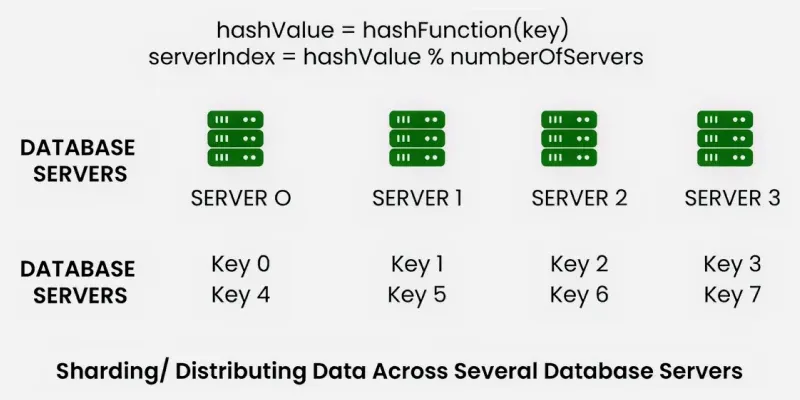
If there are three shards:
- user_id = 10 -> Shard 1
- user_id = 11 -> Shard 2
- user_id = 12 -> Shard 0
Advantages
- Can distribute records relatively evenly when the shard key has good distribution.
- Simple routing logic.
Limitations
- Adding or removing shards may require data redistribution.
- Poor shard-key selection can create hotspots.
2. Range-Based Sharding
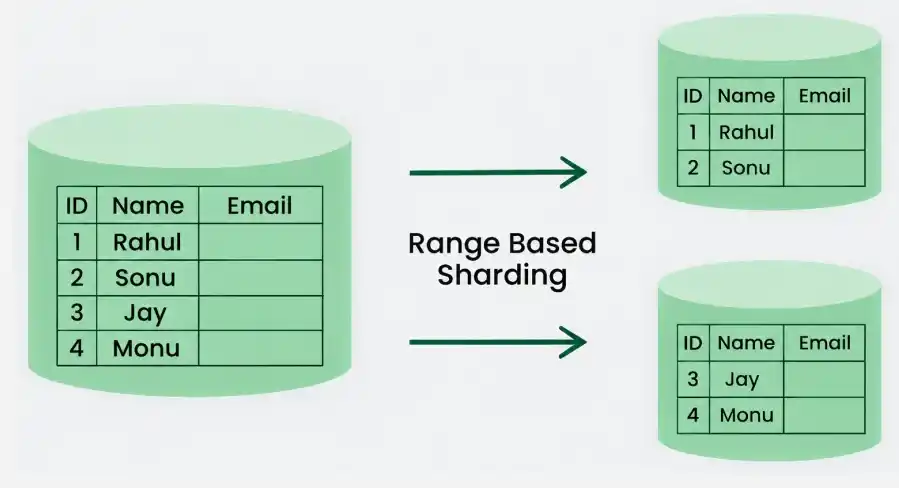
Range-based sharding distributes records according to ranges of the shard key.
Example:
- Shard 1: Customer IDs 1–1000
- Shard 2: Customer IDs 1001–2000
- Shard 3: Customer IDs 2001–3000
Advantages
- Easy to understand and implement.
- Efficient for range queries when the relevant range is stored on one shard.
Limitations
- Sequential or skewed keys can create hotspots.
- Some ranges may grow faster than others.
3. Directory-Based Sharding
Directory-based sharding uses a lookup service that maps each shard key to the shard where the data is stored.
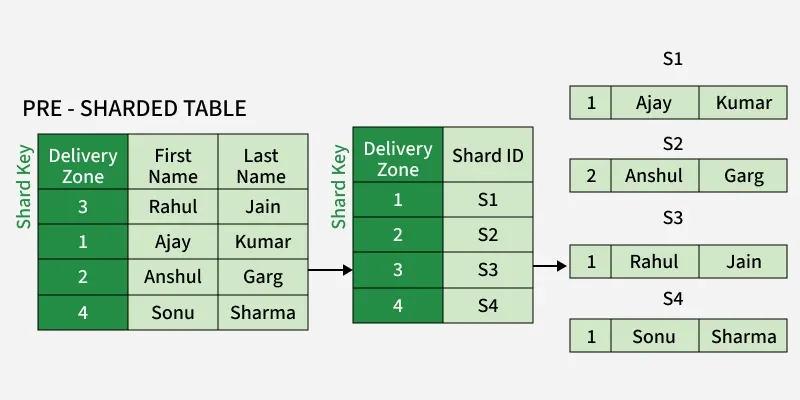
The directory can be updated when data moves or shards are added or removed.
Advantages
- Flexible data placement.
- Makes shard movement and rebalancing easier.
Limitations
- The lookup service adds an extra dependency and network hop.
- It must be replicated or otherwise made highly available to avoid becoming a single point of failure.
4. Geographic Sharding
Geographic sharding distributes data according to geographic attributes such as country, region, or data-residency requirements.
Example:
- Europe users -> EU database cluster
- Asia users -> Asia database cluster
- US users -> US database cluster
Advantages
- Can reduce latency by storing data closer to users.
- Can help satisfy data-residency requirements.
Limitations
- User or workload distribution may be uneven across regions.
- Cross-region queries and migrations can become complex.
Choosing a Good Shard Key
Shard-key selection is one of the most important parts of sharding design.
A good shard key should:
- Distribute data evenly.
- Avoid high-traffic hotspots.
- Support common query patterns.
- Have sufficient cardinality.
- Avoid frequent changes.
Poor shard-key selection can cause one shard to receive far more traffic or data than others.
Keeping Shards Balanced
Several techniques can help maintain balanced data distribution:
- Choose a well-distributed shard key: Avoid values that concentrate most traffic on a small number of shards.
- Use Consistent Hashing: Can reduce the amount of data that must be remapped when nodes are added or removed.
- Monitor Shard Usage: Track storage, request rate, latency, and CPU usage across shards.
- Rebalance Data: Move partitions or records when some shards become significantly larger or busier.
- Use Virtual Shards or Partitions: Logical partitions can make redistribution easier than mapping data directly to physical nodes.
- Automate Rebalancing: Use database or infrastructure features that support automatic partition movement where available.
Challenges of Database Sharding
Sharding improves capacity but introduces distributed-database complexity.
- Cross-Shard Queries: Queries involving multiple shards require additional coordination.
- Distributed Transactions: Transactions spanning shards are more difficult to manage.
- Rebalancing: Adding or removing shards may require moving large amounts of data.
- Hotspots: Poor shard-key selection can overload particular shards.
- Operational Complexity: Monitoring, backups, schema changes, and failover become more complex.
- Joins and Aggregations: Operations across multiple shards may require application-level or distributed processing.
