

System Design is the process of planning the architecture of a software system based on its functional and non-functional requirements. It defines how components are structured, communicate, and work together to achieve the required functionality.
- Defines system components, data flow, and interactions between services.
- Helps design the system for scalability, maintainability, reliability, and performance.
Example: In an online shopping system, system design determines how components such as the user interface, product catalog, order service, payment service, and database interact with each other.
Types of System Design
System Design is commonly divided into two complementary levels: High-Level Design (HLD) and Low-Level Design (LLD).
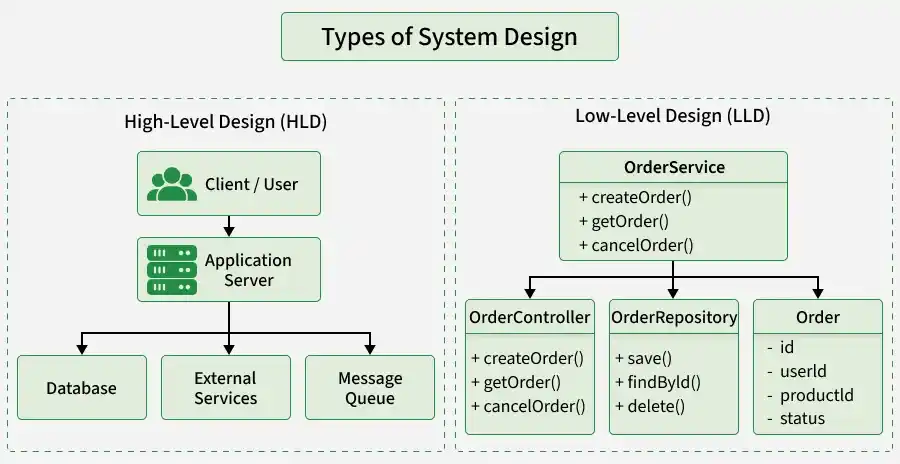
The above diagram illustrates the two types of system design: High-Level Design (HLD) and Low-Level Design (LLD).
- High-Level Design (HLD): Shows the overall architecture, including clients, application servers, databases, external services, and message queues.
- Low-Level Design (LLD): Shows the internal structure of components, including classes, methods, attributes, and their relationships.
1. High-Level Design (HLD)
High-Level Design (HLD) defines the overall system architecture, major components, their interactions, and key design decisions.
HLD Commonly Covers:
- System Architecture: Identifies major system components, services, their responsibilities, and how they work together.
- Communication: Defines how components exchange data through APIs, messaging systems, and protocols.
- Data Storage: Selects suitable databases, caching mechanisms, and storage solutions based on system needs.
- Scalability: Plans load balancing, scaling, and availability strategies to handle growing workloads.
- Security: Defines authentication, authorization, data protection, and security measures across system components.
- Deployment: Defines infrastructure, cloud services, environments, and technologies required to run the system.
Example: For an e-commerce platform, HLD may define User, Product, Order, Payment, and Notification services and show how they communicate through APIs or messaging systems.
2. Low-Level Design (LLD)
Low-Level Design (LLD) defines the internal structure and implementation details of individual system components.
LLD Commonly Covers:
- Classes and Objects: Defines class structures, object relationships, attributes, and responsibilities.
- Methods and Interfaces: Specifies functions, parameters, return types, and interaction contracts.
- Data Structures: Selects suitable data structures and algorithms for efficient processing.
- Database Design: Defines database tables, schemas, keys, and relationships between entities.
- Design Patterns: Applies reusable design solutions to improve code structure and maintainability.
- Business Logic: Defines processing rules, input validation, exception handling, and component behavior.
Example: An Order Management LLD defines classes such as Order, OrderItem, OrderService, and OrderRepository, including their methods and relationships.
High-Level Design vs Low-Level Design
HLD defines the overall system architecture, while LLD focuses on the detailed implementation of individual components.
| High-Level Design (HLD) | Low-Level Design (LLD) |
|---|---|
| Defines the overall system architecture | Focuses on detailed component-level design |
| Describes major modules and their interactions | Describes internal logic of individual modules |
| Also known as macro-level or architectural design | Also known as micro-level or detailed design |
| Focuses on services, databases, communication, and infrastructure | Focuses on classes, methods, interfaces, and data structures |
| Commonly involves architects, senior engineers, and developers | Commonly involves developers, engineers, and designers |
Important Factors to Consider in System Design
An effective system design balances several factors according to application requirements and expected workloads.
- Scalability: Ensure the system can handle increasing users, traffic, and data through vertical or horizontal scaling.
- Performance: Maintain acceptable response times, throughput, and resource utilization under expected workloads.
- Reliability and Availability: Minimize failures and downtime through redundancy, replication, health checks, and failover.
- Security: Protect sensitive information and services using authentication, authorization, encryption, and secure communication.
- Fault Tolerance: Handle component failures using timeouts, retries, circuit breakers, and graceful degradation.
- Maintainability: Design modular components that are easier to update, debug, test, and extend.
