

An API Gateway is a centralized entry point that receives client requests and routes them to appropriate backend services. It simplifies communication between clients and backend systems while applying common policies such as authentication, rate limiting, and request transformation.
- Provides a unified interface for accessing backend APIs and services.
- Can handle cross-cutting concerns such as authentication, rate limiting, logging, and protocol translation.
Example: In an e-commerce application, an API Gateway can route product requests to the Product Service, order requests to the Order Service, and payment requests to the Payment Service while applying authentication and rate limiting.
API Gateway Architecture
A typical API Gateway architecture contains clients, a gateway, and backend services.
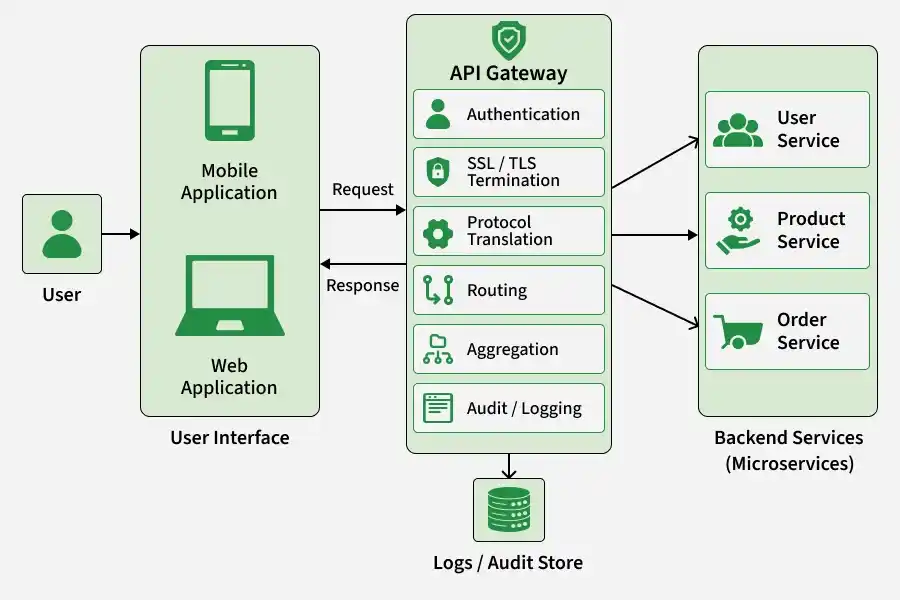
The gateway acts as an intermediary between external clients and backend services.In the above diagram:
Request Flow
- A client sends an API request using HTTPS.
- The request reaches the API Gateway.
- The gateway may authenticate the request and apply policies such as rate limiting.
- It determines the appropriate backend destination.
- The request is forwarded to the backend service or application.
- The backend processes the request and returns a response.
- The gateway forwards the response to the client.
How API Gateway Works
An API Gateway may provide several capabilities depending on the product and system architecture.
- Routing: Directs incoming requests to appropriate backend services based on URL paths, HTTP methods, hostnames, headers, or routing rules.
- Authentication and Authorization: Validates client identity using API keys, JWT, or OAuth 2.0 and may enforce access permissions before forwarding requests.
- Rate Limiting and Throttling: Controls request rates to prevent abuse, manage traffic spikes, and protect backend services from overload.
- Protocol Translation: Converts requests between supported protocols or formats, such as HTTP/JSON to gRPC, depending on the gateway implementation.
- Request Aggregation: Combines responses from multiple backend services into a single response, reducing the number of requests clients must make.
- Caching: Stores suitable API responses to reduce repeated backend requests and improve response times.
- Monitoring and Logging: Tracks request counts, response times, error rates, HTTP status codes, and authentication failures.
- Load Distribution: May distribute requests across backend instances or integrate with dedicated load balancers and other traffic-management systems.
API Gateway with Microservices
API Gateways are especially useful in microservices architectures because clients should not need to know the location or API structure of every internal service.
Example: Consider an e-commerce system built using microservices, where separate services handle user management, product catalog, shopping cart, and order processing. Clients interact with the system through a web or mobile application via a single API Gateway.

The client sends requests to a single API Gateway rather than communicating with each service directly.
The gateway may:
- Authenticate the client.
- Apply rate-limiting policies.
- Determine the appropriate backend service.
- Forward the request.
- Optionally aggregate responses.
- Return the final response to the client.
API Gateway with Monolithic Architecture
An API Gateway can also be placed in front of a monolithic application, although it is generally more valuable when multiple backend services must be exposed through a unified interface.
Example: Consider a traditional e-commerce monolithic application where all functionalities (user, product, order, payment) exist within a single codebase. The API Gateway still acts as a central entry point to manage requests and apply cross-cutting concerns.

The gateway may:
- Authenticate incoming requests.
- Apply rate limits.
- Perform request transformation.
- Route
/api/productsor/api/ordersto the monolithic application's public API. - Return the application's response to the client.
API Gateway in Monolith vs Microservices
| Feature | Monolithic Architecture | Microservices Architecture |
|---|---|---|
| Backend | Single application | Multiple independent services |
| Gateway Routing | Routes to monolith API endpoints | Routes to different backend services |
| Service Discovery | Usually unnecessary for the monolith itself | May be used depending on infrastructure |
| Authentication | Can be centralized at gateway | Often centralized partly or fully at gateway |
| Traffic Distribution | May target multiple monolith instances | May target many services and instances |
| Failure Handling | Primarily concerned with application-instance failures | Must account for independent service failures |
Best Practices for API Gateway
Following best practices helps improve API Gateway security, performance, scalability, and reliability. Key practices include:
- Use TLS/HTTPS: Encrypt communication between clients and the gateway, as well as between the gateway and backend services where required.
- Keep Business Logic Out of the Gateway: Handle routing, security, and other cross-cutting concerns at the gateway while keeping complex business logic in backend services.
- Avoid Excessive Aggregation: Limit unnecessary calls to multiple backend services to reduce latency and simplify failure handling.
- Implement Rate Limiting: Control incoming requests to prevent abuse, traffic spikes, and backend overload.
- Design for High Availability: Deploy multiple gateway instances and avoid single points of failure to maintain service availability.
- Monitor Gateway Performance: Track request throughput, latency, error rates, authentication failures, and backend errors.
- Use Consistent Error Responses: Standardize error formats and HTTP status codes to simplify client-side error handling.
- Maintain API Versioning: Use versioned endpoints, such as
/api/v1/ordersand/api/v2/orders, when introducing backward-incompatible changes.
Popular API Gateway Solutions
Several API Gateway solutions provide features for API routing, security, traffic management, and monitoring. Popular options include:
- Amazon API Gateway: A managed AWS service for creating, securing, monitoring, and managing REST, HTTP, and WebSocket APIs.
- Apigee: Google's API management platform offering API security, traffic management, analytics, developer portals, and lifecycle management.
- Kong: An API Gateway supporting request routing, authentication, rate limiting, logging, and plugin-based extensions.
- Azure API Management: A managed Microsoft Azure service for publishing, securing, monitoring, and managing APIs.
- Apache APISIX: An open-source API Gateway providing dynamic routing, authentication, traffic management, observability, and plugin-based extensibility.
Benefits of API Gateway
An API Gateway provides several advantages when exposing backend APIs.
- Simplified Client Communication: Clients interact with one entry point instead of multiple backend services.
- Centralized Security: Authentication and traffic policies can be applied consistently.
- Backend Abstraction: Internal service locations and implementations remain hidden from clients.
- Traffic Control: Rate limiting and throttling help protect backend services.
- Observability: Centralized metrics and logging improve API monitoring.
- Protocol Handling: Some gateways can transform requests, responses, or protocols.
Challenges of API Gateway
API Gateways also introduce additional design considerations.
- Potential Bottleneck: A poorly scaled gateway can limit system throughput.
- Single Point of Failure: Without redundancy, gateway failure can block access to backend services.
- Additional Latency: Authentication, transformations, aggregation, and policy evaluation add processing overhead.
- Configuration Complexity: Routing and policy management become more difficult as the number of APIs grows.
- Security Risk: Incorrect gateway configuration may expose APIs or weaken access controls.
- Operational Overhead: The gateway itself requires monitoring, scaling, and maintenance.
