

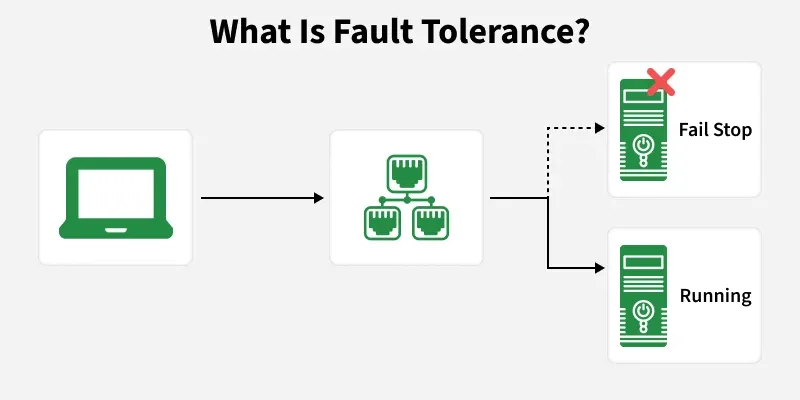
Fault tolerance in system design refers to the ability of a system to continue providing its intended functionality even when certain hardware, software, or network components fail.
- Reduces the impact of individual component failures.
- Uses redundancy, replication, failure detection, isolation, and recovery mechanisms.
- Depending on the design, the system may continue operating normally or in a degraded mode.
Example: If one application server fails, a fault-tolerant system can redirect requests to another healthy server instead of stopping the entire service.
Techniques Used to Achieve Fault Tolerance
Fault tolerance is achieved through a combination of architectural and infrastructure techniques.
- Redundancy: Maintain duplicate components so another instance can continue operation if one fails.
- Replication: Maintain copies of data or services across multiple nodes.
- Load Balancing: Distribute traffic across healthy instances and avoid routing requests to failed nodes.
- Clustering: Group multiple nodes so workloads can be transferred when a node fails.
- Failover: Switch processing or traffic to a standby or healthy component after detecting a failure.
- Health Checks and Heartbeats: Detect unhealthy servers, services, or database nodes.
- Retries and Timeouts: Handle temporary failures while preventing requests from waiting indefinitely.
- Circuit Breakers: Stop repeated calls to an unhealthy dependency and allow recovery before retrying.
- Isolation: Prevent failures in one component from spreading to unrelated parts of the system.
- Multi-Zone or Multi-Region Deployment: Distribute workloads across separate failure domains when higher resilience is required.
Replication Strategies for Fault Tolerance
Replication can improve fault tolerance by maintaining multiple copies of data or service state across nodes.
1. Full Replication
Full replication maintains a complete copy of the required dataset or service state on multiple nodes.
- Provides multiple copies that can be used when a node fails.
- Simplifies failover for workloads that require the complete dataset.
Limitation: Requires additional storage, synchronization, and consistency management.
2. Partial Replication
Partial replication copies only selected datasets, partitions, or components.
- Reduces storage and replication overhead compared with full replication.
- Useful when only specific data or services require redundancy.
Limitation: Determining which data requires replication can increase design and recovery complexity.
3. Passive Replication
Passive replication maintains a primary node and one or more standby replicas.
- The primary handles normal processing.
- Standby replicas maintain sufficient state to take over after a failure.
Limitation: Failover requires reliable failure detection and sufficiently up-to-date replica state.
4. Active Replication
Active replication allows multiple replicas to process requests while maintaining equivalent or coordinated state.
- Provides rapid continuation when one replica fails.
- Reduces dependence on a separate standby activation step.
Limitation: Requires additional coordination, ordering, consistency management, and processing resources.
Fault Detection and Recovery
Fault detection identifies failed or unhealthy components, while recovery mechanisms restore or maintain service.
Fault Detection
Common detection mechanisms include:
- Health checks
- Heartbeat messages
- Monitoring metrics
- Error-rate thresholds
- Timeout detection
Recovery
After detecting a failure, the system may:
- Restart the failed service.
- Redirect traffic to another healthy instance.
- Promote a replica.
- Replace the failed node.
- Degrade non-critical functionality.
- Restore data or service state when required.
Example: If an application server stops responding, the load balancer can remove it from the healthy server pool and route requests to the remaining instances.
Challenges in Implementing Fault Tolerance
Fault tolerance improves resilience but introduces additional complexity and cost.
- Coordination Complexity: Replicated components may require synchronization, leader election, or distributed coordination.
- Consistency Challenges: Multiple data copies can become temporarily inconsistent depending on the replication model.
- Performance Overhead: Replication, health checks, retries, and synchronization consume additional resources.
- Higher Cost: Redundant infrastructure requires additional compute, storage, networking, and operational resources.
- Failure Detection: Detecting real failures without incorrectly marking slow components as failed can be difficult.
- Recovery Complexity: Failover and restoration mechanisms must preserve correct system state.
- Testing Complexity: Fault-tolerance mechanisms should be tested through failure simulation and recovery testing.
